Hafgufa: The Legendary Sea Monster of Norse Lore
For centuries, sailors navigating the frigid waters near Iceland and Greenland spoke in hushed tones of a creature so massive it was often mistaken for land. Known in Old Norse as the hafgufa—a name translating to "sea-reek" or "sea-steamer"—this legendary sea monster has occupied a central place in Scandinavian maritime folklore. While once feared as a devourer of ships and men, modern science suggests these terrifying tales may have a fascinating biological origin.
Key Facts
- Origin: Greenland and the waters surrounding Iceland.
- Etymology: Derived from Old Norse haf (sea) and gufa (steam/vapor).
- Historical Mentions: Featured in the 13th-century Konungs skuggsjá and the Örvar-Odds saga.
- Scientific Theory: Likely inspired by the "trap-feeding" behavior of certain whales.
- Common Misconceptions: Often conflated with the lyngbakr or the kraken.
Historical Accounts and Descriptions
The hafgufa appears in several significant medieval texts, each offering a slightly different perspective on the beast's nature and terrifying capabilities.
The King's Mirror (Konungs skuggsjá)
In the mid-13th century Norwegian didactic work Konungs skuggsjá (The King's Mirror), a king describes a massive fish to his son. He characterizes the hafgufa as a creature so large it resembles an island rather than a living animal. The King noted that the creature was rarely seen, appearing only in two specific locations, leading him to conclude that there were only two such beings and that they were likely infertile.
The text provides a vivid description of its unique feeding method: the fish would belch, expelling so much food that it would attract all nearby fish. Once the prey crowded into its mouth and belly, the hafgufa would close its mouth and devour them all at once.
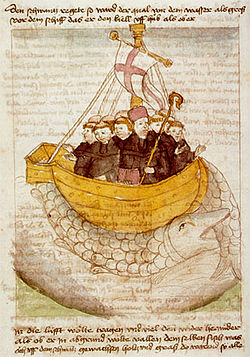
The Örvar-Odds Saga
A later 14th-century version of the Örvar-Odds saga describes the hafgufa as the largest sea monster (sjóskrímsl) in existence. According to the lore, it fed on whales, ships, and humans alike. The saga recounts an encounter where a crew mistook the creature's nostrils and lower jaw for massive rocks rising from the sea, only to realize they had actually sailed directly through its mouth.
The Connection to Other Legends
The hafgufa is frequently linked to other mythological entities, often leading to confusion in historical records.
Hafgufa vs. Lyngbakr
In many accounts, the hafgufa is distinguished from the lyngbakr (or "heather-back"). While some sources treat them as separate monsters, others, such as the Danish physician Thomas Bartholin, suggested they were synonymous. Some scholars theorize that the distinction arose from different interpretations of illustrations in the Icelandic Physiologus, a medieval bestiary.
The Kraken and St. Brendan
Historical writers have also attempted to link the hafgufa to the kraken. While some 18th-century clerics equated the two, modern scholars like Finnur Jónsson have expressed skepticism regarding this connection. Additionally, the legend of St. Brendan features a giant fish named Jasconius, which sailors mistook for an island—a narrative closely mirroring the hafgufa's island-like description.
| Creature | Primary Description | Key Source/Context |
|---|---|---|
| Hafgufa | "Sea-steamer"; massive fish mistaken for an island. | Konungs skuggsjá |
| Lyngbakr | "Heather-back"; often confused with hafgufa. | Örvar-Odds saga |
| Aspidochelone | A turtle-island or whale-island. | Physiologus |
| Jasconius | Giant fish used as an island by St. Brendan. |
Scientific Explanations: From Myth to Biology
Recent scientific research has provided a potential bridge between myth and reality. In 2023, researchers reported observing whale behaviors that closely mirror the legendary feeding habits of the hafgufa. Some whales exhibit a trap-feeding technique, where they remain stationary on the surface with their jaws open, waiting for fish to swim in. They may even use chewed-up fish to attract more prey.
This specialized feeding strategy, combined with the sight of a massive whale's back breaking the surface, likely provided the foundational observations that evolved into the fantastic tales of the hafgufa over several centuries.
Frequently Asked Questions
What does the name "hafgufa" mean?
The name comes from the Old Norse words haf (sea) and gufa (steam or vapor), often translated as "sea-reek" or "sea-steamer."
Is the hafgufa a real animal?
There is no evidence of a creature called a hafgufa in biological records. However, scientists believe the legend was inspired by the real-world feeding behaviors of large whales.
How did the hafgufa feed?
According to medieval legends, the creature would belch to attract large numbers of fish into its mouth, then snap its jaws shut to devour them all at once.
Is the hafgufa the same as the kraken?
While some historical texts have equated the two, many scholars view them as distinct entities, with the hafgufa being more closely related to whale-like descriptions.
What is the difference between hafgufa and lyngbakr?
In the Örvar-Odds saga, the hafgufa is described as the largest monster in the sea that swallows ships, while the lyngbakr is described as the largest whale in the world.