Northwestern Syria Offensive: The Fall of Aleppo and Hama
Between November 27 and December 5, 2024, a rapid and decisive military campaign unfolded in northwestern Syria. This offensive, part of a wider series of 2024 Syrian opposition operations, fundamentally altered the landscape of the Syrian Civil War. Led by a coalition of opposition forces, the campaign resulted in a significant victory, characterized by the capture of two of Syria's most strategic cities: Aleppo and Hama.
The operation, known as Operation Deterrence of Aggression (Rade Aleudwan), served as the catalyst for a broader collapse of government defenses across the region, eventually leading to the launch of Operation Dawn of Freedom.
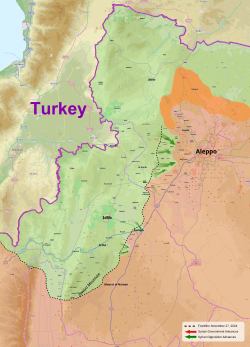
Key Facts
- Duration: November 27 – December 5, 2024 (1 week and 1 day).
- Primary Outcome: Syrian opposition victory with the capture of Aleppo and Hama.
- Major Belligerents: Syrian Opposition (including Hay'at Tahrir al-Sham) vs. Ba'athist Syria, supported by Russia, Iran, and Hezbollah.
- Humanitarian Impact: 111 civilians killed and approximately 370,000 civilians displaced.
- Strategic Shift: The offensive marked the beginning of the wider 2024 Syrian opposition offensives.
The Battle of Aleppo
The offensive began with a surprise assault on the Aleppo countryside. Opposition forces, including Hay'at Tahrir al-Sham (HTS) and the National Front for Liberation, utilized car bombs and rapid maneuvers to breach the city's defenses. By November 29, rebels had entered several neighborhoods, eventually seizing government headquarters and the historic citadel.
The government's collapse in Aleppo was swift. As Ba'athist forces and their Iranian-backed allies withdrew, the Syrian Democratic Forces (SDF)—a multi-ethnic alliance primarily composed of Kurdish units—deployed to fill the vacuum, taking control of checkpoints and the Aleppo International Airport.
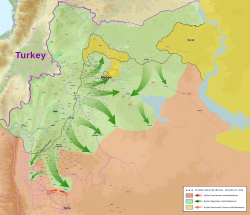
The Battle of Hama
Following the success in Aleppo, the opposition shifted its focus toward Hama. The fighting here was characterized by intense aerial bombardment from Russian and Syrian warplanes. Despite these efforts, the opposition forces, including the "Red Bands," managed to encircle the city, cutting off vital supply routes to Raqqa and Aleppo.
By December 5, the Syrian Army withdrew from the strategic city of Hama and its military airport, allowing the opposition to secure the city. This victory effectively severed the government's grip on the northwestern region and paved the way for further advances toward the coast and the capital.
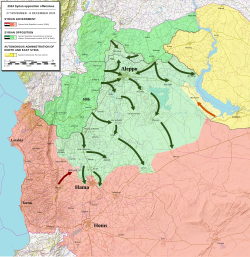
Strategic Alliances and Forces
The offensive involved a complex array of military actors. The opposition coalition was led by the Military Operations Command, featuring groups such as the Syrian National Army and various brigades like Jaysh al-Izza and the Suqour al-Sham Brigades. They were opposed by the Syrian Armed Forces, supported by the Russian Air Force, Spetsnaz GRU, and the Iranian Quds Force.
The conflict also saw friction between the opposition and the SDF, leading to clashes in northern Aleppo as both groups vied for territorial control during the government's retreat.
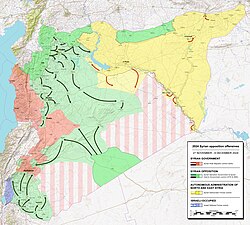
Summary of the Offensive
| Category | Details |
|---|---|
| Timeline | Nov 27 – Dec 5, 2024 |
| Key Cities Captured | Aleppo, Hama |
| Opposition Leaders | Ahmed al-Sharaa, Abdurrahman Mustafa |
| Government Leaders | Bashar al-Assad, Suhayl al-Hasan |
| Estimated Casualties | 311 opposition killed; ~1,000 government killed (claimed); 111 civilians killed |
| Displacement | 370,000 civilians |
Frequently Asked Questions
What was Operation Deterrence of Aggression?
It was the initial military operation launched by the Syrian opposition on November 27, 2024, which led to the rapid capture of Aleppo and Hama.
Which groups led the opposition forces?
The offensive was led by a coalition including Hay'at Tahrir al-Sham (HTS), the Syrian National Army, and the National Front for Liberation, among other smaller brigades.
What role did the Syrian Democratic Forces (SDF) play?
The SDF moved into areas vacated by the Syrian government, such as the Aleppo International Airport, and subsequently engaged in clashes with opposition forces.
How did the Syrian government respond to the offensive?
The government relied heavily on the Syrian Air Force and Russian aerial support to conduct airstrikes, but these efforts failed to prevent the fall of Aleppo and Hama.
What were the humanitarian consequences of the fighting?
The offensive resulted in the deaths of 111 civilians and the displacement of approximately 370,000 people from their homes.