North West Highlands Geological Wonders and Landscapes
The North West Highlands of Scotland serve as a living laboratory for geology, home to some of the most significant tectonic discoveries in history and breathtaking natural landmarks. From towering sea stacks to ancient cave systems, the region offers a profound look at the forces that shaped the British Isles.
The Moine Thrust Belt and the Highlands Controversy
One of the most scientifically significant features of the region is the Moine Thrust Belt, formed between 430 and 500 million years ago. This area is famous for a geological anomaly where Precambrian Moine rocks were found resting on top of younger Cambrian and Ordovician rocks.
This discovery sparked the "Highlands Controversy," a fierce debate among Victorian geologists. While Roderick Murchison and Archibald Geikie argued that the Moine rocks must be younger than those beneath them, James Nicol and Charles Lapworth disagreed. The mystery was eventually solved by Ben Peach and John Horne, who determined that tectonic action had pushed the Moine rocks approximately 70 kilometres east over the younger strata. This discovery marked the first identified thrust fault (a type of low-angle fault where older rock is pushed over younger rock) in history.
Today, this phenomenon is most visible at Knockan Crag, the site where the anomaly was first identified. Visitors can explore the area via a dedicated visitor's centre and view modern sculptures. A monument erected in 1930 honors Peach and Horne for their work between 1883 and 1897 in unraveling the region's complex structure.
Subterranean Wonders: Caves of the Highlands
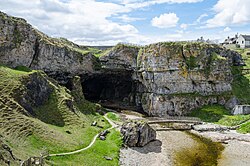
The region is rich in limestone caves, most notably Smoo Cave near Durness. This site is unique in the UK because it features an outer chamber carved by seawater and inner chambers formed by fresh water. With an entrance 15 metres high, it is the largest sea cave entrance in the British Isles. Beyond its geology, archaeological finds indicate human habitation dating back to the Mesolithic period, and the cave gained further fame following a visit by Sir Walter Scott in 1814.
Other significant sites include the Inchnadamph Bone Caves, where remains of polar bears, brown bears, reindeer, Arctic foxes, and Eurasian lynx have been discovered. Human remains found here are dated between 4,515 and 4,720 years old. Additionally, Uamh an Claonaite, the longest cave in Scotland, is partially located beneath the Bone Caves.
Coastal Landmarks and Mountain Peaks
The coastline of the North West Highlands is defined by dramatic extremes. Cape Wrath, the northwesternmost point of the Scottish mainland, boasts the highest vertical cliffs in mainland Britain. Nearby, the Old Man of Stoer stands as a striking sandstone sea stack off the Point of Stoer in Assynt.
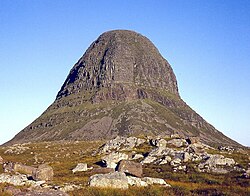
While the Moine Thrust Belt marks the northwest boundary of the Caledonian mountain belt (a massive range formed by the collision of ancient continents), the park contains several iconic peaks. The most distinctive is Suilven, often used in promotional imagery for the region. Other notable mountains include Stac Pollaidh, Canisp, Quinag, Foinaven, and Arkle.
Key Facts
- First Thrust Fault: The Moine Thrust Belt was the first of its kind discovered globally.
- Tectonic Shift: Moine rocks were pushed 70 kilometres east over younger rocks.
- Smoo Cave: Features the largest sea cave entrance in the British Isles (15m).
- Ancient Fauna: Bone Caves contain remains of extinct-to-region species like the polar bear and Eurasian lynx.
- Cape Wrath: Home to the highest vertical cliffs on the Scottish mainland.
| Feature | Type | Significance |
|---|---|---|
| Moine Thrust Belt | Geological Fault | First discovered thrust fault; resolved the Highlands Controversy. |
| Smoo Cave | Sea/Freshwater Cave | Largest sea cave entrance in the British Isles. |
| Inchnadamph Bone Caves | Archaeological Site | Contains prehistoric animal and human remains. |
| Cape Wrath | Coastal Point | Highest vertical cliffs in mainland Britain. |
| Suilven | Mountain | Highly distinctive peak and regional icon. |
Frequently Asked Questions
What was the Highlands Controversy?
It was a Victorian-era geological debate regarding the age of rocks in the North West Highlands. Geologists disagreed on whether the Moine rocks were younger or older than the rocks beneath them, until Ben Peach and John Horne proved they were older rocks pushed over younger ones by tectonic action.
Why is Smoo Cave considered unique in the UK?
Smoo Cave is unique because it combines two different formation processes: its outer chamber was created by the action of the sea, while its inner chambers were formed by fresh water.
What animals have been found in the Inchnadamph Bone Caves?
Excavations have uncovered the remains of the Eurasian lynx, brown bear, Arctic fox, reindeer, and polar bears.
Where can the Moine Thrust be seen most clearly?
The fault is most easily observed at Knockan Crag, where the apparent anomaly in rock ages was first identified and where a visitor's centre is now located.
Which mountain is the most iconic in the park?
Suilven is regarded as the most notable and distinctive mountain in the park and is frequently used in promotional materials.