North German Confederation: The Blueprint for a Unified Germany
The North German Confederation (Norddeutscher Bund) was a pivotal confederal state that existed from July 1867 to December 1870. Uniting the German regions north of the Main river, it served as the critical bridge between a fragmented collection of states and the creation of a centralized nation. By placing the Kingdom of Prussia at the helm and intentionally excluding Austria, the Confederation laid the political and legal groundwork for the modern German state.
This entity was not merely a temporary alliance but a sophisticated political experiment that introduced universal manhood suffrage and a bicameral legislature, eventually evolving into the German Empire following the victory in the Franco-Prussian War.
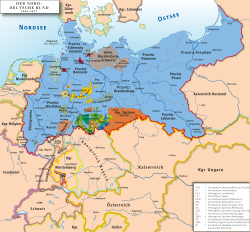
Key Facts
- Duration: 1866–1871.
- Capital: Berlin.
- Key Figures: King Wilhelm I (President) and Otto von Bismarck (Chancellor).
- Government Type: Confederal semi-presidential semi-constitutional monarchy.
- Legislature: Bicameral, consisting of the Bundesrat (Upper House) and the Reichstag (Lower House).
- Currency: Vereinsthaler.
- Outcome: Transitioned into the German Empire on January 1, 1871.
The Road to Unification: Prelude and Conflict
The German Confederation (1815–1866)
Before the North German Confederation, the region was organized as the German Confederation, created by the Congress of Vienna in 1815. This was a loose defense-oriented federation of 39 states dominated by two rivals: the Austrian Empire and the Kingdom of Prussia. Unlike later efforts, this body made no attempt to create a unified nation-state.
The Revolutions of 1848
In 1848, revolutionary unrest led to the gathering of the Frankfurt National Assembly. Delegates debated two visions of unification: a "Greater Germany" (including Austria) and a "Lesser Germany" (excluding Austria). The assembly eventually opted for the Lesser Germany path, but the movement collapsed after Prussia rejected the proposed constitution.
The Austro-Prussian War
The tension between Prussia and Austria culminated in the Austro-Prussian War of 1866. Prussia's victory effectively removed Austria from German affairs, clearing the way for a Prussian-led unification of the northern states.
Formation and Governance
The Confederation Treaty
On August 18, 1866, Prussia and fifteen other north and central German states signed the North German Confederation Treaty. This established an offensive and defensive alliance intended to preserve the independence and security of the member states.
The Federal Constitution
The constitution, adopted on April 16, 1867, established a federal state led by Prussia. A landmark feature was the Imperial Election Law, which mandated universal, equal, and direct manhood suffrage for the lower house.
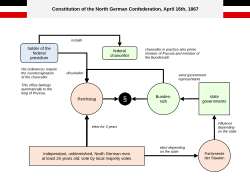
The government structure was divided into two primary bodies:
- The Bundesrat: The upper house representing the member states. While Prussia held only 40% of the votes, it could block constitutional amendments (which required a two-thirds majority) and easily form majorities with smaller states.
- The Reichstag: The lower house elected by the people. Its first session convened on February 24, 1867.
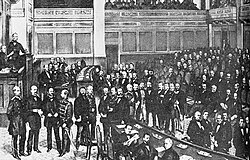
Administrative and Economic Integration
During its short existence, the Reichstag focused on legal and administrative unification to make the confederation function as a single entity. Key achievements included:
- The establishment of free movement for citizens within the territory.
- The creation of a common postal system and common passports.
- The granting of equal rights to all religious denominations, including Jewish citizens.
- The introduction of the metric system for unified weights and measures.
The Restructured Customs Union
To draw the southern states (Bavaria, Württemberg, Baden, and Hesse-Darmstadt) closer, Prussia restructured the German Customs Union (Zollverein). This created economic ties that bypassed political boundaries, though south German representatives often opposed Bismarck's specific policies in the Customs Union Parliament.
Transition to the German Empire
The final step toward full unification was triggered by the Franco-Prussian War (1870–1871). Otto von Bismarck leveraged French resistance to Prussian influence to spark a conflict that ignited German patriotism. This pushed the southern states to sign mutual defense pacts and eventually join the Confederation.
On December 8, 1870, the Bundesrat voted to rename the entity the German Empire (Deutsches Reich). On January 18, 1871, King Wilhelm I was proclaimed German Emperor in the Hall of Mirrors at the Palace of Versailles.
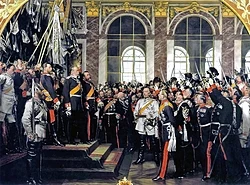
The transition was finalized on May 4, 1871, when the Constitution of the German Empire took effect. This new constitution was a minimally altered version of the North German Confederation's original framework.
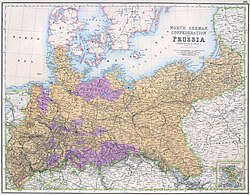
Summary of the North German Confederation
| Feature | Details |
|---|---|
| Head of State | King Wilhelm I of Prussia |
| Chief Executive | Chancellor Otto von Bismarck |
| Legislative Structure | Bicameral (Bundesrat and Reichstag) |
| Voting Rights | Universal manhood suffrage (for Reichstag) |
| Core Territory | Germany north of the Main river |
| Successor State | German Empire |
Frequently Asked Questions
What was the primary purpose of the North German Confederation?
It was designed to unite the German states north of the Main river under Prussian leadership, creating a stable political and military alliance while excluding Austria from German affairs.
Who was the most influential figure in the Confederation?
Otto von Bismarck, serving as the Chancellor, was the primary architect of the Confederation's constitution and its diplomatic strategy toward unification.
How did the North German Confederation differ from the earlier German Confederation?
The earlier German Confederation (1815–1866) was a loose association of 39 states dominated by both Austria and Prussia. The North German Confederation was a more tightly integrated federal state led exclusively by Prussia.
What role did the Franco-Prussian War play in its evolution?
The war created a surge of national patriotism that convinced the southern German states to join the North German Confederation, leading directly to the proclamation of the German Empire in 1871.
Was the Reichstag powerful?
While the Reichstag had budgetary oversight of the military and passed significant administrative laws, the overall structure remained dominated by Prussia through the Bundesrat and the authority of the Chancellor.