Non-Violent Video Games: Genres, Examples, and Design Philosophy
While many people associate gaming with conflict and combat, non-violent video games represent a diverse and expansive category of interactive entertainment. Unlike most genres defined by their mechanics or art style, non-violent games are defined by their purpose: to provide an experience that lacks violence. This purpose spans a vast array of gameplay styles, from simple puzzles to complex simulations.
For many developers, the goal is not just to avoid violence in naturally peaceful genres, but to reimagine traditionally violent categories—such as action games, role-playing games (RPGs), and first-person shooters (FPS)—through a lens of peace and cooperation.
Key Facts
- Definition: Non-violent games are defined by the absence of violence rather than a specific gameplay style.
- Educational Impact: A study in Chile indicated that educational games improved student progress in math, reading comprehension, and spelling.
- Cognitive Benefits: Non-violent action games can provide the same visual processing benefits as violent ones without the negative associations.
- Genre Adaptation: Developers often adapt violent engines (like those used in FPS games) by replacing lethal combat with non-lethal alternatives like "zorching" or "slobbing."
- Broad Spectrum: The category includes everything from "serious games" designed for peace-building to traditional puzzle games.
Traditionally Non-Violent Genres
Many genres are inherently peaceful, making the label "non-violent" almost redundant. These include maze games, adventure games, life simulations, visual novels, and construction management simulations. Because their lack of violence is self-evident, these titles are rarely marketed specifically as non-violent.
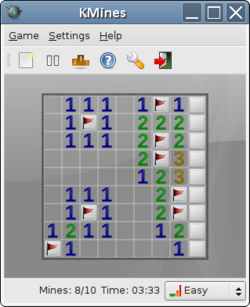
Other common examples include puzzle games, music games, programming games, and party games. However, some boundaries are blurred; for instance, Minesweeper is a puzzle game, yet it is an abstraction of a war-related scenario.
Examples of Traditionally Non-Violent Games
- Sudoku Gridmaster: A mathematical puzzle game.
- Roller Coaster: A game focused on navigating an amusement park to collect money.
- Alleyway: A block-breaking game featuring environmental hazards.
- The Eggerland series: A series of block-sliding puzzles used to unlock doors.
- Robots: A strategic game where players induce malfunctioning robots to crash into one another.
Non-Violent Action Games
Action games have historically relied on combat to thwart enemies. As graphics improved, this violence often became more realistic. To counter this, some developers use "cartoon violence" or create entirely peaceful action experiences. Research suggests that action games—regardless of violence—can increase a player's ability to process visual information quickly and accurately, prompting the creation of non-violent alternatives that retain these cognitive benefits.

Notable Non-Violent Action Titles
- Journey: An award-winning experience where players travel with an anonymous companion toward a mountaintop.
- Seiklus: A platformer where a small character traverses a natural landscape.
- Knytt and Knytt Stories: Games focused on guiding a creature through caverns and mountains.
- Sunday Funday: A skateboarding game where the player avoids bullies and clowns.
- Steer Madness: A vegetarian-themed game endorsed by PETA.
- Barney's Hide and Seek: An educational game teaching safety lessons to children.
Non-Violent First-Person Shooters (FPS)
The term "non-violent FPS" is often viewed as an oxymoron because the genre is traditionally defined by shooting. However, developers have successfully adapted the FPS perspective and engine for peaceful purposes. Some games, like Portal or Garry's Mod, are often categorized as non-violent by the community despite containing some violent elements.
Many non-violent FPS games are modified versions of violent titles. For example, Chex Quest uses the Doom engine but replaces blood with slime and lethal weapons with "zorch guns" that incapacitate enemies non-lethally. Other titles use the FPS perspective for non-combat activities, such as target shooting in NRA Gun Club or hide-and-seek in Elebits.
Non-Violent FPS Examples
- H.U.R.L.: A game where players avoid being "slobbed" with trash.
- Narbacular Drop: A dungeon-navigation game using cursor-based interaction.
- Gotcha! Extreme Paintball: A non-lethal take on the shooter genre.
- Super 3D Noah's Ark: A non-violent Christian-themed game.
- Postal 2: While known for extreme violence, it can be completed entirely without harming anyone, earning the player the title of "Jesus."
Non-Violent RPGs and Strategy Games
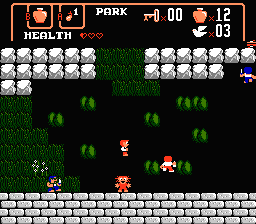
Role-playing games (RPGs) typically involve "leveling up" to fight stronger foes. While some series like Pokémon soften this by using terms like "fainting," true non-violent RPGs are rare. Spiritual Warfare is a notable example, where the hero spreads repentance using holy fruit.
Strategy games often involve war and territorial expansion. While the distant perspective makes the violence feel more stylized, the core themes remain conflict-oriented. Some "serious games" attempt to change this by focusing on peace-building. PeaceMaker, for example, tasks players with fostering peace between Israelis and Palestinians, though failure in the game may still result in violence.
Comparison of Non-Violent Game Categories
| Category | Approach to Non-Violence | Example Titles |
|---|---|---|
| Traditional | Inherently peaceful mechanics | Sudoku, Visual Novels |
| Adapted Action | Replacing combat with exploration/avoidance | Journey, Seiklus |
| Modified FPS | Replacing lethal weapons with non-lethal tools | Chex Quest, Paintball games |
| Serious Games | Focus on diplomacy and peace-building | PeaceMaker, A Force More Powerful |
Sports and Vehicle Simulations
In sports and vehicle simulations, the divide between violent and non-violent is stark. This is seen in the distinction between a standard racing game and a vehicular combat game, or a flight simulator versus a combat flight simulator. Companies like Kush Games specialize in the non-violent sports sector, focusing on the athletic experience without destruction.
Frequently Asked Questions
What defines a video game as non-violent?
A non-violent video game is defined by its purpose to provide an experience that lacks violence, regardless of the gameplay genre it belongs to.
Can action games be non-violent?
Yes. Non-violent action games replace combat with other challenges, such as navigating landscapes, avoiding hazards, or solving puzzles, while still providing the visual processing benefits associated with the action genre.
How can a First-Person Shooter be non-violent?
Non-violent FPS games either remove combat entirely (focusing on interaction or puzzles) or replace lethal weapons and death sequences with non-lethal alternatives, such as paintball or "zorching."
Are educational games always non-violent?
While most educational games are primarily non-violent in nature, the category is defined by its educational purpose rather than a strict ban on violence.
What are "serious games" in the context of non-violence?
Serious games are titles designed for a purpose beyond entertainment, such as PeaceMaker, which aims to teach players about diplomacy and the prevention of conflict.