Newfoundland Time: The Unique Half-Hour Offset of Canada's Easternmost Province
While most of the world adheres to full-hour increments between time zones, the province of Newfoundland and Labrador operates on a distinct schedule. Newfoundland Time is one of the few remaining half-hour offsets in the world, creating a unique temporal identity for the region and occasionally complicating synchronization with the rest of North America.
The Geography and History of a Half-Hour Offset
The existence of this specific time zone is a result of both geography and political history. The island of Newfoundland is situated in the eastern half of the Atlantic Time Zone. Specifically, the capital city of St. John's sits almost exactly on the 52.5 degrees west longitude meridian, which is the standard meridian for a half-hour time zone.
Historically, Newfoundland was a separate dominion when global time zones were first established. This independence gave the Dominion of Newfoundland the authority to set its own clock. In 1935, the Newfoundland Commission of Government passed the Standard Time Act, officially setting the region's time at 3.5 hours behind Greenwich Mean Time (GMT).
Despite its unique status, there have been attempts to align with the rest of the country. In 1963, the government tried to transition the province to Atlantic Time to match the rest of Atlantic Canada, but the plan was abandoned due to strong public opposition.
Regional Variations: Newfoundland vs. Labrador
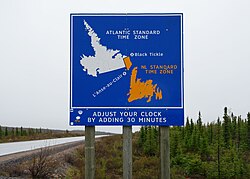
Although provincial law states that the entire province observes Newfoundland Time, the practical application differs across the region. The island of Newfoundland and its smaller offshore islands strictly follow Newfoundland Time. In Labrador, the observation is split.
Southeastern Labrador communities, including those south of and including Black Tickle, prefer Newfoundland Time. This preference is largely driven by the desire to synchronize with radio broadcasts originating from the island. Conversely, the rest of Labrador—from Cartwright northward and westward—observes Atlantic Time, aligning with the rest of Atlantic Canada.
Daylight Saving and Temporal Quirks
The province observes daylight saving time, though it has experimented with different formats. In 1988, the government tested "double daylight saving time," advancing clocks by two hours instead of one. This experiment failed because it resulted in children having to travel to school in the dark during October. In 2007, the province extended its daylight saving period to align with the United States and other Canadian provinces.
This offset creates a distinct gap between Newfoundland and its neighbors. The island is 30 minutes ahead of the rest of Atlantic Canada, 90 minutes ahead of Central Canada, and 30 minutes behind Saint-Pierre and Miquelon.
Impact on Media and Culture
Because Newfoundland hits time milestones before almost any other part of the continent, it often gains national attention during major releases. For example, the Canadian releases of Halo 2 and Harry Potter and the Half-Blood Prince were publicized specifically in relation to Newfoundland's early timing.
This quirk is also evident in broadcasting. CJON-DT (NTV), the province's only independently owned TV station, frequently uses "World Television Premiere" bumpers for shows that air in Newfoundland before they air elsewhere in North America. Meanwhile, national networks like the CBC often use Atlantic-time feeds for Newfoundland, leading to common phrasing across Canada that programs air "6:00, 6:30 in Newfoundland."
Key Facts
- Standard Offset: 3.5 hours behind Greenwich Mean Time (GMT).
- Legal Status: Officially observed province-wide, but Atlantic Time is used in most of Labrador.
- Key Meridian: St. John's is located near the 52.5 degrees west longitude meridian.
- Historical Basis: Established via the Standard Time Act of 1935 while Newfoundland was a separate dominion.
- Regional Split: Labrador is divided between Newfoundland Time (southeast) and Atlantic Time (north and west).
| Region | Time Zone Observed | Difference from Newfoundland Time |
|---|---|---|
| Island of Newfoundland | Newfoundland Time | 0 minutes |
| Southeastern Labrador | Newfoundland Time | 0 minutes |
| Northern/Western Labrador | Atlantic Time | -30 minutes |
| Central Canada | Central Time | -90 minutes |
| Saint-Pierre and Miquelon | Local Time | +30 minutes |
Frequently Asked Questions
Why does Newfoundland have a half-hour time zone?
It is due to the island's geographic location near the 52.5 degrees west longitude meridian and the fact that it was a separate dominion with the legal right to establish its own time zone via the Standard Time Act of 1935.
Does all of Labrador use Newfoundland Time?
No. While southeastern Labrador (including and south of Black Tickle) uses Newfoundland Time to stay synchronized with radio broadcasts, the rest of Labrador from Cartwright north and west observes Atlantic Time.
What happened during the double daylight saving experiment?
In 1988, the government moved clocks ahead by two hours instead of one. The experiment was unsuccessful because it forced children to go to school in the dark during the month of October.
How does the time difference affect television broadcasting?
National broadcasters like the CBC often use Atlantic-time feeds for the province. However, local stations like CJON-DT (NTV) sometimes air programming as "World Television Premieres" because they reach the airtime before most other North American stations.
Is Newfoundland Time different from Atlantic Time?
Yes, Newfoundland Time is 30 minutes ahead of Atlantic Time.