New Zealand's 1931 Coalition Government and the Rise of the National Party
The political landscape of New Zealand in the early 1930s was defined by economic instability and a desperate need for political consolidation. As the country grappled with the Great Depression, the centre-right forces of the United Party and the Reform Party were forced into an uneasy alliance to prevent the rise of the Labour Party.
The Formation of the 1931 Coalition
In September 1931, a coalition was formed between the United and Reform parties. This move followed the collapse of a previous support arrangement between the United Party and Labour. The primary motivation for this alliance was the fear of vote-splitting—a scenario where two similar parties divide the anti-Labour vote, allowing a Labour candidate to win a seat even if the combined centre-right vote is higher.
To prevent this, the two parties entered into an election agreement. A key component of this deal was that any sitting member supporting the coalition would receive the official endorsement as the coalition candidate. While pragmatic, this caused significant friction in electorates like Otaki and Wairarapa, where voters were dissatisfied with the incumbents but had no alternative coalition candidate to support.
In the subsequent election, the coalition secured 54.0% of the popular vote, significantly ahead of Labour's 34.3%. Despite the Reform Party winning more seats (28) than the United Party (19), George Forbes, the leader of United, remained the Prime Minister.
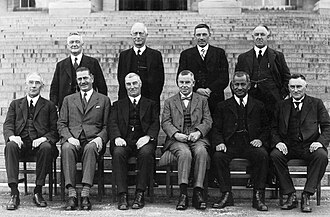
Governance During the Depression
The coalition government's primary objective was to steer New Zealand out of the economic depression. Their strategy focused on fiscal austerity, which involved cutting government spending to balance the national budget.
To address widespread unemployment, the government implemented relief work. This system compelled the unemployed to participate in various projects, some of which were productive public works, while others were viewed as pointless activity. This approach led to the government being perceived as heartless. This reputation was cemented by a persistent, though inaccurate, urban legend that Employment Minister Gordon Coates told a delegation of unemployed men to "go and eat grass" in 1932.
The 1935 Defeat and Electoral Wipeout
The public's dissatisfaction culminated in the 1935 election. While the coalition still held 32.9% of the popular vote compared to Labour's 46.1%, the result in terms of seats was a total collapse. Labour won 53 seats, while the coalition was reduced to just 16. The remaining eleven seats were split among independents and minor parties.
This defeat highlighted the continued danger of vote-splitting. In the 1931 election, for example, only 24 of the 53 electorates where Labour stood had a single anti-Labour candidate. In Auckland West, candidates from both United and Reform ran, collectively receiving only slightly more than half the votes of the winner, Mickey Savage. In Auckland East, four different anti-Labour candidates ran, ensuring a Labour victory.
The Birth of the National Party
In the wake of the 1935 disaster, leaders of the centre-right recognized that a formal merger was necessary. In early 1936, the Dominion Executive of the National Political Federation organized a conference to form a new political entity. The executive members included Sir George Wilson, George Forbes, Robert Masters, Fred Waite, Claude Weston, E.E. Hammond, L.O.H. Tripp, and J.J. McGrath.
Gordon Coates was the sole objector among the executive, suggesting a "wait and see" approach. However, the momentum for unity prevailed. In May 1936, members of the United Party, the Reform Party, and the National Political Federation officially formed the National Party, creating a unified front to challenge Labour.
Key Facts
- Coalition Start: Formed in September 1931 between the United and Reform parties.
- 1931 Election Result: Coalition won 54.0% of the popular vote; Labour won 34.3%.
- Economic Strategy: Focused on balancing the budget through spending cuts and mandatory relief work.
- 1935 Election Result: Labour won 53 seats; the Coalition won 16.
- National Party Formation: Established in May 1936 to prevent future vote-splitting.
| Election Year | Coalition Popular Vote | Labour Popular Vote | Coalition Seats | Labour Seats |
|---|---|---|---|---|
| 1931 | 54.0% | 34.3% | 47 (Combined) | Not Specified |
| 1935 | 32.9% | 46.1% | 16 | 53 |
Frequently Asked Questions
Why did the United and Reform parties form a coalition in 1931?
They formed a coalition to prevent the anti-Labour vote from being split between two similar centre-right parties, which would have allowed the Labour Party to win seats even with a lower overall percentage of the vote.
Who was the Prime Minister during the 1931-1935 coalition?
George Forbes, the leader of the United Party, served as Prime Minister, despite the Reform Party winning more seats in the 1931 election.
How did the government handle unemployment during the Great Depression?
The government initiated relief work, which required unemployed individuals to work on various projects, ranging from useful public infrastructure to activities that were considered pointless.
What was the "eat grass" controversy?
It was a widely believed but untrue story that Employment Minister Gordon Coates told unemployed men to eat grass in 1932, reflecting the public's perception of the government as heartless.
What led to the creation of the National Party in 1936?
The devastating defeat in the 1935 election and the recurring problem of vote-splitting led the United Party, Reform Party, and the National Political Federation to merge into a single party in May 1936.