New York College of Music: A Legacy of Musical Excellence
For nine decades, the New York College of Music stood as a cornerstone of artistic education in Manhattan. Established in 1878, this prestigious conservatory provided a rigorous academic environment for musicians, offering degrees ranging from a Bachelor of Music to a Doctor of Music. By the time of its closure, it held the distinction of being the oldest music conservatory in New York City.
The institution's journey reflects the evolution of the city's cultural landscape, transitioning from a private conservatory to a foundational part of a major university. Today, its legacy continues through the Music and Performing Arts Professions department of the Steinhardt School of Culture, Education, and Human Development at New York University (NYU).
Key Facts
- Founded: 1878 by Louis Alexander.
- Duration: Operated for 90 years until its merger in 1968.
- Academic Scope: Empowered to confer diplomas and degrees from Bachelor to Doctor of Music.
- Final Status: Merged with New York University to become part of the Steinhardt School.
- Notable Achievement: Presented the U.S. premiere of Benjamin Britten's The Turn of the Screw in 1958.
Institutional History and Evolution
The college was founded by Louis Alexander (1839–1903) and initially opened its doors at 163 East 70th Street. From its inception, the school attracted high-caliber talent, with early faculty including the renowned conductor Theodore Thomas and pianist Rafael Joseffy.
Under the leadership of second director Alexander Lambert (1887–1905), the college expanded its prestige and physical footprint, moving to a new facility at 128-130 East 58th Street on September 1, 1891. During this era, the faculty grew to include the celebrated pianist Leopold Godowsky.
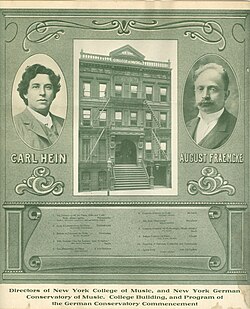
The leadership then passed to co-directors Carl Hein (1864–1945) and August Fraemcke (1870–1933). In 1920, they relocated the institution to its final home at 114–116 East 85th Street. Following Fraemcke's death in 1933, Hein led the college until 1945, succeeded by Arved Kurtz, who served until 1965. The final president, Jerrold Ross, took office in 1965 as the youngest president in the college's history.
Growth and Academic Expansion
The conservatory grew not only through enrollment but through strategic acquisitions. In 1920, it absorbed the German Conservatory, and in 1923, it took over the American Conservatory. These mergers solidified its position as a dominant force in American music education.
Academic Departments and Faculty
The New York College of Music was organized into specialized departments, each led by masters of their craft:
- Violin: Led by Hans Letz, a prominent musician and member of the Kneisel and Letz Quartets.
- Piano: Directed by August Fraemcke.
- Theory and Composition: Initially led by Rubin Goldmark and later by Cornelius Rybner in the mid-1920s.
- Vocal: Directed by Carl Hein.
- Cello: Led for 45 years by William Ebann, who performed with both the Philadelphia Orchestra and the New York Philharmonic.
- Sight-Singing: Directed by Wilbur Luyster.
The faculty roster was a "who's who" of musical expertise, featuring figures such as Paul Creston, Emanuel Feuermann, and Stefan Wolpe.
Notable Alumni and Honors
The college produced a diverse array of influential musicians across jazz, classical, and popular genres. Notable alumni include the legendary songwriter Jerome Kern, pop icon Barry Manilow, and jazz innovators such as Cecil Taylor and Cy Coleman.
The institution also recognized global excellence through its own awards. The New York College of Music Medal was awarded to composer Richard Strauss in 1932. Additionally, the college conferred honorary Doctor of Music degrees upon distinguished figures including Jan Peerce (1949), Walter Piston (1953), and Marion Bauer (1954).
| Year | Event | Key Figure/Detail |
|---|---|---|
| 1878 | Foundation | Louis Alexander |
| 1891 | Second Location | 128-130 East 58th Street |
| 1920 | Third Location & Merger | 114-116 East 85th Street; absorbed German Conservatory |
| 1923 | Expansion | Absorbed American Conservatory |
| 1958 | Artistic Milestone | U.S. premiere of The Turn of the Screw |
| 1968 | Closure/Merger | Merged with New York University (NYU) |
Frequently Asked Questions
When was the New York College of Music founded and when did it close?
The college was established in 1878 by Louis Alexander and operated for 90 years until it closed in June 1968.
What happened to the college after it closed?
The conservatory merged with New York University and was reinvented as part of the Steinhardt School of Culture, Education, and Human Development, specifically within the Music and Performing Arts Professions department.
Who are some of the most famous alumni of the institution?
Notable alumni include composer Jerome Kern, singer and songwriter Barry Manilow, jazz pianist Cecil Taylor, and songwriter Cy Coleman.
What degrees could students earn at the conservatory?
The college was legally empowered to confer a variety of diplomas and degrees, ranging from a Bachelor of Music to a Doctor of Music.
Where was the college located in Manhattan?
The college had three locations over its history: 163 East 70th Street, 128-130 East 58th Street, and finally 114–116 East 85th Street.