The Legacy of Excellence: A History of the New England Conservatory of Music
For over 150 years, the New England Conservatory of Music (NEC) has stood as a beacon of musical innovation and academic rigor. Located in the heart of Boston, Massachusetts, this private institution has evolved from a modest seven-room operation into a world-renowned conservatory that shapes the future of global music performance.
From its pioneering role in introducing music to public schools to its groundbreaking development of jazz and contemporary musical arts, NEC has consistently pushed the boundaries of what a music conservatory can achieve. Today, it remains a vital part of the American cultural landscape, boasting a rich history of diverse leadership and prestigious alumni.
Key Facts
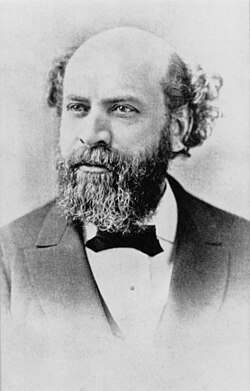
- Founded: February 18, 1867, by Eben Tourjée.
- Location: 290 Huntington Ave, Boston, Massachusetts.
- Status: U.S. National Historic Landmark and listed on the National Register of Historic Places.
- Student Body: Approximately 750 students.
- Endowment: $164.5 million.
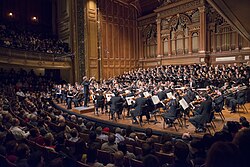
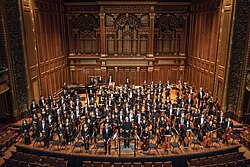
- Primary Venue: Jordan Hall, a premier Renaissance-style performance space.
The Founding and Early Years (1867–1900)
The story of NEC began following the Civil War. After gaining experience founding music schools in Rhode Island, Eben Tourjée successfully convinced a group of Boston's leading musicians and patrons of the need for a dedicated conservatory. On February 18, 1867, the school officially opened in seven rented rooms above the Boston Music Hall.
In its infancy, NEC was a true pioneer. It was the first school in the United States to offer a course in public school music. One notable faculty member, Luther Whiting Mason, used this expertise to introduce music into Boston Public Schools and later traveled to Japan to implement the "Mason-song" system of Western music education.
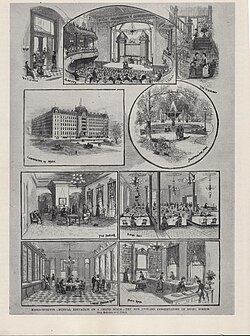
As enrollment surged—reaching 1,212 students by the end of 1868—the school required more space. In 1882, NEC moved to the St. James Hotel in Franklin Square, which served as both an academic facility and a residence for female students. To meet the growing demand for performance space, the conservatory opened Sleeper Hall in 1886.
Expansion and the Move to Huntington Avenue
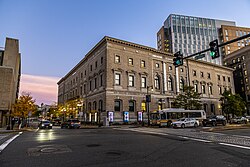
Under the leadership of composer George W. Chadwick, the conservatory began planning for a permanent home. This vision led to the acquisition of land on Huntington Avenue, a burgeoning cultural hub. Construction began in 1901 on the current main building, designed by architects Wheelwright and Haven in the Renaissance style. The landmark Jordan Hall was officially inaugurated on October 20, 1903, with a grand performance by the Boston Symphony Orchestra.
A Transformative 20th Century
The 20th century brought both challenges and radical innovation. While the Great Depression and World War II caused temporary declines in enrollment, the post-war era saw a massive resurgence. By 1946, enrollment doubled to over 2,300 students, many of whom were veterans utilizing the G.I. Bill.
Under President Harrison Keller in the 1950s, the school shifted its focus toward formal degree programs, including Master's degrees and the Artist Diploma—a program designed for exceptionally gifted performers. Keller also laid the groundwork for the current Preparatory School.
The arrival of Gunther Schuller as President in 1967 marked a new era of musical synthesis. Schuller is credited with establishing the first fully-accredited jazz degree program in the United States. He also introduced "Third Stream" studies, a term he coined to describe the fusion of jazz and classical music. This concept eventually evolved into the Contemporary Musical Arts (CMA) department, which integrates global traditions and improvisation into the curriculum.
Growth and Modernization
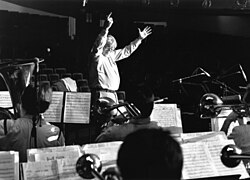
The latter half of the century focused on academic expansion and facility restoration. Between 1983 and 1996, President Laurence Lesser oversaw the introduction of the Doctorate of Musical Arts (DMA) and a major restoration of Jordan Hall. In the 21st century, leaders like Daniel Steiner and Tony Woodcock worked to elevate NEC's global reputation, establishing joint-degree programs with institutions like Harvard and Tufts, and breaking ground on the school's first new building since 1960.

Campus and Facilities
The NEC campus is an urban collection of specialized spaces designed for high-level performance and study:
- The Jordan Hall Building: The main hub, housing Jordan Hall, Williams Hall, Brown Hall, the Keller Room, and the Performance Library.
- The St. Botolph Building: Contains Pierce Hall and the majority of classrooms and administrative offices.
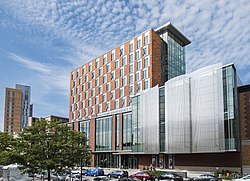
- Student Life and Performance Center (SLPC): Opened in 2017, this facility serves as the NEC Residence Hall and includes the Blumenthal Family Library and the Plimpton Shattuck Black Box Theater.
Performance Excellence
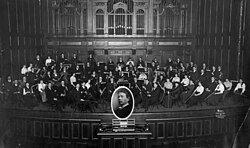
The conservatory provides numerous venues for its students to showcase their talents, ranging from grand orchestral halls to intimate recital spaces. These venues host everything from the NEC Symphony Orchestra to the NEC Youth Philharmonic Orchestra.
The Preparatory School
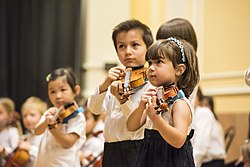
NEC's mission extends to the next generation through its Preparatory School. This open-enrollment institution serves over 1,300 students aged 0–18. The curriculum is diverse, offering private lessons, theory, composition, and over 35 ensembles. For younger children (ages 0–6), the school provides Early Childhood Music Education, including Suzuki Strings and Eurhythmics, to build foundational musical skills.
Summary of NEC Overview
| Category | Details |
|---|---|
| Established | February 18, 1867 |
| Current President | Andrea Kalyn |
| Primary Location | Boston, MA |
| Key Academic Areas | Classical, Jazz, Contemporary Musical Arts, Music Education |
| Notable Recognition | National Historic Landmark |
Frequently Asked Questions
What is "Third Stream" music?
Coined by Gunther Schuller, Third Stream refers to a musical synthesis that combines elements of classical music and jazz. This concept eventually led to the creation of the Contemporary Musical Arts department at NEC.
Does NEC offer programs for younger musicians?
Yes. The NEC Preparatory School is an open-enrollment institution for students aged 0–18, offering everything from early childhood music education to advanced ensemble training.
What is the significance of Jordan Hall?
Jordan Hall is NEC's principal performance space. Located in the main building on Huntington Avenue, it is a Renaissance-style hall that has hosted major performances, including the Boston Symphony Orchestra, since its inauguration in 1903.
Is the New England Conservatory a historic site?
Yes, the New England Conservatory is recognized as a U.S. National Historic Landmark and is listed on the National Register of Historic Places.
What kind of degrees does NEC offer?
NEC offers a wide range of programs, including Artist Diplomas, Bachelor's degrees, Master's degrees, and the Doctorate of Musical Arts (DMA).