New Orleans Truck Attack: The January 1 Terrorist Incident on Bourbon Street
In the early hours of New Year's Day 2025, the festive atmosphere of New Orleans' iconic Bourbon Street was shattered by a coordinated act of domestic terrorism. A vehicle-ramming attack, combined with gunfire and attempted bombings, resulted in a mass casualty event that claimed 15 lives and left dozens more injured. The attack, later identified as being inspired by Islamic extremism, targeted pedestrians during the city's New Year celebrations.
Key Facts
- Date and Time: January 1, 2025, between 3:15 and 3:17 a.m. CST.
- Location: Bourbon Street, New Orleans, Louisiana.
- Casualties: 15 deaths (including the perpetrator) and 57 injuries.
- Perpetrator: Shamsud-Din Bahar Jabbar.
- Motive: Islamic extremism inspired by the Islamic State (ISIS).
- Weapons Used: A Ford F-150 Lightning pickup truck, a .308 AR-10 semi-automatic rifle, and a Glock semi-automatic pistol.
The Attack and Immediate Aftermath
The perpetrator, Shamsud-Din Bahar Jabbar, utilized a rented Ford F-150 Lightning electric pickup truck to plow into crowds of pedestrians on Bourbon Street. The vehicle-ramming portion of the attack caused the majority of the casualties, with 52 people injured by the truck. Following the ramming, a shootout occurred, resulting in five additional injuries by gunfire.
Investigation revealed that Jabbar had also attempted to use improvised explosive devices (IEDs). Two pipe bombs were recovered at the scene, though they remained unused. The chaos of the event led to a swift response from emergency services and law enforcement, while the city struggled to secure the area in the immediate wake of the violence.
Victims of the Tragedy
The attack claimed the lives of 14 innocent civilians in addition to the perpetrator. The victims represented a diverse cross-section of people, including an aspiring nurse, a football star, and parents.
| Name | Age |
|---|---|
| Kareem Badawi | 18 |
| Nikyra Cheyenne Dedeaux | 18 |
| Hubert Gauthreaux | 21 |
| Billy DiMaio | 25 |
| Matthew Tenedorio | 25 |
| Andrew Dauphin | 26 |
| Martin “Tiger” Bech | 27 |
| Nicole Perez | 27 |
| Edward Pettifer | 31 |
| Reggie Hunter | 37 |
| Elliot Wilkinson | 40 |
| Brandon Taylor | 43 |
| LaTasha Polk | 47 |
| Terrence Kennedy | 63 |
The Perpetrator: Shamsud-Din Bahar Jabbar
The FBI identified the attacker as Shamsud-Din Bahar Jabbar, a former member of the U.S. Army who had served as the information technology team chief for the 82nd Airborne Division's 1st Brigade Combat Team. Investigators determined that Jabbar acted alone and was "100% inspired by ISIS," having posted videos declaring support for the group shortly before the attack.
![Jabbar serving as the information technology team chief for the 82nd Airborne Division's 1st Brigade Combat Team during his Army service, pictured in 2013 at Fort Polk.[47]](/images/37/84/3784e9f0c11ca7b24bdfb19b87558fe24a987e13594ac38d208bff3dd4d74f5e.jpg)
Jabbar's path to radicalization was a primary focus of the subsequent investigation. Evidence found at his home in Texas included bomb-making materials, and his movements prior to the attack included a trip to Ontario in July 2023.
Timeline of Events
The attack was the culmination of a planned journey from Texas to Louisiana:
- December 30, 2024: Jabbar purchased coolers in Texas to be used for storing IEDs.
- December 31, 2024: Jabbar drove from Houston to Louisiana, arriving in the state by 2:30 p.m. and reaching his rental home by 10:00 p.m.
- January 1, 2025 (1:53 a.m.): Jabbar planted the first IED in a cooler on Bourbon Street near St. Peter Street before returning to his truck for a second device.
- January 1, 2025 (3:15 a.m.): The vehicle-ramming and shooting attack commenced.
- January 1, 2025 (Post-5 a.m.): A fire was reported at Jabbar's rental home.
Public Reaction and Security Concerns
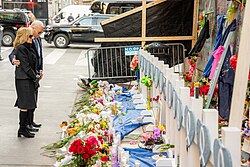
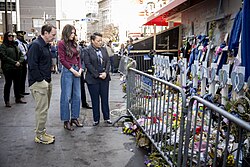
The attack drew condemnation from global leaders, including the Pope and various foreign ministries. In the United States, President Joe Biden and First Lady Jill Biden visited a memorial on Bourbon Street to pay their respects.
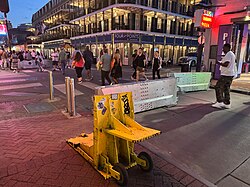
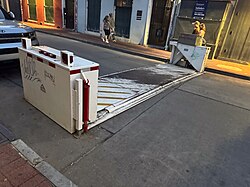
The tragedy also sparked a debate regarding urban security. Reports emerged that malfunctioning security bollards—retractable posts used to prevent vehicle access—had been removed from Bourbon Street for repairs prior to the attack. Experts suggested that the use of permanent steel barriers could have significantly altered the outcome of the event.
In the months following the attack, the city implemented new security measures to prevent similar incidents, including the installation of ramp barriers.
Frequently Asked Questions
What was the motive behind the New Orleans truck attack?
The FBI concluded that the perpetrator, Shamsud-Din Bahar Jabbar, was motivated by Islamic extremism and was inspired by the Islamic State (ISIS).
How many people were killed and injured?
A total of 15 people died, including the attacker. Additionally, 57 people were injured, with 52 victims harmed by the vehicle and 5 by gunfire.
Did the attacker have any military experience?
Yes, Shamsud-Din Bahar Jabbar previously served in the U.S. Army as an information technology team chief for the 82nd Airborne Division's 1st Brigade Combat Team.
Were there any other weapons used besides the truck?
Yes, the attacker used a .308 AR-10 semi-automatic rifle and a Glock semi-automatic pistol. He also planted two pipe bombs, although neither was detonated.
Why were security barriers missing from Bourbon Street?
According to reports, security bollards that were intended to protect the pedestrian area had been removed for repairs before the attack occurred.