New Orleans English and the Unique Yat Dialect
The linguistic landscape of New Orleans is as rich and layered as its history. While many visitors associate the region with a general Southern drawl or Cajun French, the city actually hosts a diverse array of English varieties. From African-American Vernacular English (AAVE) and Cajun English to the broader Southern U.S. English, the metropolitan area is a melting pot of sounds. However, the most distinctive local varieties are those traditionally spoken by the city's white residents: the affluent accent of the Uptown and Garden District and the working-class dialect known as Yat.
The Yat dialect, in particular, is a fascinating sociolinguistic phenomenon. To the untrained ear, a strong Yat accent sounds remarkably similar to that of New York City. This unique blend of Northeastern and Southern influences serves as a powerful identity marker for those raised in the greater New Orleans area, particularly in blue-collar neighborhoods like the Irish Channel and the Ninth Ward.
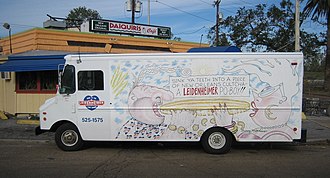
Key Facts
- Yat is a sub-dialect of New Orleans English most associated with working-class white residents.
- The accent shares significant phonological features with New York City English, such as non-rhoticity and th-stopping.
- The term "Yat" is derived from the local greeting "Where y'at?" (meaning "How are you?").
- The dialect likely developed due to strong commercial and demographic ties between New York City and New Orleans in the 19th century.
- Yat is distinct from Cajun English, which is primarily spoken in rural Acadiana.
The Origins of the Yat Accent
The striking resemblance between the speech of New Orleans and the New York metropolitan area has long intrigued linguists. Following the 1803 Louisiana Purchase, New Orleans saw an influx of Irish, German, and Italian immigrants. While some early theories suggested that similar immigrant stocks independently produced similar accents in both cities, modern linguists believe there was a direct relationship.
Significant commercial interactions and the movement of merchant-class and working-class Northeasterners to New Orleans likely diffused New York accent features to the Gulf Coast by the late 19th century. Linguist William Labov suggests that Jewish American bankers and cotton merchants with strong New York ties were particularly influential in shaping the upper-class accents of the city, which eventually trickled down through the social strata.
Phonology: The Sounds of the City
The Yat dialect is defined by several specific linguistic markers. One of the most prominent is non-rhoticity, where the "r" sound is dropped at the end of syllables (e.g., "heart" becomes [hɔət]). Another key feature is th-stopping, where "th" sounds are replaced by "t" or "d," making "those" sound like "doze."
Distinctive Vowel Shifts
Yat speakers utilize a "short-a split," similar to New York City English, where words like "mad" and "map" use different vowel sounds. Additionally, the coil–curl merger—where the sounds in "coil" and "curl" merge—was historically common, though it is now receding. Some speakers also exhibit monophthongization of /aɪ/, a trait shared with many Southeastern U.S. accents.
Local Pronunciations
Native speakers typically pronounce "New Orleans" as [nəˈwɔəlɪnz], destressing the "New." The stereotypical "N'awlins" is rarely used by locals. Similarly, "Louisiana" may be slightly reduced to [ləˈwiziænə] in the Yat dialect.
Local Vocabulary and Cultural Terms
Beyond the accent, New Orleans English is defined by a colorful lexicon that reflects its Creole and multicultural roots.
| Term | Meaning |
|---|---|
| Lagniappe | A small bonus or something extra given for free. |
| Neutral Ground | The grassy median between traffic lanes. |
| Making Groceries | The act of grocery shopping. |
| Po' boy | A traditional sandwich; "dressed" means with lettuce, tomato, pickles, and mayo. |
| Who Dat | A chant of pride for the New Orleans Saints football team. |
| Second Line | A celebratory parade following a main brass band. |
Directional terms also differ from standard American English. Uptown and Downtown refer to positions relative to the river's flow (Upriver or Downriver) rather than socioeconomic status. Similarly, Riverside and Lakeside indicate proximity to the Mississippi River or Lake Pontchartrain.
Yat in Popular Culture
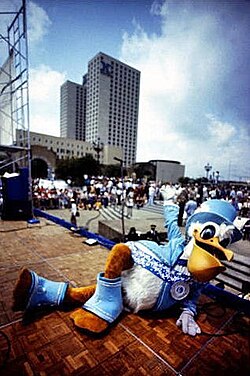
For decades, the Yat accent was rarely heard in national media, as prominent New Orleanians often toned down their speech. However, the dialect has appeared in specific contexts, such as the 1984 World Exposition mascot Seymore D. Fair (a play on "See More of the Fair").
While movies like The Big Easy historically relied on exaggerated Cajun or Southern accents, more recent productions like HBO's Treme have sought greater authenticity by featuring actual New Orleans locals speaking in Yat and its variations.
Common Misconceptions
A frequent mistake is the conflation of New Orleans English with Cajun English. While both are found in Louisiana, they are distinct. Cajun English is rooted in the rural Acadiana region, whereas the New Orleans dialect is a product of the city's urban, mercantile, and Creole history. While some Cajuns have moved into the city, the core "Yat" culture remains separate from the rural Cajun tradition.
Frequently Asked Questions
What does the word "Yat" actually mean?
The term is derived from the common local greeting "Where y'at?", which is a shortened version of "Where are you at in life?" and is used to ask "How are you?"
Why does the New Orleans accent sound like New York City?
Linguists believe this is due to significant commercial and demographic interactions in the 19th century, where working-class and merchant-class individuals from the Northeast migrated to New Orleans, bringing their speech patterns with them.
Is the Yat accent the same as a Cajun accent?
No. The Yat accent is specific to the urban New Orleans area and has strong Northeastern influences, while Cajun English is associated with the rural Acadiana region of South Louisiana.
Is the Yat dialect still common today?
The dialect is receding among younger generations in the city due to various social factors, but it remains very strong in the suburbs, particularly in areas like Chalmette.
What is a "second line" in New Orleans culture?
A second line is a celebratory parade. Originally, it referred to the crowd that followed the official "main line" of a parade, but it has since evolved into its own distinct cultural entity organized by Social Aid & Pleasure Clubs.