New Jersey Counties: Governance, History, and Demographics
The state of New Jersey is divided into 21 counties, which serve as a critical layer of local government positioned between the state administration and individual municipalities. These counties oversee a complex network of 564 municipalities, comprising 253 boroughs, 52 cities, 15 towns, 240 townships, and 4 villages.
From the densely populated urban hubs of the northeast to the expansive rural landscapes of the south, New Jersey's counties vary significantly in size and population. The smallest county by area is Hudson County at 47 square miles, while Burlington County is the largest, spanning 805 square miles.
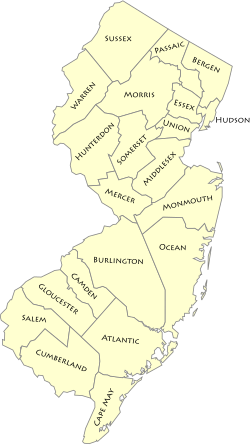
Key Facts
- Total Counties: 21
- Most Populous: Bergen County (977,026 residents)
- Least Populous: Salem County (66,280 residents)
- Largest Area: Burlington County (805 sq mi)
- Smallest Area: Hudson County (47 sq mi)
- Government Structure: Includes an elected Board of County Commissioners, sheriff, clerk, and surrogate.
County Governance and Administration
In New Jersey, county government is responsible for state-mandated duties, including the maintenance of parks, jails, and specific road networks. The administrative and judicial center of a county is known as the county seat.
The leadership structure typically consists of elected officials, including the Board of County Commissioners, a sheriff, a clerk, and a surrogate—the official responsible for routine and uncontested probate matters. Additionally, counties that have organized under the Optional County Charter Law may feature an elected county executive.
Historical Evolution
The origins of New Jersey's counties date back to the late 17th century when the region was divided into two provinces: East Jersey and West Jersey. East Jersey established its first four counties—Bergen, Essex, Middlesex, and Monmouth—in 1675. West Jersey followed in 1681 with the creation of Burlington and Salem counties.
Over the centuries, new counties were carved out of existing ones to accommodate growth and administrative needs. The final county to be established was Union County in 1857, named to commemorate the union of the United States during the onset of the Civil War. Most county names are derived from English place names or prominent figures from the colonial and revolutionary eras.
Legislative Representation and Reform
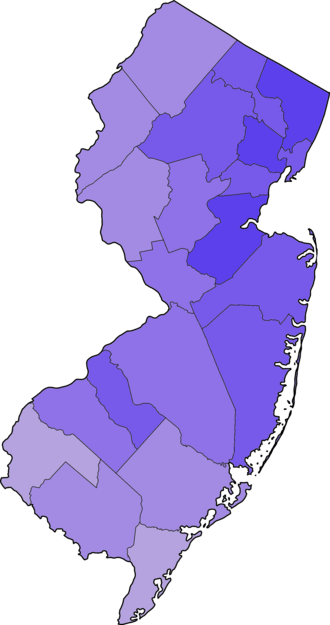
Historically, the New Jersey Senate granted one representative to each county regardless of its population. This system was challenged in the 1960s following the U.S. Supreme Court decision in Reynolds v. Sims, which established the "one man, one vote" principle.
After a legal challenge led by David Friedland, the New Jersey Supreme Court ruled the county-based system unconstitutional. An attempt by the senate to implement a weighted voting system—where a senator from Essex County would have significantly more voting power than one from Cape May County—was also struck down. Consequently, the state constitution was amended in 1966 to create 40 legislative districts based on population rather than county boundaries.
County Data and Identification
For administrative and census purposes, the U.S. government assigns each county a Federal Information Processing Standard (FIPS) code. In New Jersey, these five-digit codes begin with "34," followed by a three-digit identifier unique to each county.
| County | County Seat | Population | Area (sq mi) | Formed |
|---|---|---|---|---|
| Bergen | Hackensack | 977,026 | 234 | 1683 |
| Essex | Newark | 896,379 | 126 | 1683 |
| Middlesex | New Brunswick | 883,335 | 311 | 1683 |
| Hudson | Jersey City | 735,033 | 47 | 1840 |
| Burlington | Mount Holly | 481,439 | 805 | 1694 |
| Salem | Salem | 66,280 | 338 | 1694 |
Frequently Asked Questions
Which is the most populous county in New Jersey?
As of the 2020 Census, Bergen County is the most populous county in the state.
What is a county seat?
A county seat is the town or city that serves as the site for the county's administration and its courts.
How are New Jersey's legislative districts determined?
Since 1966, New Jersey has used 40 legislative districts based on population to ensure equal representation, moving away from the previous system of one representative per county.
What is the purpose of a FIPS code?
The Federal Information Processing Standard (FIPS) code is a unique five-digit number used by the U.S. government to identify counties for data and census purposes.
Which county is the largest by land area?
Burlington County is the largest in terms of area, covering 805 square miles.