Neoteny and Paedomorphosis: The Biology of Juvenile Traits in Adults
In the natural world, the transition from youth to adulthood usually follows a predictable path of physiological and physical change. However, some organisms defy this trajectory through a biological phenomenon known as neoteny. Also referred to as juvenilization, neoteny is the slowing or delaying of somatic (body) or physiological development, allowing an animal to retain juvenile characteristics well into its adult life.
Neoteny is a specific form of heterochrony—a change in the timing or rate of developmental processes during an embryo's growth. When an adult retains traits that were previously seen only in the young, the result is paedomorphosis (or paedomorphism). While neoteny slows down physical development, a related process called progenesis (or paedogenesis) achieves a similar result by accelerating sexual development, effectively "locking in" the juvenile body form while the organism becomes capable of reproduction.
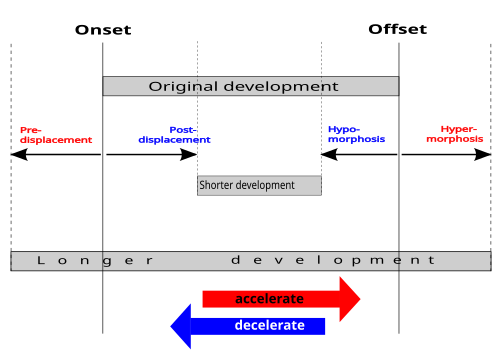
Key Facts
- Neoteny is the slowing of physical development; progenesis is the acceleration of sexual maturity.
- Both processes lead to paedomorphosis, the retention of juvenile traits in adults.
- Environmental factors like cool temperatures and high altitudes often trigger neotenic traits to increase survival fitness.
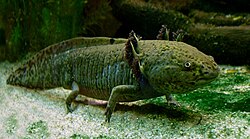
- The axolotl is a primary example of full neoteny, remaining aquatic with gills for its entire life.
- In humans, neoteny is more pronounced than in other primates, particularly regarding skull development.
History and Etymology
The term "neoteny" was coined in 1885 by Julius Kollmann. He developed the concept after studying the axolotl, a salamander that matures sexually while remaining in a tadpole-like aquatic stage, unlike frogs or toads that undergo full metamorphosis.
In 1926, Louis Bolk proposed that neoteny was a central driver in "humanization." While later scholars, including Stephen Jay Gould, noted that Bolk's work was sometimes used to justify scientific racism and sexism, Gould acknowledged the core biological observation: humans reach sexual maturity while their bodies are still in a relatively infantile stage of development compared to other primates.
Neoteny in Humans and Domestic Animals
Human evolution is marked by significant neoteny, which is evident in our cranial structure and developmental timing. This trait is also mirrored in the domestication of animals, particularly dogs. As dogs transitioned from working animals to companions, humans selectively bred them for morphological neoteny.
Traits associated with puppies—such as wide-set eyes and short snouts—are often perceived as more attractive, strengthening the human-canine bond. Breeds like the Cavalier King Charles Spaniel, Saint Bernard, and Maremma Sheepdog exhibit these juvenile physical traits as adults.
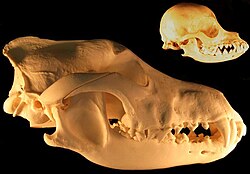
However, the scientific consensus on this is nuanced. A 2004 study of over 1,000 wolf and dog skulls suggested that dog evolution cannot be broadly described by heterochronic processes. By 2011, researchers concluded that while some breeds resemble juvenile wolves, "dogs are not paedomorphic wolves."
Neoteny in the Wild
In wild populations, neoteny is often an evolutionary strategy for survival. Biologists distinguish between two types:
- Partial Neoteny: The retention of larval forms beyond the usual age of maturation, though the organism may eventually reach a full adult form. An example is the frog Lithobates clamitans.
- Full Neoteny: The organism remains in its larval form throughout its entire life, as seen in the axolotl (Ambystoma mexicanum) and some Tiger salamanders.
Environmental Triggers
Neoteny is frequently favored in high-altitude or cold environments. Metamorphosis requires significant energy; in harsh climates, the energy cost of transforming into an adult can decrease an individual's overall fitness. Neotenous individuals can utilize available resources more efficiently and often exhibit higher fecundity (reproductive success) in these conditions.
Amphibians and Arthropods
Many salamanders are environmentally neotenous. The northwestern salamander (Ambystoma gracile), for instance, exhibits neoteny due to high-altitude conditions. In insects, neoteny often manifests as flightlessness. In colder climates, wings lose heat rapidly and are disadvantageous. This leads to larviform females—females that reach sexual maturity without undergoing metamorphosis or developing wings, as seen in some Strepsiptera beetles.
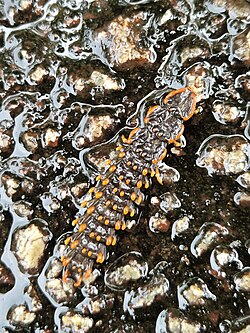
Other examples include aphids, which may forgo wing development if resources on a host plant are abundant, and certain deep-ocean isopods of the family Ischnomesidae.
Amniotes and Subcellular Neoteny
Neoteny also appears in birds and mammals. Some manakins (Chiroxiphia linearis and C. caudata) exhibit partial neoteny by retaining juvenile plumage into early adulthood. Bonobos also share neotenous skull characteristics with humans, where the skull increases in size but does not significantly change shape during maturation.
Interestingly, neoteny occurs even at the subcellular level. In fruit flies, one of the two sperm centrioles retains a "juvenile" structure resembling an early procentriole, a phenomenon known as centriolar neoteny.
Summary of Neotenic Processes
| Process | Mechanism | Result | Example |
|---|---|---|---|
| Neoteny | Slowing of somatic development | Paedomorphosis | Axolotl gills |
| Progenesis | Acceleration of sexual maturity | Paedomorphosis | Larviform insect females |
| Peramorphosis | Extension of development | Exaggerated adult traits | Hypermorphosis/Acceleration |
Frequently Asked Questions
What is the difference between neoteny and paedomorphosis?
Neoteny is the process (the slowing down of development), while paedomorphosis is the result (the actual physical state of an adult looking like a juvenile).
Why would an animal evolve to stay in a larval state?
It is often an energy-saving strategy. In cold or high-altitude environments, the energy required for metamorphosis is too high, making the larval form more fit for survival and reproduction.
Are dogs simply "juvenile wolves"?
While some dog breeds have skulls that resemble juvenile wolves due to selective breeding for cute, juvenile traits, research indicates that the overall evolution of dog skulls is not a simple case of neoteny.
Can neoteny happen in cells?
Yes. Subcellular neoteny has been observed in the centrioles of fruit fly sperm cells, where the structure remains in a "juvenile" procentriole stage.
What is a larviform female?
A larviform female is an insect that reaches sexual maturity without undergoing full metamorphosis, often remaining wingless and resembling a larva throughout her adult life.