Neoclassical Synthesis: Bridging Keynesian and Neoclassical Economics
The neoclassical synthesis (NCS) represents one of the most influential movements in economic history. Emerging in the mid-20th century, this paradigm sought to reconcile the macroeconomic insights of John Maynard Keynes—specifically those detailed in his 1936 landmark work, The General Theory of Employment, Interest and Money—with the established principles of neoclassical economics.
At its core, the synthesis proposed a dual-layered view of the economy: while neoclassical principles govern the long-run equilibrium, Keynesian policies are essential for managing the short-run fluctuations of the business cycle. By blending these perspectives, economists aimed to create a comprehensive framework capable of ensuring full employment and economic stability.
Key Facts
- Core Objective: To merge Keynesian macroeconomics with neoclassical microeconomic foundations.
- Primary Architects: Formulated largely by John Hicks, Franco Modigliani, and Paul Samuelson.
- Temporal Scope: Dominated mainstream macroeconomic thought from the 1950s through the 1970s.
- Key Mechanism: Utilizes the IS-LM model to analyze the relationship between investment, savings, liquidity preference, and money supply.
- Long-run vs. Short-run: Assumes neoclassical market forces prevail in the long run, while government intervention is effective in the short run.
The Emergence and Development of the Synthesis
The period between 1940 and 1970 is often described as the "golden age" of macroeconomics. During this era, the neoclassical synthesis evolved from a theoretical attempt at reconciliation into the dominant academic paradigm. The process began in 1937 when John Hicks published "Mr. Keynes and the Classics," introducing the IS-LM model. This model translated Keynesian theory into a general equilibrium framework involving three markets: goods, money, and financial assets.
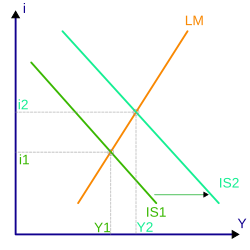
Further refinements followed in the 1940s and 50s. Franco Modigliani expanded the IS-LM scheme by incorporating the labor market, while Paul Samuelson popularized the term "neoclassical synthesis" in his influential textbook, Economics (1948). Samuelson introduced the 45-degree diagram, or the Keynesian cross, which visually demonstrated how government intervention could address underemployment without abandoning the classical analysis of relative prices and resource allocation.
Empirical Advancements and Theoretical Tools
To move beyond theoretical models, economists in the 1950s, including Lawrence Klein and Franco Modigliani, began developing macro-econometric models to quantify variables such as the marginal propensity to consume and the sensitivity of money demand to interest rates.
Other significant contributions included:
- Tobin's Q Theory: James Tobin popularized the "Q Theory," using the Tobin ratio to determine the optimal time for companies to issue shares for new investment based on the replacement cost of capital versus market value.
- Money Demand Theories: Tobin and William Baumol treated money as an inventory, suggesting that households balance cash and interest-bearing bonds based on risk, performance, and liquidity.
- Consumption Hypotheses: Milton Friedman's permanent income theory and Modigliani's life cycle hypothesis advanced the understanding of consumption beyond Keynes's focus on current income.
The Crisis of the 1970s and the Shift to New Synthesis
The success of the neoclassical synthesis peaked in the 1960s, a period of high prosperity where counter-cyclical fiscal and monetary policies seemed foolproof. However, the 1973 oil shock triggered a phenomenon known as stagflation—the simultaneous occurrence of high inflation and high unemployment.
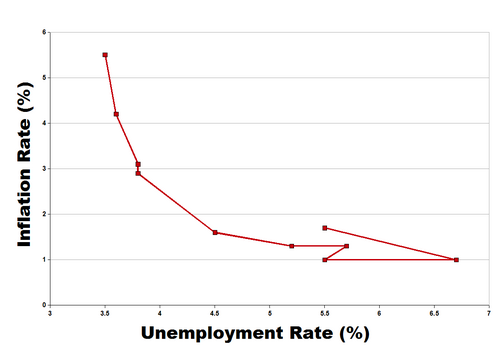
Stagflation contradicted the traditional Phillips curve, which suggested an inverse relationship between inflation and unemployment. This created a "policy bind," as expansionary policies to fight unemployment worsened inflation, and contractionary policies to fight inflation increased unemployment. This crisis led to the rise of monetarism, led by Milton Friedman, and eventually gave birth to New Classical and New Keynesian economics.
These newer schools sought to provide macroeconomics with stronger microeconomic foundations. Eventually, they merged into a "new neoclassical synthesis," which continues to underpin much of modern mainstream macroeconomic theory.
Summary of Economic Frameworks
| Perspective | Time Horizon | Primary Driver | Role of Government |
|---|---|---|---|
| Neoclassical | Long Run | Market Forces / Equilibrium | Minimal (Laissez-faire) |
| Keynesian | Short Run | Aggregate Demand | Active Intervention |
| NCS Synthesis | Both | Hybrid (Market + Policy) | Stabilization & Full Employment |
Frequently Asked Questions
What is the main difference between the long-run and short-run views in the neoclassical synthesis?
In the long run, the synthesis assumes the economy follows neoclassical principles where markets clear and reach equilibrium. In the short run, however, it acknowledges that market failures and rigidities occur, making Keynesian fiscal and monetary interventions necessary to stimulate growth and reduce unemployment.
What is the IS-LM model?
The IS-LM model (Investment-Saving / Liquidity preference-Money supply) is a macroeconomic tool that shows the relationship between interest rates and real output in the goods and money markets, serving as a cornerstone for the neoclassical synthesis.
How did stagflation affect the neoclassical synthesis?
Stagflation—the combination of high inflation and high unemployment—proved that the traditional Phillips curve was not a permanent trade-off. This rendered the synthesis's policy tools ineffective, leading to its collapse and the emergence of New Classical and New Keynesian schools.
Who were the primary contributors to this school of thought?
The movement was led by John Hicks, who provided the initial IS-LM framework; Paul Samuelson, who coined the term and promoted it through his textbooks; and Franco Modigliani, who integrated the labor market and developed the life cycle hypothesis of consumption.
What is the "New Neoclassical Synthesis"?
The New Neoclassical Synthesis is the modern evolution of the original synthesis. It incorporates microeconomic foundations into macroeconomic models, blending New Classical and New Keynesian elements to form the current basis of mainstream economics.