Nematodes: The Diverse World of Roundworms
Nematodes, commonly known as roundworms, are an incredibly diverse and abundant phylum of animals found in nearly every environment on Earth. From the deepest ocean trenches to the frozen Siberian permafrost, these unsegmented worms play critical roles in soil health, nutrient cycling, and the life cycles of various hosts. While many people associate them primarily with parasitic infections, the vast majority of nematode species are free-living organisms essential to global ecosystems.
The sheer scale of nematode diversity is a subject of ongoing scientific debate. Because many species are cryptic species—organisms that look identical but are genetically distinct—they are difficult to distinguish. While some early surveys suggested over 25,000 species, more recent research utilizing DNA barcoding (a method of using short genetic sequences to identify species) suggests the actual number may be closer to one million.
![Carl Linnaeus described nematodes including the parasitic Dracunculus medinensis, seen here under a person's skin.[21]](/images/44/e0/44e08c8e4edbf0de049c2cad07b7595f2cd2f02f99eb40f44a6f89fccfe37207.png)
Key Facts
- Temporal Range: They have existed since the Early Devonian period.
- Species Diversity: Estimates range from 40,000 to as many as one million species.
- Habitat: Found in soil, marine environments, and as parasites in plants and animals.
- Model Organism: Caenorhabditis elegans is widely used in biological research.
- Classification: Belong to the superphylum Ecdysozoa, characterized by molting their cuticle.
Taxonomy and Systematics
The classification of the phylum Nematoda has evolved as genetic sequencing has improved. Historically, they were divided into various classes and orders based on morphology, but molecular data has refined these groupings. Modern systematics generally recognizes two primary classes: Chromadorea and Enoplea.
Early DNA studies identified five major clades: Dorylaimida, Enoplia, Spirurina, Tylenchina, and Rhabditina. The complex phylogeny of these worms continues to be mapped to understand how they diverged from other protostomes (animals whose mouth develops before the anus during embryonic growth).
| Category | Details |
|---|---|
| Kingdom | Animalia |
| Superphylum | Ecdysozoa |
| Phylum | Nematoda |
| Primary Classes | Chromadorea, Enoplea |
| Estimated Species | 40,000 to 1,000,000+ |
| Temporal Range | Early Devonian to Recent |
Anatomy and Biology
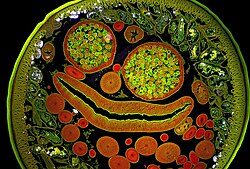
Nematodes possess a relatively simple body plan consisting of a tubular digestive tract and a protective outer cuticle. This cuticle is a non-cellular layer that must be shed (molted) as the worm grows.
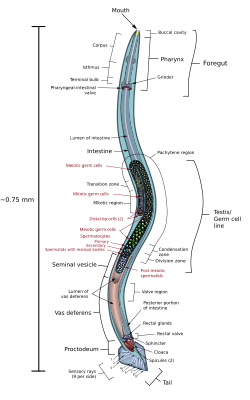
Their internal systems are streamlined for efficiency. The digestive system typically runs the length of the body, and the nervous system consists of nerve cords (ventral and dorsal) that coordinate movement. Reproduction varies by species; some are hermaphroditic, while others have distinct males and females. Male nematodes often possess a specialized structure called a spicule, used during copulation.
![Extremity of a male nematode showing the spicule, used for copulation, bar=100 μm[55]](/images/5f/73/5f7304077e44c8c74c655bd67d6786e78bb6f985dfe21233a4bf970d90a12b4d.jpg)
Ecological and Economic Impact
Soil and Marine Ecosystems
Free-living nematodes are vital components of the soil food web. They regulate bacterial and fungal populations, which in turn influences the availability of nutrients for plants. Some species have even evolved extreme survival mechanisms, such as the ability to survive intracellular freezing in Antarctic environments or entering a dormant state in permafrost.
Agriculture and Horticulture
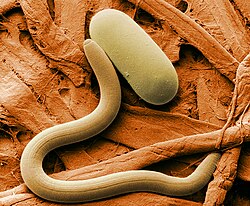
Certain nematodes are devastating agricultural pests. Plant-parasitic species, such as the soybean cyst nematode, attack root systems and reduce crop yields. To combat this, farmers use biological pest control, employing beneficial nematodes or other organisms to manage pest populations naturally.
Human and Animal Health
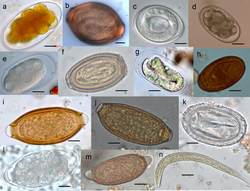
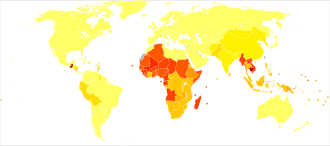
Parasitic nematodes can cause significant health issues in humans and livestock. Intestinal nematode infections contribute to a high number of disability-adjusted life years (a measure of overall disease burden), particularly in developing regions. These parasites can inhabit the gastrointestinal tract or migrate through tissues, causing various pathologies.
Frequently Asked Questions
What is the difference between free-living and parasitic nematodes?
Free-living nematodes live independently in soil or water and typically feed on bacteria, fungi, or other small organisms. Parasitic nematodes rely on a host (plant, animal, or human) for nutrients and often cause disease or tissue damage.
Why is C. elegans important to science?
Caenorhabditis elegans is a model organism because it is transparent, has a fully mapped genome, and has a known number of cells, making it ideal for studying genetics, development, and aging.
How do nematodes survive extreme environments?
Some nematodes can enter a state of cryptobiosis, where metabolic activity nearly stops, allowing them to survive extreme cold, desiccation, or lack of oxygen for long periods.
How are plant-parasitic nematodes controlled?
Control methods include the use of biopesticides, green manures (such as Indian mustard), and biological control agents like entomopathogenic nematodes that target pests.
How many species of nematodes actually exist?
While some conservative estimates place the number at 40,000, the use of DNA barcoding and the discovery of cryptic species suggest there may be up to one million species worldwide.