NCBI: The Global Hub for Biotechnology and Biomedical Data
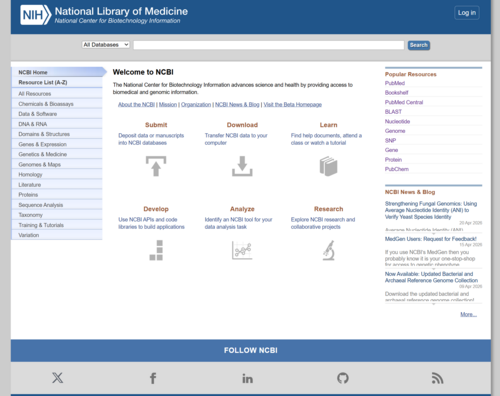
The National Center for Biotechnology Information (NCBI) serves as a cornerstone of modern biological research. As a vital branch of the National Library of Medicine (NLM) within the National Institutes of Health (NIH), the NCBI provides the digital infrastructure necessary for scientists to access, analyze, and share the vast complexities of genetic and biomedical information.
Founded in 1988 through legislation sponsored by US Congressman Claude Pepper, the NCBI was established to solve a critical problem: the fragmentation of biotechnology knowledge. Before its creation, inconsistent naming schemes and a lack of connectivity between databases made it difficult for researchers to integrate information from different sources. Today, the NCBI acts as a centralized repository, a distribution center, and a developer of sophisticated analysis tools that power global scientific discovery.

Key Facts
- Founded: 1988
- Headquarters: Bethesda, Maryland, USA
- Parent Organization: National Library of Medicine (NLM)
- Core Function: Hosting biotechnology databases and bioinformatics tools
- Major Resources: GenBank, PubMed, BLAST, and Entrez
The Evolution of Bioinformatics at NCBI
The history of the NCBI is marked by rapid technological advancement. In 1990, a team including mathematician Stephen Altschul developed the BLAST tool, a revolutionary method for comparing biological sequences. By 1994, the NCBI launched its official website, providing online access to the GenBank DNA database and the Entrez retrieval system.
The organization's influence expanded significantly in 2000 when it began hosting access to the human genome mapped by the Human Genome Project. Furthermore, the introduction of PubMed Central (PMC) provided a free online archive for biomedical literature. In 2008, US Congress mandated that research funded by the NIH be made publicly available on PubMed within 12 months, ensuring that scientific knowledge remains accessible to the global community.
Essential NCBI Resources and Databases
The NCBI ecosystem is organized into several specialized categories, ranging from literature archives to molecular sequence databases.
Literature and Educational Resources
For researchers seeking published studies and academic texts, the NCBI offers three primary pillars:
- PubMed: A massive database for searching citations and abstracts of biomedical literature.
- PubMed Central (PMC): A free full-text archive of biomedical and life sciences journal literature.
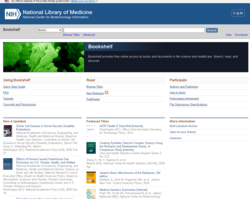
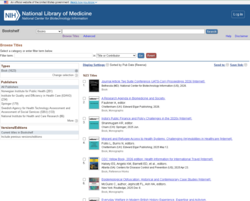
- NCBI Bookshelf: A digital repository providing free access to biomedical books, textbooks, clinical manuals, and monographs contributed by academic and government institutions.
Molecular and Genomic Databases
The NCBI hosts a diverse array of databases that allow scientists to explore the building blocks of life:
- GenBank: An annotated collection of all publicly available DNA sequences.
- Gene: A centralized collection of organized information about genes across various species.
- Protein: A collection of text records for individual protein sequences, including 3D coordinate sets for experimentally determined structures.
- Nucleotide and Genome Databases: Resources providing access to nucleotide sequences and over 3.45 million genomes.
- dbSNP: A database focusing on human single-nucleotide variations, microsatellites, and small-scale insertions or deletions.
- PubChem: A public resource for chemical molecules and their activities against biological assays.
![Diagram exemplifying how the different databases that compose PubChem interact with each other and with the user, as depicted by Rosania et al., 2007[17]](/images/2f/37/2f37853f69e14c6f789f10d05cf49fcb14417d97d2e45e8a1e09b1cd63878758.jpg)
Summary of Major NCBI Databases
| Resource Name | Primary Content Type | Key Use Case |
|---|---|---|
| PubMed | Biomedical Literature | Searching citations and abstracts |
| GenBank | DNA Sequences | Accessing annotated nucleotide data |
| BLAST | Sequence Alignment Tool | Finding similarities between sequences |
| PubChem | Chemical Information | Studying molecular bioactivity |
| Bookshelf | Biomedical Books | Accessing textbooks and manuals |
Advanced Analysis Tools
The BLAST Algorithm
BLAST (Basic Local Alignment Search Tool) is an essential algorithm used to perform sequence similarity searches. Instead of performing exhaustive, computationally expensive comparisons, BLAST uses heuristic methods—essentially intelligent shortcuts—to find matches quickly. The process involves analyzing a query sequence for low complexity, finding short matching sequences, extending those matches, and finally performing a "traceback" to produce detailed, high-quality alignments.
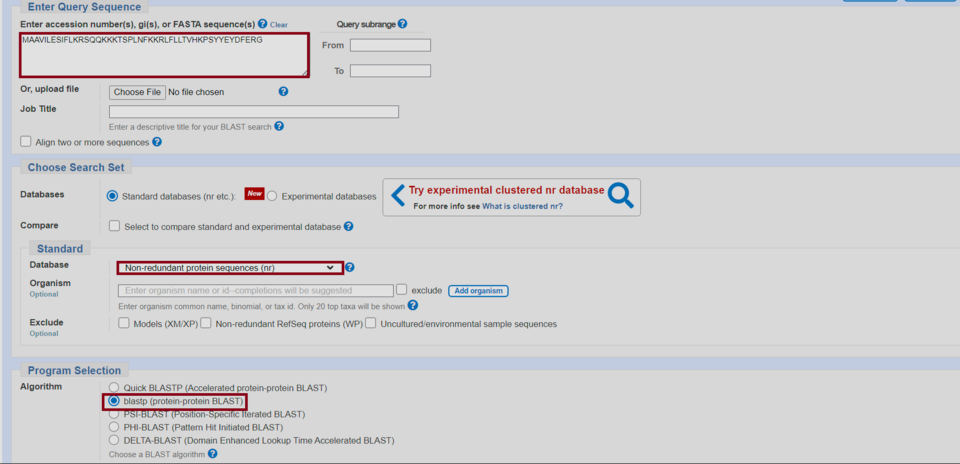
Different versions of BLAST are tailored to specific data types:
- blastn: Compares nucleotide sequences against nucleotide databases.
- blastp: Compares protein sequences against protein databases.
- blastx: Compares translated nucleotide sequences against protein databases.
- tblastn: Compares protein sequences against translated nucleotide databases.
The Entrez Search System
To navigate this vast sea of data, the NCBI utilizes Entrez, a Global Query Cross-Database Search System. Entrez acts as both an indexing and retrieval system, integrating data from diverse sources—such as protein structures, taxonomy, and complete genomes—into a single, uniform information model. This allows researchers to move seamlessly between a gene record, its corresponding protein sequence, and the related scientific literature.
Frequently Asked Questions
What is the main purpose of the NCBI?
The NCBI serves to standardize, store, and distribute biotechnology and biomedical information, providing researchers with the tools and databases necessary to conduct genomic and molecular research.
How does BLAST work?
BLAST uses heuristic methods to quickly identify regions of local similarity between a query sequence and a database. It identifies short matches and extends them to find significant alignments without the computational cost of a full exhaustive search.
What is the difference between PubMed and PubMed Central?
PubMed is a database used to search for citations and abstracts of biomedical research, whereas PubMed Central (PMC) is a free archive that provides access to the full text of many scientific journal articles.
What is the NCBI Bookshelf?
The NCBI Bookshelf is a free digital repository that provides access to high-quality biomedical books, textbooks, and clinical manuals contributed by academic and government institutions.
How is chemical information handled at NCBI?
Chemical information is managed through PubChem, which includes databases for chemical substances, validated chemical compounds, and biological assay data (BioAssay).