The Significance of National Liberation Day of Korea
Every year on 15 August, the Korean Peninsula pauses to observe a momentous chapter in its history. National Liberation Day is a public holiday celebrated in both North and South Korea, marking the end of 35 years of Japanese colonial rule in 1945. It is a rare instance of a political holiday shared by both nations, serving as a solemn reminder of the struggle for sovereignty and the subsequent establishment of two distinct governments.
Historical Context: From Occupation to Liberation
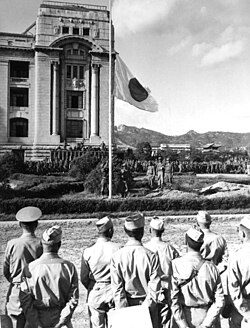
The roots of this holiday trace back to 1910, when the Korean Peninsula fell under foreign control for the first time since its founding in 2333 BC. During the subsequent 35-year occupation, there were systematic attempts to eradicate Korean culture and language.
The tide turned on 15 August 1945, when Japan announced its unconditional surrender to the Allies. Following this announcement, all Imperial Japanese Army forces were ordered to surrender, and the last occupation troops departed southern Korea by 6 November 1945. In the immediate aftermath, the United States and the Soviet Union agreed to a three-year trusteeship—a period of temporary administration—to oversee the establishment of national governments.
On 1 September, the Committee for the Preparation of the National Government established the People's Republic of Korea. During the transition, negotiations took place between Lyuh Woon-hyung and Endou Ryuusaku (the representative of the Governor-General of Chōsen) to ensure the release of prisoners and the transfer of administrative and judicial control to Korean authorities.
The Divergent Names of Liberation
While the event is the same, the two Koreas use different terminology to describe the day, reflecting their unique political identities.
- In South Korea: It is known as Gwangbokjeol (광복절), which literally translates to "The Day the Light Returned." The use of the term "restoration" (bok) rather than "independence" emphasizes that Korea had been an independent nation for millennia prior to the colonial period.
- In North Korea: It is known as Joguk haebangui nal (조국해방의 날), meaning "Liberation of the Fatherland Day."
Celebrations and Traditions
The ways in which the holiday is observed vary significantly between the North and the South, ranging from military displays to community-focused festivities.
Observance in North Korea
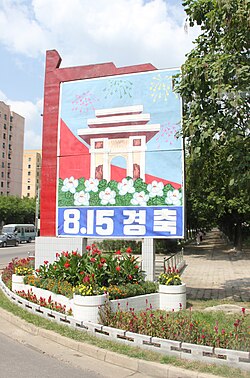
In North Korea, the holiday is often marked by military parades at Kim Il Sung Square, particularly during jubilee years (such as 25th, 50th, or 70th anniversaries). These parades are typically attended by the Chairman of the State Affairs Commission and the Commander-in-Chief of the Armed Forces. While parades were held annually between 1953 and 1960, they became less frequent until resuming in the early 2000s. Interestingly, it is also a common tradition for citizens to schedule weddings on this holiday.
Observance in South Korea
South Korea hosts official ceremonies attended by the President, often held at the Independence Hall of Korea in Chean or the Sejong Center for the Performing Arts. During these celebrations, the national flag, the Taegukgi, is prominently displayed on homes and buildings. In the Jamsil area of Seoul, international flags are temporarily replaced with South Korean flags to honor the occasion.
The holiday also features several cultural and social benefits:
- The Gwangbokjeol Song: An official anthem with lyrics by Jeong In-bo and melody by Yoon Yong-ha is sung during ceremonies.
- Public Access: Many museums are free for the descendants of independence activists, and public transport and intercity trains are often provided free of charge to these individuals.
- Presidential Pardons: The government traditionally issues special pardons on this day.

Key Facts
- Date: 15 August annually.
- Primary Significance: Commemorates the 1945 liberation from Japanese colonial rule and the 1948 establishment of the South Korean government.
- South Korean Name: Gwangbokjeol ("The Day the Light Returned").
- North Korean Name: Joguk haebangui nal ("Liberation of the Fatherland Day").
- Shared Status: It is the only political holiday celebrated by both North and South Korea.
Summary of National Liberation Day
| Feature | South Korea | North Korea |
|---|---|---|
| Local Name | Gwangbokjeol | Joguk haebangui nal |
| Literal Meaning | The Day the Light Returned | Liberation of the Fatherland Day |
| Common Celebrations | Official ceremonies, flag displays, free museum access | Military parades, weddings |
| Key Locations | Independence Hall (Cheonan), Sejong Center (Seoul) | Kim Il Sung Square (Pyongyang) |
Frequently Asked Questions
How does the meaning of "Gwangbokjeol" differ from "Independence Day"?
The term Gwangbok uses the concept of "restoration" rather than just "independence." This is intended to signify that Korea is restoring its original, sovereign state that had existed for thousands of years before the colonial era.
What happened during the 1974 Gwangbokjeol ceremony in South Korea?
On 15 August 1974, an assassination attempt was made on President Park Chung Hee at the National Theater of Korea during a ceremony. While President Park was unharmed, his wife, First Lady Yuk Young-soo, was killed in the attack.
Did North Korea ever change its time zone in relation to this holiday?
Yes. On 5 August 2015, to mark the 70th anniversary of liberation and as a break from "imperialism," North Korea changed its time zone to UTC+08:30, known as Pyongyang Time. However, this change was reversed in May 2018.
What was the "People's Mandate Ceremony" in 2025?
On 15 August 2025, coinciding with the 80th anniversary of liberation, President Lee Jae Myung held a "de facto" public inauguration ceremony at Gwanghwamun Square in Seoul. This ceremony was held because he had taken office on 4 June following the 21st presidential election without an official inauguration.