National Express: The Evolution of Great Britain's Intercity Coach Network
National Express (NX) is the primary provider of long and medium-distance intercity coach services across Great Britain. As a subsidiary of the multinational public transport company Mobico Group, it maintains a vast network that connects major cities and transport hubs. While the brand is ubiquitous across the UK, much of its operational delivery is handled through subcontracts with local coach companies.
Headquartered above the Birmingham Coach Station, the company serves as a critical link in the UK's infrastructure, facilitating thousands of cross-country journeys every week.
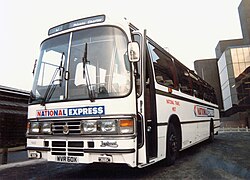
Key Facts
- Founded: December 4, 1972.
- Parent Company: Mobico Group.
- Network Scale: Over 550 routes with 11,000 weekly cross-country journeys (as of 2022).
- Major Hubs: Birmingham, London, Manchester, Bristol, Leeds, and airports including Heathrow and Stansted.
- Airport Services: 1,100 daily services operating 24 hours a day.
History and Privatisation
The origins of National Express trace back to the Transport Act 1968, which created the National Bus Company (NBC) to manage state-owned local bus firms. Under the leadership of NBC chair Frederick Wood and consultant Norman Wilson, the "National" brand was developed for marketing purposes. The specific National Express brand debuted in 1974, eventually becoming the primary identity for the coach business.
The landscape of UK travel shifted with the deregulation of coach services in 1980 and buses in 1985. This paved the way for the company's privatisation via a management buyout in March 1988. Throughout the late 1980s, the company expanded aggressively, acquiring ATL Holdings, a stake in Yelloway Trathen, and Eurolines services to destinations like Paris and Barcelona. It also absorbed Stagecoach's express services in Scotland, operating them under the Caledonian Express brand.
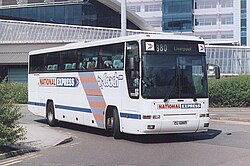
By June 1991, the company was sold to the Drawlane Group, and by December 1992, National Express Group plc was floated on the London Stock Exchange. While it initially faced little competition, the 2003 launch of Megabus by Stagecoach introduced a "no-frills" model with £1 fares, sparking an intense price war that peaked around 2004 and 2007.
Operational Network and Airport Services
National Express operates a comprehensive network linking the UK mainland's major urban centers. A significant portion of its business is dedicated to aviation logistics. In 2003, the company streamlined its airport offerings by merging the Airlink, Flightlink, Jetlink, and Speedlink brands into a single Airport brand.
These services provide 24-hour direct access to terminals at Gatwick, Heathrow, Luton, Stansted, and East Midlands airports.
Fleet and Vehicle Innovation
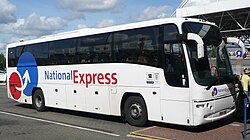
The fleet is characterized by a high degree of standardization. The primary vehicle is the Caetano Levante, a body designed specifically for National Express by Portuguese builder Salvador Caetano. These coaches are built on Mercedes-Benz, Scania, or Volvo chassis and feature front-entrance wheelchair lifts for accessibility.
The fleet has evolved through several iterations, including the Levante III (2018) and the Levante IIIA (2022). Recent expansions include the purchase of 25 Van Hool Altano TDX21 coaches for high-traffic routes between London, Bristol, and Manchester.
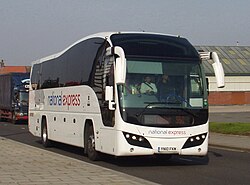
Sustainability is becoming a priority, with the company trialing electric vehicles. Following a 2020 trial of the Yutong TCe12, National Express began trialing the Yutong GTe14 tri-axle battery electric coach on Stansted Airport routes in March 2024.
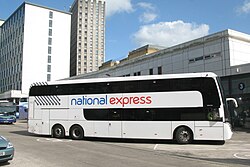
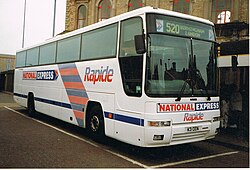
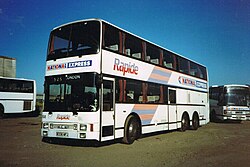
Double-decker operations are more limited. Currently, ten Caetano Boa Vista bodied Scania K410 coaches are operated by Edwards Coaches. This follows a previous era of "Rapide" services using MCW Metroliner double-deckers and Neoplan Skyliners, the latter of which were withdrawn following a fatal accident on the M25.
Passenger Services and Fares
Tickets are primarily sold online via the official website and third-party platforms, though telephone bookings and physical ticket offices remain available. Between 2013 and 2023, the Post Office also served as a sales channel.
Discount Coachcards
To maintain affordability, National Express offers several Coachcards that provide a one-third discount on standard and flexible fares:
- Young Persons Coachcard: For passengers aged 16–26.
- Senior Coachcard: For those over 60.
- Disabled Coachcard: For adults registered as disabled.
On-Board Entertainment History
The company has experimented with on-board amenities. After phasing out catering in 2001 and TV in the 1990s, it launched NXTV in 2004. This service featured BBC and ITV programming on overhead monitors. However, the service was discontinued in 2006 due to the rise of the Apple iPod and a lack of interest in purchasing the required headphones.
Impact of the COVID-19 Pandemic
The pandemic caused significant disruptions to the network. Services were first limited on March 24, 2020, before a total suspension on April 6. While services resumed on July 1 with reduced frequency, a second suspension occurred in January 2021 during the third national lockdown. Full limited services did not resume until March 29, 2021.
| Category | Details |
|---|---|
| Parent Company | Mobico Group |
| Primary Vehicle | Caetano Levante |
| Key Hubs | Birmingham, London, Manchester, Bristol |
| Discount Rate | 1/3 off for Coachcard holders |
| Airport Coverage | 24/7 service to all major UK airports |
Frequently Asked Questions
Who owns National Express?
National Express is a subsidiary of the Mobico Group, a British multinational public transport company.
What is a Coachcard and how does it work?
A Coachcard is a discount pass available to young people (16-26), seniors (60+), and disabled adults, providing a one-third reduction on standard and fully flexible fares.
Does National Express operate its own buses?
While it manages the brand and network, most of the actual coach services are subcontracted to local coach companies.
What are the current efforts toward green travel?
National Express is trialing battery-electric coaches, such as the Yutong GTe14 tri-axle model, to reduce its environmental impact.
Which airports are served by National Express?
The network provides 24-hour direct services to Heathrow, Gatwick, Stansted, Luton, and East Midlands airports.