Nathan Söderblom: The Archbishop Who Championed Global Peace
Nathan Söderblom was a towering figure in 20th-century theology and diplomacy. As the Archbishop of Uppsala and a Nobel Peace Prize laureate, he dedicated his life to the belief that faith should not only provide spiritual guidance but also serve as a catalyst for social justice and international harmony.
Early Life and Academic Foundations
Born in the village of Trönö within the Söderhamn Municipality of Gävleborg County, Söderblom grew up in a religious household; his father served as a parish priest. He began his higher education at Uppsala University in 1883. While he initially struggled to define his academic path, he eventually chose to follow his father's vocation. After traveling to the United States, he was ordained as a priest in 1893.
Söderblom's leadership qualities emerged early during his university years. Between 1892 and 1893, he served as the first vice president and subsequently the president of the Uppsala Student Union.
Diplomatic and Academic Career
From 1894 to 1901, Söderblom served in a ministry position at the Swedish Embassy in Paris. This period placed him in the company of some of the era's most influential figures, including August Strindberg and Alfred Nobel. Söderblom's connection to Nobel was particularly poignant, as he officiated the memorial service for the inventor in 1897.
Following his time in Paris, Söderblom transitioned into academia. He held a chair in the School of Theology at Uppsala University from 1901 to 1914. His intellectual influence extended beyond Sweden, as he also served as a professor of religious studies at Leipzig University between 1912 and 1914.
Leadership as Archbishop and Pursuit of Peace
In 1914, Söderblom reached the pinnacle of the Swedish church when he was elected Archbishop of Uppsala, the head of the Lutheran church in Sweden. His tenure coincided with the devastation of the First World War, a period that defined his commitment to humanitarianism.
During the conflict, he urged Christian leaders worldwide to collaborate in the pursuit of peace and justice. He focused his efforts on alleviating the suffering of refugees and prisoners of war, viewing the church as a vital tool for global stability.
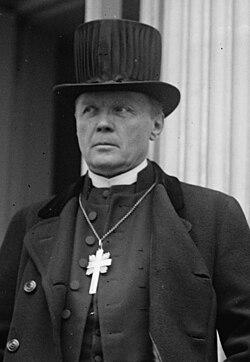
The Ecumenical Movement and the Nobel Peace Prize
Söderblom is widely recognized as one of the principal founders of the ecumenical movement—the effort to promote unity and cooperation among different Christian denominations. He believed that church unity was essential for effectively presenting the gospel to the world and that the teachings of Jesus remained deeply relevant to social life.
In the 1920s, he led the "Life and Work" movement, emphasizing the practical application of faith in society. He was instrumental in chairing the World Conference of Life and Work in Stockholm in 1925. Furthermore, he worked toward intercommunion (the mutual recognition of sacraments between different churches) between the Church of Sweden and the Church of England, maintaining a close partnership with George Bell, the Dean of Canterbury and Bishop of Chichester.
In recognition of his tireless efforts to foster international peace and religious unity, Nathan Söderblom was awarded the Nobel Peace Prize in 1930.
Key Facts
- Role: Archbishop of Uppsala and head of the Lutheran church in Sweden.
- Major Award: Nobel Peace Prize recipient in 1930.
- Legacy: Principal founder of the ecumenical movement.
- Key Event: Chaired the 1925 World Conference of Life and Work in Stockholm.
- Academic Ties: Professor at both Uppsala University and Leipzig University.
| Period/Year | Position or Achievement | Location/Organization |
|---|---|---|
| 1893 | Ordained as a priest | Sweden |
| 1894–1901 | Ministry position | Swedish Embassy, Paris |
| 1901–1914 | Chair in School of Theology | Uppsala University |
| 1912–1914 | Professor of Religious Studies | Leipzig University |
| 1914 | Elected Archbishop | Church of Sweden (Uppsala) |
| 1925 | Chair of World Conference | Life and Work (Stockholm) |
| 1930 | Nobel Peace Prize | International |
Frequently Asked Questions
What was Nathan Söderblom's role in the ecumenical movement?
Söderblom is considered one of the principal founders of the ecumenical movement. He led the "Life and Work" movement in the 1920s and worked to establish intercommunion between the Church of Sweden and the Church of England.
Why did Nathan Söderblom receive the Nobel Peace Prize?
He was awarded the Nobel Peace Prize in 1930 for his efforts to promote peace and justice, particularly his work during the First World War to help refugees and prisoners of war, and his leadership in uniting Christian churches.
Which famous figures did Söderblom know during his time in Paris?
While serving at the Swedish Embassy in Paris from 1894 to 1901, his congregation included the writer August Strindberg and the inventor Alfred Nobel.
What was the purpose of the "Life and Work" movement?
The movement aimed to demonstrate that the messages of Jesus were relevant to social life and that church unity was necessary to present the gospel to the world effectively.
Where did Nathan Söderblom teach?
He held a chair in the School of Theology at Uppsala University and served as a professor of religious studies at Leipzig University.