Nassau Presbyterian Church
Located at 61 Nassau Street in the heart of Princeton, New Jersey, the Nassau Presbyterian Church stands as a cornerstone of spiritual and academic history. As a member of the Presbyterian Church (U.S.A.) and a proponent of Liberal Protestant churchmanship, this congregation has long been intertwined with the intellectual life of the region due to its close proximity to Princeton University and the Princeton Theological Seminary.
Beyond its role as a place of worship, the church is a contributing property to the Princeton Historic District and is responsible for the operation of the Princeton Cemetery. Its legacy is marked by a series of mergers, architectural rebirths, and a roster of members who have shaped American history.
Key Facts
- Founded: 1766 (originally as First Presbyterian Church of Princeton).
- Architectural Style: Greek Revival, designed by Charles Steadman and completed in 1836.
- Historic Status: Added to the National Register of Historic Places (NRHP) on June 27, 1975.
- Denomination: Presbyterian Church (U.S.A.).
- Current Leadership: The Reverend Dr. David A. Davis.
The Evolution of the Congregation
The First Church
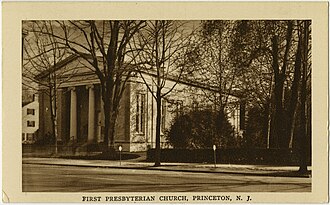
In the mid-18th century, Presbyterians in central New Jersey typically worshipped in Kingston or Lawrenceville. This changed in 1756 when the College of New Jersey (now Princeton University) opened, leading to services being held in Nassau Hall. To accommodate the growing number of students and faculty, funds were raised to build a dedicated sanctuary. The First Presbyterian Church of Princeton officially opened its doors in 1766. In 1768, John Witherspoon, the President of the College, began a distinguished 25-year tenure as the church's pastor.
Divisions and the Second Church
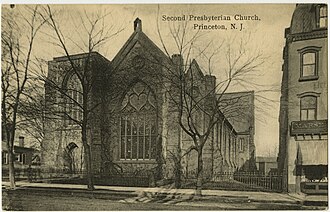
Over time, internal divisions led to the formation of two separate congregations. Following a fire that destroyed the building in 1835, African-American members were encouraged to leave, resulting in the establishment of the Witherspoon Street Presbyterian Church. Later in the 1830s, the Second Presbyterian Church was chartered by members seeking a less formal style of worship and different pastoral leadership.
The Path to Unification
Throughout the years, various attempts were made to reunite these fractured congregations, including an effort led by Woodrow Wilson. The successful merger finally occurred in the early 1970s. At the time, both First Church and St. Andrews (the renamed Second Church) were without installed pastors. To avoid the appearance of one church absorbing the other, the two decided to form an entirely new entity.
Chartered in 1973, the Nassau Presbyterian Church began with a combined membership of 2,335 people (1,759 from First Church and 576 from St. Andrew's). While the Witherspoon Church was invited to join the merger, they declined. In 1978, the former St. Andrews building was sold to the Nassau Christian Center, a plant of the Assemblies of God.
Architecture and Heritage
The current church building is a striking example of Greek Revival architecture, a style characterized by its use of columns and symmetry to evoke the ideals of ancient Greece. Designed by architect Charles Steadman and completed in 1836, the structure replaced previous buildings that had burned down in 1813 and 1835.
| Category | Details |
|---|---|
| Address | 61 Nassau Street, Princeton, NJ 08542 |
| Architect | Charles Steadman |
| NRHP Date | June 27, 1975 |
| Coordinates | 40°20′56.4″N 74°39′38.5″W |
| Affiliation | Presbyterian Church (U.S.A.) |
Notable Ministers and Members
The church's history is distinguished by the influential figures who have passed through its pews or led its services. Notable individuals associated with the congregation include:
- Theologians and Educators: Jonathan Edwards, John Witherspoon, Charles Hodge, A.A. Hodge, and James McCosh.
- Political Figures: Grover Cleveland, Woodrow Wilson, and Bill Bradley.
- Other Influential Figures: Joseph Ruggles Wilson, John Gresham Machen, and Charles R. Erdman, Sr.
Frequently Asked Questions
When was the Nassau Presbyterian Church founded?
The original congregation, known as the First Presbyterian Church of Princeton, was founded in 1766. The current entity, Nassau Presbyterian Church, was chartered in 1973 following a merger.
What architectural style is the church building?
The church is built in the Greek Revival style and was completed in 1836 under the design of architect Charles Steadman.
Why did the church split into multiple congregations in the 19th century?
Splits occurred due to racial tensions following the 1835 fire, leading to the founding of Witherspoon Street Presbyterian Church, and due to preferences for different worship styles and leadership, which led to the Second Presbyterian Church.
Is the church listed on any historic registers?
Yes, it was added to the National Register of Historic Places on June 27, 1975, and is a contributing property to the Princeton Historic District.
Who is the current pastor of the church?
The current pastor is the Reverend Dr. David A. Davis.