Naro-1: South Korea's First Journey to Earth Orbit
The Naro-1 (also known as KSLV-1) represents a pivotal milestone in South Korea's aerospace history. As the nation's first carrier rocket, it served as the primary vehicle that allowed South Korea to achieve Earth orbit for the first time. Developed through a strategic partnership with Russia, the Naro-1 program overcame significant technical and political hurdles to eventually place a satellite into low Earth orbit (LEO).
The rocket takes its name from the Naro region in Goheung, where the Naro Space Center is located. While the program faced early setbacks, its ultimate success paved the way for future indigenous projects, such as the Nuri rocket.
Key Facts
- First Orbital Success: Achieved on 30 January 2013 with the STSAT-2C satellite.
- Collaborative Effort: First stage manufactured by Khrunichev (Russia); second stage by KARI and Korean Air (South Korea).
- Total Cost: Approximately ₩ 520.5 billion (US$ 460 million).
- Configuration: A two-stage rocket standing 33 meters tall with a total mass of 140,000 kg.
- Launch Site: Naro Space Center, Goheung, South Korea.
Development and Technical Specifications
The journey toward the Naro-1 began in the early 1990s with the development of sounding rockets—uncrewed rockets used for scientific measurements—such as the KSR-1 and KSR-2. By 2000, South Korea began constructing the Naro Space Center with Russian assistance. While the original goal was to create a completely indigenous launcher, political pressures from the United States regarding ballistic missile technology led South Korea to seek a partnership with Russia.
To comply with the Missile Technology Control Regime (MTCR)—an informal political understanding among states to limit the proliferation of missiles and UAV technology—South Korea collaborated with GKNPTs Khrunichev and NPO Energomash. This resulted in a hybrid design utilizing Russian propulsion for the initial ascent and Korean technology for the final orbital insertion.
Vehicle Architecture
The Naro-1 was a two-stage vehicle designed for small-lift capabilities. The first stage utilized a modified Russian Angara Universal Rocket Module (URM) powered by an RD-191 engine (de-powered to 1.7 MN). The second stage consisted of a solid rocket motor developed domestically by the Korea Aerospace Research Institute (KARI).
| Feature | First Stage (Russian) | Second Stage (Korean) |
|---|---|---|
| Engine | 1 RD-191 | 1 Solid rocket motor |
| Propellant | LOX / RP-1 (Kerosene) | Solid fuel |
| Thrust | 1670 kN | 86.2 kN |
| Specific Impulse | 338 sec | 288 sec |
| Burn Time | 300 seconds | 25 seconds |
Launch History: A Path to Success
The road to orbit was marked by two high-profile failures before the program achieved its goal.
The First and Second Attempts
The maiden flight on 25 August 2009 failed when the payload fairing—the protective nose cone covering the satellite—malfunctioned. Half of the cover remained attached, causing the rocket to tumble and veer off course; the STSAT-2 satellite subsequently disintegrated upon reentry.
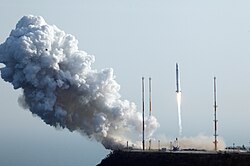
The second attempt on 10 June 2010 ended abruptly 137 seconds into flight. Contact was lost, and the vehicle was believed to have exploded in midair. Despite extensive reviews by a joint Korean-Russian Failure Review Board, a definitive cause for the second failure was never officially declared.
The Final Triumph
The third and final flight took place on 30 January 2013. After overcoming several delays caused by fuel leaks and electrical malfunctions, the Naro-1 successfully placed the STSAT-2C satellite into low Earth orbit. This success was particularly significant as it occurred shortly after North Korea's Unha-3 launch, highlighting South Korea's growing capabilities in space technology.
Frequently Asked Questions
Why was the Naro-1 a joint project with Russia?
South Korea faced political pressure from the United States, which discouraged independent research into rocket technology to prevent the development of clandestine military ballistic missiles. Partnering with Russia allowed South Korea to acquire necessary propulsion technology while adhering to MTCR commitments.
What caused the failure of the first Naro-1 launch?
The first launch failed because the payload fairing separation system malfunctioned. The remaining weight of the fairing caused the rocket to lose stability and deviate from its planned altitude, leading to the loss of the satellite.
What is the difference between Naro-1 and the Nuri rocket?
Naro-1 was a collaborative effort using a Russian first stage. In contrast, the Nuri rocket was designed as a fully indigenous successor to replace the retired Naro-1, representing South Korea's transition to independent launch capabilities.
How much did the Naro-1 program cost?
The project cost was approximately ₩ 520.5 billion, which is roughly US$ 460 million. This expenditure led to some public debate in South Korea regarding the value of the space program during its development.