Nándor Hidegkuti: The Architect of the False 9
In the annals of football history, few players have altered the tactical landscape as profoundly as Nándor Hidegkuti. A cornerstone of Hungary's legendary "Golden Team" of the 1950s, Hidegkuti was more than just a prolific scorer; he was a tactical revolutionary. By redefining the role of the centre-forward, he dismantled the rigid defensive structures of his era and paved the way for the modern game.
Key Facts
- Role: Pioneered the deep-lying centre-forward position, now known as the false 9.
- International Success: Won an Olympic Gold Medal (1952) and was a 1954 FIFA World Cup runner-up.
- Club Legacy: Spent the majority of his playing career at MTK Hungária FC, winning three league titles.
- Managerial Achievement: Led ACF Fiorentina to the first-ever European Cup Winners' Cup title in 1961.
- Global Impact: Coached Al Ahly in Egypt for seven seasons, introducing the 5–3–2 formation.
The Tactical Revolution: Inventing the False 9
During the 1950s, most international teams utilized the WM formation, a system where a defending centre-half was tasked with marking the opposition's centre-forward (typically the number 9). Hidegkuti, working with coach Márton Bukovi and teammate Péter Palotás at MTK, disrupted this logic by playing as a deep-lying centre-forward.
Instead of staying high up the pitch, Hidegkuti dropped deep into the midfield. This movement forced opposing defenders into a dilemma: if they followed him, they left a gaping hole in the heart of their defense; if they stayed put, Hidegkuti was left unmarked to distribute the ball to other attackers. This "hide-and-seek" style of play caused immense confusion for defenses and revolutionized offensive strategy.
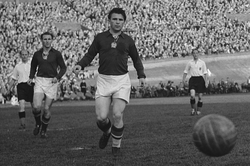
The Wembley Masterclass
The most famous demonstration of this tactic occurred on November 25, 1953, at Wembley Stadium. Hidegkuti scored a hat-trick as Hungary defeated England 6–3. Don Revie, the former England and Leeds United manager, later noted that Hidegkuti "tore the England defence to shreds" with his positional intelligence. This dominance continued in the return match in Budapest in May 1954, where Hungary won 7–1.
Club Career and Domestic Dominance
Hidegkuti began his journey at Elektromos FC and Herminamezei AC before joining MTK Hungária FC in 1947. His tenure at MTK was marked by both political turmoil and sporting brilliance. As Hungary transitioned into a communist state, the club underwent several name changes—becoming Textiles SE, Bástya SE, and Vörös Lobogó SE—before returning to MTK.
Despite these changes, Hidegkuti led the team to three Hungarian League titles, a Hungarian Cup, and a Mitropa Cup. In 1955, while playing as Vörös Lobogó SE, he participated in the inaugural European Cup, scoring twice in a 10–4 aggregate victory over RSC Anderlecht.
International Glory with the Golden Team
Between 1945 and 1958, Hidegkuti earned 69 caps and scored 39 goals for Hungary. He was a vital component of the Golden Team alongside icons like Ferenc Puskás, Sándor Kocsis, and József Bozsik. Together, Puskás, Kocsis, and Hidegkuti contributed a staggering 198 goals during their era of dominance.
While Puskás often garnered the most public attention, West German manager Sepp Herberger identified Hidegkuti as the most important player in the Hungarian squad. Herberger specifically adjusted his tactics for the 1954 World Cup final to neutralize Hidegkuti's influence, which ultimately helped West Germany secure the title.
A Distinguished Managerial Career
After retiring as a player, Hidegkuti transitioned into coaching, leaving his mark across Europe and Africa. His most notable European achievement came in 1961 when he guided ACF Fiorentina to victory in the first European Cup Winners' Cup.
He also found great success in Hungary with Győri ETO FC, winning the league in 1963 and reaching the European Cup semi-finals in 1965. Later, from 1973 to 1980, he coached Al Ahly in Egypt, where he introduced the 5–3–2 formation and won five Egyptian Premier League titles.
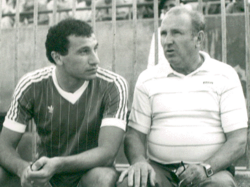
In recognition of his exemplary conduct throughout his career, FIFA honored him with the Fair Play Award in 1993.
Career Summary
| Category | Details / Achievements |
|---|---|
| Playing Positions | Forward / Attacking Midfielder (Deep-lying Centre-forward) |
| Club Stats (Total) | 367 Apps, 253 Goals |
| International Stats | 69 Apps, 39 Goals |
| Major Player Honours | Olympic Gold (1952), World Cup Runner-up (1954), 3x Hungarian League Titles |
| Major Managerial Honours | European Cup Winners' Cup (1961), 5x Egyptian Premier League Titles |
Frequently Asked Questions
What is a "False 9" and how did Hidegkuti pioneer it?
A false 9 is a center-forward who drops deep into midfield rather than staying near the opposition's goal. Hidegkuti pioneered this by drawing defenders out of position, creating space for teammates to attack and allowing himself to act as a playmaker from a deep position.
Which teams did Nándor Hidegkuti manage?
Hidegkuti managed several clubs, including MTK Hungária FC, ACF Fiorentina, A.C. Mantova, Győri ETO FC, FC Tatabánya, Budapest Spartacus, Stal Rzeszów, Egri Dózsa, Al Ahly, and Shabab Al Ahli.
How did Hidegkuti impact the 1954 World Cup?
He was the tactical engine of the Hungarian team. His ability to disrupt the WM formation made Hungary dominant throughout the tournament, though West Germany's manager, Sepp Herberger, specifically tailored his strategy to stop Hidegkuti in the final.
What happened to MTK Hungária FC's stadium?
In honor of his immense contribution to the club and the sport, MTK Hungária FC renamed their stadium the Hidegkuti Nándor Stadium.
What was Hidegkuti's success in Egypt?
Coaching Al Ahly from 1973 to 1980, Hidegkuti won five Egyptian Premier League titles and the Egypt Cup in 1978, while introducing the 5–3–2 formation to the team.