Naming Rights: The Business of Branding Venues and Events
In the modern landscape of sports, entertainment, and public infrastructure, the name of a building is rarely just a label—it is often a high-value asset. Naming rights are a form of advertising or memorialization where a corporation, individual, or entity pays for the right to name a facility, location, program, or event. While most commonly associated with sports stadiums, this practice extends to everything from public transit lines to biological species.
These agreements typically last between three and 20 years, though high-profile professional sports facilities often command longer terms. The primary goal is brand visibility, turning a physical landmark into a permanent billboard for the sponsor.
Key Facts
- Title Sponsors replace the original name of a property entirely.
- Presenting Sponsors attach their brand to an existing traditional name.
- The most expensive naming rights deal to date is the Crypto.com Arena at US$700 million over 20 years.
- Corporate naming of major US professional sports venues rose from 7% in 1994 to 61% by 2004.
- Some entities donate their acquired naming rights to nonprofits or government agencies.
Types of Naming Agreements
Not all naming deals are structured the same way. The industry generally distinguishes between two primary models of sponsorship:
- Title Sponsorship: The sponsor's name becomes the primary identity of the venue, completely replacing the previous name. This is the most common model for modern sports arenas.
- Presenting Sponsorship: The sponsor's name is added to a traditional or existing name. Examples include the Mall of America Field at Hubert H. Humphrey Metrodome.
In some unique cases, a company may purchase naming rights only to donate them to another organization. For instance, Swedbank donated the rights of the Stockholm stadium to the Friends Foundation, resulting in the Friends Arena. Similarly, the Kentucky Farm Bureau donated rights to the Kentucky Department of Agriculture, creating Kentucky Proud Park.
The Evolution of Stadium Naming in the United States
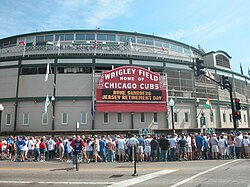
Until the 1990s, American stadiums typically bore generic, descriptive names or were named after team owners. Early examples include Fenway Park (1912) and Wrigley Field (1926), named after William Wrigley Jr. In the 1950s, attempts to use corporate brands—such as the proposed "Budweiser Stadium"—were initially rejected by baseball commissioners, leading to the compromise of "Busch Stadium," named after a company founder.
The shift toward pure corporate advertising began in earnest with the ARCO Arena in 1985, where the naming rights were purchased by a business not involved in team ownership. In the collegiate sector, the Carrier Dome (1980) set an early precedent after a $2.75 million construction donation.
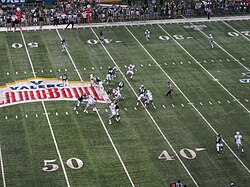
By 2025, the trend became the industry standard: 29 of 30 NBA arenas, 27 of 30 NFL stadiums, and 22 of 30 MLB stadiums have utilized corporate naming rights.

Public Reaction and Resistance
While new venues generally face little resistance to corporate naming, renaming established landmarks often triggers public backlash. A notable example occurred at San Francisco's Candlestick Park. After the venue was renamed 3Com Park and later Monster Park, voters passed a local initiative (Proposition H) to revert the name back to Candlestick Park once the contract expired.
Global Trends and Diverse Applications
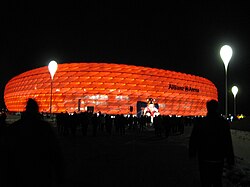
The practice is a global phenomenon. In Germany, eight of the ten largest football stadiums have corporate names, such as the Allianz Arena.
In the United Kingdom, the trend is growing with venues like the Emirates Stadium and the Kia Oval. Beyond permanent structures, naming rights are applied to events and competitions. For example, the French Professional Football Ligue is currently known as Ligue 1 McDonald's.
Public Transit and Media
City infrastructure has also become a revenue stream. The San Diego Metropolitan Transit System sold naming rights for its trolley lines, including a 30-year, $30 million deal for the UC San Diego Blue Line. Similar deals have appeared in the Madrid Metro and the Manila Light Rail Transit System.

Historically, early television and radio programs were often named after their bankrolling sponsors, such as The Fleischmann's Yeast Hour. While this fell out of favor by the late 1950s, a few examples like the Hallmark Hall of Fame persist.
Financial Records and Regulatory Constraints
The financial scale of these deals has reached staggering heights. The current record is held by the Crypto.com Arena in Los Angeles, with a 20-year deal worth US$700 million. This surpassed the previous record held by Toronto's Scotiabank Arena (CA$ 800 million / US$517 million).
| Venue | Sponsor | Estimated Value | Term |
|---|---|---|---|
| Crypto.com Arena | Crypto.com | US$700 Million | 20 Years |
| Scotiabank Arena | Scotiabank | US$517 Million (CA$ 800M) | 20 Years |
| UC San Diego Blue Line | UC San Diego Health | US$30 Million | 30 Years |
Restrictions and Controversies
Certain organizations prohibit corporate naming to prevent ambush marketing (where a brand attempts to associate itself with an event without paying official fees). The Olympics and FIFA often require "clean venues," where sponsored names are replaced by generic ones during the event. However, for the 2028 Los Angeles Olympics, the IOC will allow sponsored names on venue exteriors for a fee.
Controversy also arises when naming rights affect cultural heritage. In Indonesia, the renaming of the protected Semarang Tawang station to "Semarang Tawang Bank Jateng station" sparked criticism from historians due to the lack of regulations protecting heritage objects from commercial renaming.
Frequently Asked Questions
What is the difference between a title sponsor and a presenting sponsor?
A title sponsor completely replaces the original name of the venue or event with their own brand. A presenting sponsor adds their name to the existing title, maintaining the original identity while gaining visibility.
Why do some stadiums change names back to generic ones during the Olympics?
This is due to "clean venue" rules designed to prevent ambush marketing. By removing corporate names, the organizing committee ensures that only official Olympic sponsors receive primary visibility.
Can naming rights be donated?
Yes. Some corporations purchase naming rights and then donate them to a related nonprofit or government agency, as seen with the Friends Arena in Stockholm and Kentucky Proud Park.
What is the most expensive naming rights deal in history?
The most expensive deal is the Crypto.com Arena in Los Angeles, which was valued at US$700 million over a 20-year period.
Are naming rights only for sports stadiums?
No. Naming rights are sold for a wide variety of assets, including public transit lines, radio and television programs, and even biological species.