Myna Birds: Characteristics, Species, and Distribution of the Starling Family
Mynas (also spelled mynah) are a diverse group of passerine birds—perching birds with a specialized toe arrangement—belonging to the starling family, Sturnidae. Native to vast regions of Central and South Asia, including India, Pakistan, Bangladesh, Nepal, Sri Lanka, Afghanistan, and Iran, these birds are well-known for their intelligence and adaptability.
While they are native to Asia, several species have expanded their reach globally. The common myna, in particular, has been introduced to North America, South Africa, Fiji, New Zealand, and Australia, where it is frequently categorized as an invasive species. In Singapore, these birds are highly prevalent and are locally referred to as "Selarang" in Malay and "Teck Meng" in Chinese.
Interestingly, "myna" is not a formal taxonomic group. Instead, the term is used broadly to describe any starling found within the Indian subcontinent. Evolutionary history shows that this region was colonized twice: first by ancestral starlings related to the Aplonis and coleto lineages, and later by ancestors related to the wattled and common starlings. The later group is generally more terrestrial, possessing longer tails and less glossy plumage, except on their heads.
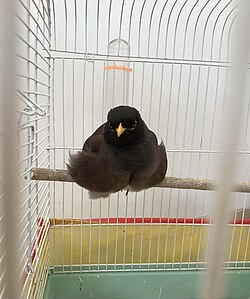
Key Facts
- Family: Sturnidae (Starlings).
- Native Range: Central and South Asia.
- Diet: Primarily insects and fruit.
- Behavior: Gregarious birds with strong, direct flight.
- Special Ability: Some species, such as the common hill myna, are capable of mimicking human speech in captivity.
- Etymology: The name derives from the Hindi mainā, which originates from the Sanskrit madanā.
Physical and Behavioral Characteristics
Mynas are medium-sized birds characterized by strong feet and a gregarious nature. They prefer open country habitats where they can easily forage for food. Their plumage is typically dark or brown, though certain species feature distinct yellow ornaments on their heads. Most myna species are cavity nesters, meaning they build their nests in holes.
Beyond their physical traits, mynas are celebrated for their cognitive abilities. Specifically, certain species are recognized as talking birds due to their capacity to reproduce a wide array of sounds, including human language, when kept in captivity.
Classification of Myna Species
The diversity of mynas is broad, spanning various genera. They are generally categorized into jungle and hill mynas, "true" mynas, and the Gracupica group.
Jungle and Hill Mynas
This group includes species known for their vocal abilities and distinct appearances, such as:
- Common hill myna (Gracula religiosa)
- Southern hill myna (Gracula indica)
- Bali myna (Leucopsar rothschildi) - a critically endangered species nearly extinct in the wild.
- Other notable species: Yellow-faced, Golden, Long-tailed, Sulawesi, Helmeted, Long-crested, Apo, White-necked, Bare-eyed, Fiery-browed, Finch-billed, and Golden-crested mynas.
"True" Mynas and Related Starlings
The "true" mynas primarily fall under the Acridotheres genus. This group includes the Common myna (Acridotheres tristis), as well as the Great, Crested, Javan, Pale-bellied, Jungle, Collared, and Bank mynas.
Additionally, the Gracupica group consists of the Indian pied, Siamese pied, and Javan pied mynas. Other closely related starlings often grouped with Acridotheres include the Vinous-breasted, Black-winged, Red-billed, and White-cheeked starlings.
| Group | Key Genera/Examples | Notable Traits |
|---|---|---|
| Hill Mynas | Gracula | High capacity for speech mimicry |
| True Mynas | Acridotheres | Often invasive; highly adaptable |
| Pied Mynas | Gracupica | Distinctive pied (black and white) plumage |
| Rare Mynas | Leucopsar | Critically endangered (e.g., Bali myna) |
Frequently Asked Questions
Are myna birds the same as starlings?
Yes, mynas are members of the starling family (Sturnidae). The term "myna" is specifically used for starlings found in the Indian subcontinent, regardless of their exact genetic relationship.
Can all myna birds talk?
Not all species have this ability, but some are well-known for their imitative skills. The common hill myna is one of the most proficient at reproducing human speech when in captivity.
Why is the common myna considered invasive?
The common myna has been introduced to various regions outside its native range, such as Australia and North America, where it can outcompete local species and disrupt native ecosystems.
What do myna birds eat?
Mynas have a generalist diet consisting primarily of insects and fruit.
Which myna species is the most endangered?
The Bali myna (Leucopsar rothschildi) is critically endangered and is nearly extinct in the wild.