Muir of Ord: A Journey Through the Heart of Easter Ross
Nestled in the Highland council area of Scotland, Muir of Ord (Scottish Gaelic: Am Blàr Dubh) is a village that blends ancient history with modern community spirit. Located in Easter Ross near the western edge of the Black Isle, it serves as a gateway to the Highlands, situated approximately 9 miles (14 km) west of Inverness and 5.5 miles (9 km) south of Dingwall.
With a population of 2,840 as of 2020, the village sits 35 metres (115 ft) above sea level. It is perhaps best known as the birthplace of the renowned Scottish geologist Sir Roderick Murchison, born here in 1792.
Key Facts
- Location: Easter Ross, Highland council area, Scotland.
- Population: 2,840 (2020 estimate).
- Notable Landmark: Glen Ord distillery, a key producer of Scotch whisky.
- Ancient History: Home to the Castle Hill Henge, a Neolithic or Bronze-Age monument.
- Major Event: The Black Isle Show, one of Scotland's largest agricultural exhibitions.
The Evolution of Muir of Ord
Until 1862, the village was known as Tarradale. For centuries, its growth was hindered by the natural barriers of the River Beauly and the River Conon. This isolation ended in 1814 with the construction of the Conon Bridge, which opened the area to cattle drivers transporting livestock to market. By 1820, markets were established near the current village center.
The 19th century marked a period of rapid expansion, driven largely by the goods industry and the legal granting of whisky distilling operations in 1835. By 1885, the Mill of Ord had become a powerhouse of production, yielding 80,000 imperial gallons (360,000 L) of whisky annually.
Ancient Monuments and Dark History
Castle Hill Henge
The village is home to the Castle Hill Henge, also known as the Muir of Ord Fort. This Neolithic or Bronze-Age henge is a designated national monument of Scotland. Measuring 85 by 65 feet (26 by 20 m), the structure is encircled by a ditch 18 ft (5.5 m) wide and 4 ft (1.2 m) deep. Today, this ancient site is uniquely situated on the green of the Muir of Ord golf course, with two additional standing stones located about 3/4 mile (1.2 km) away.
The Kilchrist Massacre
On the outskirts of the village lies the chapel of Kilchrist, a site associated with a grim event in 1603. According to historical accounts, warriors from Clan MacDonell of Glengarry attacked the MacKenzies of Kintail while they were at prayer. The MacDonells sealed the congregation inside the church and set it ablaze; legend says a piper played the 'March Glengarry' to drown out the screams of those inside. Restored in the late 19th century, the building now serves as the mausoleum for the MacKenzies of Ord.
Modern Life and Community Amenities
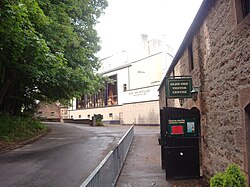
Today, Muir of Ord is a vibrant community with a variety of local attractions. Just outside the village center is the Glen Ord distillery, one of the few remaining distilleries on the Black Isle.
The village also hosts the Black Isle Show every August. As one of Scotland's largest agricultural shows, it attracts visitors to a showground renowned for its surrounding flower fields. For sports enthusiasts, the Muir of Ord Rovers football club competes in the Inverness and District Football League Division Two, playing their home matches at Pavilion Park.
A cornerstone of recent community development is the Muir Hub. Opened in January 2017 after the refurbishment of the former Tarradale primary school, this charity-funded venue operates as a multi-functional space, housing a cafe, a small cinema, and conference facilities for local groups.
Transport and Connectivity
Historically, the A9 road was the primary artery passing through the village. However, in 1982, the village was bypassed following the construction of the Kessock Bridge. For rail travel, the Muir of Ord railway station provides essential links via the Kyle of Lochalsh Line and the Far North Line, connecting residents to Dingwall and Inverness.
| Category | Detail |
|---|---|
| Scottish Gaelic Name | Am Blàr Dubh |
| Population (2020) | 2,840 |
| Postcode District | IV6 |
| Dialling Code | 01463 |
| Notable Births | Sir Roderick Murchison (1792) |
Frequently Asked Questions
What is the significance of the Castle Hill Henge?
It is a Neolithic or Bronze-Age national monument of Scotland, characterized by a large ditch and currently located on a local golf course.
What happened during the Kilchrist Massacre?
In 1603, Clan MacDonell of Glengarry attacked the MacKenzies of Kintail, sealing them inside the Kilchrist chapel and setting it on fire.
What is the Muir Hub?
The Muir Hub is a refurbished former primary school that serves as a charity-funded community center featuring a cafe, cinema, and social spaces.
Which major event takes place in Muir of Ord every August?
The village hosts the Black Isle Show, which is one of the largest agricultural shows in Scotland.
How is the village connected by rail?
Muir of Ord has its own railway station on the Kyle of Lochalsh and Far North Lines, providing transport between Inverness and Dingwall.