Muhammadu Buhari's 2015 Presidential Inauguration and Transition
The transition of power in May 2015 marked a pivotal moment in Nigerian political history. As Muhammadu Buhari prepared to take office, the period was characterized by high expectations, political tension, and a clear desire for a shift in governance. From the specific protocols of presidential address to the stark assessments of the nation's state, the lead-up to the ceremony reflected the complexities of the Nigerian landscape.
Key Facts
- Inauguration Date: May 29, 2015, at 10:51 AM WAT.
- Presidential Order: Muhammadu Buhari became the 15th president of Nigeria and the 4th president of the Fourth Republic.
- Economic Concerns: The All Progressives Congress (APC) cited a $60 billion national debt and severe power shortages upon takeover.
- Security Priority: The relocation of the command and control center to Maiduguri to combat Boko Haram.
- Energy Gap: A national economy of 180 million people generating only 4,000 MW of electricity.
The Transition Period
In the days preceding the ceremony, the Buhari campaign established strict guidelines for the new president's public identity. On May 17, 2015, it was announced that he would be addressed simply as Muhammadu Buhari, President and Commander-in-Chief of the Armed Forces of the Federal Republic of Nigeria, eschewing titles such as "Mr.," "Alhaji," or "Mallam."
The political atmosphere remained charged. On May 24, the All Progressives Congress issued a critical assessment of the administration led by outgoing President Goodluck Jonathan. The APC claimed the nation was in a "deep crisis," citing a grounded economy, fuel shortages, widespread electricity failures, and billions owed to state and federal workers.
Diplomatic and Internal Tensions
The inauguration was not without controversy. On May 26, the National Union of Nigerian Students expressed opposition to the attendance of South African President Jacob Zuma, citing his handling of xenophobic attacks against foreign nationals in South Africa. Meanwhile, reports from Premium Times suggested that the People's Democratic Party (PDP) managed the distribution of 5,000 invitation cards to ensure a "cheerful exit" for President Jonathan and prevent him from being booed during the event.
Facing calls for probes into his administration, President Jonathan stated during a Federal Executive Council valedictory session that any such investigation must extend beyond his own term to avoid being a "witch-hunt."
A Gesture of Devotion
The fervor surrounding the election was exemplified by Suleiman Hashimu, who fulfilled a personal vow by walking 750 km from Lagos to Abuja. The journey took 18 days. Although he started with ₦100,000 ($500), he spent only ₦3,500, as citizens along the route provided for his needs.
The Inauguration and Presidential Mandate
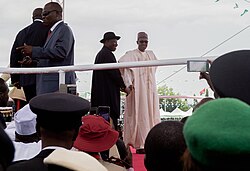
On May 29, 2015, Chief Justice Mahmud Mohammed swore in Muhammadu Buhari as the 15th president of Nigeria. In his inaugural address, Buhari sought to ease the anxieties of his political opponents, stating that there would be no "paying off old scores" and that his administration would serve all Nigerians regardless of affiliation.
Buhari invoked the legacy of great African civilizations, including the Oyo, Benin, and Kanem Borno Empires, as well as Shehu Othman Dan Fodio’s caliphate, to inspire national pride.
Addressing National Crises
The President identified the Boko Haram insurgency as the most immediate challenge. To ensure victory, he announced the relocation of the command and control center from Abuja to Maiduguri. He emphasized that the defeat of the "mindless, godless group" would not be complete without the rescue of the Chibok girls and other hostages.
Buhari also highlighted the critical state of Nigeria's infrastructure, describing it as a "national shame" that a population of 180 million people generated only 4,000 MW of electricity, with even lower distribution rates.
| Category | Details |
|---|---|
| President | Muhammadu Buhari (15th President) |
| Predecessor | Goodluck Jonathan |
| Swearing-in Official | Chief Justice Mahmud Mohammed |
| Primary Security Goal | Subdue Boko Haram and rescue Chibok girls |
| Key Infrastructure Issue | Power generation limited to 4,000 MW |
| Reported National Debt | $60 billion |
Frequently Asked Questions
How did Muhammadu Buhari wish to be addressed after his inauguration?
He requested to be addressed simply as Muhammadu Buhari, President and Commander-in-Chief of the Armed Forces of the Federal Republic of Nigeria, specifically requesting that titles like "Mr.," "Alhaji," or "Mallam" not be used.
What was the APC's view of the nation's state during the handover?
The All Progressives Congress stated that President Goodluck Jonathan was handing over a nation in "deep crisis," characterized by a grounded economy, $60 billion in national debt, and failures in fuel and electricity supply.
What strategic change did Buhari make to fight Boko Haram?
President Buhari announced that the command and control center for security forces would be relocated from Abuja to Maiduguri to better coordinate the effort to subdue the insurgency.
What was the significance of Suleiman Hashimu's journey?
Suleiman Hashimu walked 750 km from Lagos to Abuja over 18 days to fulfill a vow he made if Muhammadu Buhari won the presidency.
What did Buhari say regarding the rescue of the Chibok girls?
He stated that the government could not claim to have defeated Boko Haram without rescuing the Chibok girls and all other innocent persons held hostage, vowing to do everything possible to rescue them alive.