Morphology: The Science of Word Structure and Formation
In the vast field of linguistics, morphology serves as the study of how words are constructed and how they relate to one another within a language. While phonology examines speech sounds and syntax investigates how words combine into sentences, morphology operates at the crucial middle scale, focusing on the internal architecture of the words themselves.
At the heart of this study are morphemes—the smallest units of language that carry independent meaning or grammatical function. These can be roots, which can stand alone as words, or affixes, which must be attached to a root to function. For instance, in the English word "catching," the root "catch" and the suffix "-ing" are both distinct morphemes working together.
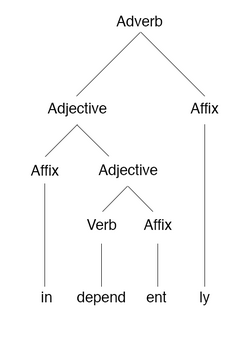
Key Facts
- Morphology is the study of word formation and structure.
- Morphemes are the smallest meaningful units in a language.
- Lexemes represent the abstract concept of a word, while word-forms are the specific variations used in speech or writing.
- Inflection modifies a word to express grammatical categories like tense or number, whereas word formation creates entirely new lexemes.
- Morphological typology classifies languages based on how they use morphemes.
Fundamental Concepts in Morphology
Lexemes vs. Word-Forms
In linguistic analysis, the term "word" can be ambiguous. To provide precision, experts distinguish between lexemes and word-forms. A lexeme is an abstract unit representing a set of related forms. For example, the lexeme EAT includes the word-forms eat, eats, eaten, and ate. Conversely, eat and eater are considered different lexemes because they represent distinct concepts.
The Complexity of the "Word"
Defining a "word" becomes difficult when comparing different languages. In some languages, such as Latin, a single phonological word might encompass what English would treat as a full phrase. In Kwak'wala, meaning relations like possession are handled by affixes that attach to the preceding word rather than the word they actually modify. This creates a mismatch between prosodic words (how they sound) and morphological words (how they are structured). Some linguistic units, known as clitics, exist in a hybrid state: they possess the grammatical features of independent words but lack the phonological freedom of bound morphemes.
Inflection and Word Formation
Morphological rules generally fall into two categories:
- Inflectional rules: These produce different forms of the same lexeme to satisfy grammatical requirements, such as changing "dog" to "dogs" to indicate plurality.
- Word formation rules: These create entirely new lexemes, such as turning "dog" into "dog catcher" through compounding.
The relationship between morphology and syntax—the rules governing sentence structure—is known as morphosyntax. This field examines how inflectional categories, such as person and number, are used in paradigms to ensure grammatical agreement within a sentence.
Models of Morphological Analysis
Linguists use different frameworks to model how language works, often depending on the type of language being studied:
| Model Type | Primary Approach | Common Application |
|---|---|---|
| Morpheme-based | Item-and-arrangement | Agglutinative languages |
| Lexeme-based | Item-and-process | Fusional languages |
| Word-based | Word-and-paradigm | Fusional languages |
Morphological Typology
Languages can be categorized by their morphological complexity:
- Isolating languages: Have little to no morphology (e.g., Chinese).
- Agglutinative languages: Use many easily separable morphemes (e.g., Turkish).
- Fusional (or inflectional) languages: Use morphemes that are "fused" together, where one unit may convey multiple pieces of information (e.g., Latin, Greek, or Russian).
Historical Context
Morphological analysis is an ancient practice. The linguist Pāṇini formulated nearly 4,000 rules of Sanskrit morphology in the text Aṣṭādhyāyī using constituency grammar. The Greco-Roman tradition also engaged in these studies, and Arabic morphological analysis has been documented since at least 1200 CE. The specific term "morphology" was introduced to the field of linguistics by August Schleicher in 1859.
Frequently Asked Questions
What is the difference between a root and an affix?
A root is a morpheme that can often exist as a word on its own and carries the core meaning. An affix is a morpheme that cannot stand alone and must be attached to a root to function, such as a prefix or a suffix.
What is allomorphy?
Allomorphy occurs when a single morpheme has different phonetic forms depending on the context. For example, the English plural marker can sound like "s" in "cats" or "z" in "dogs," even though they serve the same grammatical function.
How does morphology differ from syntax?
Morphology focuses on the internal structure of individual words, while syntax focuses on how those words are arranged to form phrases and sentences.
What is lexical morphology?
Lexical morphology is the branch of the field that focuses on the lexicon (the collection of all lexemes in a language), specifically dealing with processes like derivation and compounding.
What are directional suffixes?
Directional suffixes are morphemes added to a root to indicate the direction of an action. For example, in Pingelapese, adding "-da" to the verb "walk" specifies that the subject is walking "up".