Morenada: The History and Cultural Significance of the Andean Folk Dance
The Morenada is a vibrant and evocative Andean folk dance that serves as a profound expression of cultural identity in the highlands of South America. While it originated in modern-day Bolivia, its influence extends across borders, remaining a cornerstone of celebrations in Peru, Chile, and Argentina. More than just a performance, the Morenada is a living historical record, blending African, European, and Native American influences into a singular artistic tradition.
In Bolivia, the dance is so central to the national identity that it was officially declared Cultural Heritage of Bolivia in 2011 under Law No. 135. It is a staple of civic and patron festivals throughout the country. Similarly, in Peru, the dance is a highlight of the Puno region and a key part of the Feast of the Virgin of La Candelaria, which is recognized as an Intangible Cultural Heritage of Humanity by UNESCO. In Chile, it is prominently featured in Arica's Carnaval Internacional con la Fuerza del Sol, and in Argentina, it is kept alive primarily by the Bolivian immigrant community in Buenos Aires.
Key Facts
- Origin: Modern-day Bolivia, dating back to the colonial era.
- Legal Status: Declared Cultural Heritage of Bolivia in 2011.
- Primary Regions: Bolivia and Peru (specifically Puno, Tacna, and Moquegua).
- Core Instruments: Matraca, cymbal, bass drum, trumpet, and tuba.
- Cultural Influence: A fusion of African, European, and Native American elements.
The Evolution and Theories of Origin
The Morenada is deeply rooted in the colonial era, inspired by the transatlantic slave trade. It is believed to have begun within brotherhoods of enslaved Africans who used dance to mock the settlers and the white majority. Over time, the dance was adopted by the Aymara people, who dressed as black people to represent characters such as the caporal (overseer) and the black troop.
The transition from a marginalized ritual to a widely accepted cultural phenomenon occurred in Oruro, Bolivia. Groups like the "Comparsa de Morenos de los Veleros" (founded in 1913) and the "Comparsa de los Morenos" (founded in 1924) helped bridge social classes. The dance officially adopted the name "Morenada" between 1950 and 1954.
The Potosí Silver Mines Theory
The most prevalent theory suggests the dance reflects the suffering of African slaves forced to work in the silver mines of Potosí. Proponents of this theory point to the exaggerated tongues of the masks as a representation of the workers' physical exhaustion, while the rattling sound of the matraca (a wooden noisemaker) is said to mimic the sound of slave chains. However, historical evidence suggests that while Africans were present in Potosí, they primarily worked in domestic service or at the Casa de la Moneda (the mint) rather than inside the mines.

The Oruro Winemaking Theory
Another theory links the dance to African slaves who settled in Oruro for wine production. This hypothesis suggests that slaves transported grapes from the La Paz valley to Oruro, and the dance's rhythmic stepping imitates the treading of grapes. Furthermore, the barrel-shaped costumes are thought to represent wine barrels. This theory is supported by early Morenada chants that explicitly mention slaves working in winemaking, and historical records of Afro-Bolivians working in vineyards in regions like Chuquisaca.
The La Paz Cave Painting Theory
A third perspective attributes the dance to the Aymara people of La Paz. In areas like Achacachi, the dance is known as the "Fish Dance." This claim is supported by the discovery of murals approximately 200 to 300 years old depicting Morenada dancers, as well as a long-standing local tradition of creating intricate, embroidered costumes.
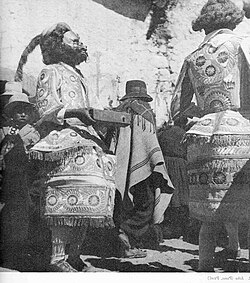
The Puno Highlands Influence
In Peru, historical records from 1602 by Ludovico Bertonio, an Italian Jesuit, document a black population in the Puno highlands, referred to as Ch'ara or yanaruna. By the early 20th century, newspapers such as El Eco de Puno and El Pueblo reported on "brunettes" (morenos) dancing in devotion to the Virgin of La Candelaria, highlighting the dance's deep integration into the Puno region's spiritual and social life.
Summary of Morenada Characteristics
| Category | Details |
|---|---|
| Primary Instruments | Matraca, cymbal, bass drum, trumpet, tuba |
| Key Symbols | Exaggerated masks, barrel-shaped costumes, matracas |
| Associated Festivals | Oruro Carnival (Bolivia), Feast of the Virgin of La Candelaria (Peru) |
| Core Themes | Colonialism, slavery, cultural resistance, and religious devotion |
Frequently Asked Questions
What is the meaning behind the Morenada masks?
The masks often feature exaggerated features and long tongues, which are widely believed to represent the physical suffering and exhaustion of enslaved African workers during the colonial era.
Which countries practice the Morenada?
While it originated in Bolivia, it is practiced extensively in Bolivia and Peru, and is also performed in Chile and Argentina, often by Bolivian immigrant communities.
What is a matraca and why is it used?
A matraca is a wooden rattling instrument. In the context of the Morenada, its sound is frequently associated with the rattling of the chains worn by enslaved people.
Is the Morenada recognized by UNESCO?
While the Morenada itself is a Bolivian Cultural Heritage, it is a key component of the Feast of the Virgin of La Candelaria in Peru, which is recognized as an Intangible Cultural Heritage of Humanity by UNESCO.
What are the different theories regarding its origin?
There are four main theories: it was inspired by slaves in the Potosí silver mines, it originated from African winemakers in Oruro, it was created by the Aymara people in La Paz (as evidenced by cave paintings), or it evolved from the African population in the Puno highlands of Peru.