Monarch Flycatchers: A Diverse Family of Insectivorous Songbirds
The Monarchidae, commonly known as monarchs or monarch flycatchers, are a vibrant family of over 100 species of passerine birds. These small to medium-sized insectivorous songbirds are recognized for their long tails and agile hunting styles. From the lush forests of sub-Saharan Africa to the remote islands of the Pacific, monarchs occupy a wide array of ecological niches, blending striking aesthetics with specialized survival strategies.
Key Facts
- Family Size: Over 100 species across 15 genera.
- Diet: Primarily insectivorous, often utilizing a flycatching technique.
- Distribution: Found across sub-Saharan Africa, South and Southeast Asia, Australasia, and various Pacific islands.
- Key Groups: Includes paradise flycatchers, shrikebills, and magpie-larks.
- Nesting: Typically build open, cup-shaped nests on branches, sometimes decorated with lichen.
Taxonomy and Evolutionary History
The classification of the Monarchidae has evolved significantly with the advent of molecular biology. Historically, some species were grouped based on morphology or behavior. For instance, the magpie-lark was once placed in the family Grallinidae because it builds mud nests, similar to the white-winged chough. However, DNA-DNA hybridization studies conducted toward the end of the 20th century revealed that these birds share a common crow-like ancestor with drongos.
Current taxonomic refinements place monarchs within a broader "Core corvine" group, which encompasses crows, ravens, shrikes, birds of paradise, fantails, and drongos. The family is divided into two primary subfamilies: Terpsiphoninae and Monarchinae.
Taxonomic Breakdown
The family consists of fifteen genera. Within the Terpsiphoninae subfamily, the genus Terpsiphone (typical paradise flycatchers) is the most diverse with 17 species, while Hypothymis contains four species and Trochocercus contains two.
Physical Characteristics
Monarchs are generally slim, arboreal birds with broad bills. While most are forest-dwellers, the magpie-lark is a notable exception as it is terrestrial. Bill shapes vary by function; for example, shrikebills possess heavy-set bills used to probe through dead wood and leaves for food.
Plumage varies from the monochrome black of the black monarch to the vivid hues of the golden monarch. The paradise flycatchers are particularly famous for their exceptionally long tails.
Sexual dimorphism—the physical difference between males and females—varies wildly across the family:
- Subtle: In the paperbark flycatcher, females differ only by a slight buff color on the throat.
- Striking: In the Chuuk monarch, males are almost entirely white while females are entirely black.
- Non-existent: The Tahiti monarch shows no significant difference between sexes.
- Polymorphic: In the Malagasy paradise flycatcher, males can exhibit two or more different color morphs.
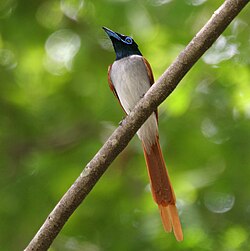
Distribution and Habitat
The Monarchidae have a predominantly Old World distribution. They are found throughout sub-Saharan Africa, Madagascar, and the tropical Indian Ocean islands, extending through South and Southeast Asia to Japan, New Guinea, and most of Australia. They have also colonized numerous Pacific islands, leading to the evolution of endemic genera in Micronesia, Melanesia, and Polynesia.
The genus Terpsiphone boasts the widest range, spanning from Africa and the Mascarenes to Korea and the Philippines. Other genera are more localized; for example, the Hawaiian Elepaio is restricted to Hawaii, and the buff-bellied monarch is found only in Vanuatu.
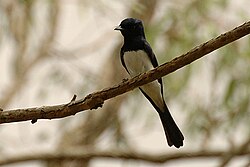
Most monarchs inhabit forests and woodlands. In dense forests, they typically occupy the middle and lower canopy levels, whereas those in open woodlands stay higher in the trees. Some species also utilize mangroves and savannahs. While most are resident birds, a few are migratory. The satin flycatcher is fully migratory, and the Japanese paradise flycatcher is almost entirely migratory.
Breeding and Social Behavior
Monarchs are generally monogamous. Pair bonds vary from a single breeding season, as seen in the African paradise flycatcher, to lifelong partnerships, as seen in the Elepaio. While most are territorial—defending areas of approximately 2 hectares—some species cluster their nests together.
Interestingly, some monarchs nest near aggressive species for protection; leaden flycatchers, for instance, may build nests near the noisy friarbird. All monarch species build open, cup-shaped nests on twigs or forks of branches.
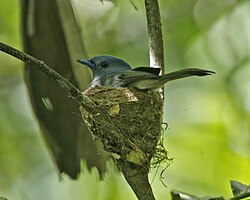
Summary of Monarchidae Characteristics
| Feature | Description |
|---|---|
| Diet | Insectivorous (Flycatching) |
| Primary Habitats | Forests, woodlands, mangroves, and savannahs |
| Geographic Range | Africa, Asia, Australasia, and Pacific Islands |
| Nest Type | Open cup on branches/forks |
| Key Genera | Terpsiphone, Hypothymis, Trochocercus, etc. |
Frequently Asked Questions
What is the difference between a monarch and a paradise flycatcher?
Paradise flycatchers are a specific group within the monarch family (genus Terpsiphone and Trochocercus). While all paradise flycatchers are monarchs, not all monarchs are paradise flycatchers; the family also includes shrikebills and magpie-larks.
Are all monarch flycatchers resident birds?
No. While the majority are resident, some are partially migratory. The satin flycatcher is fully migratory, and the Japanese paradise flycatcher is almost entirely migratory.
How do monarch birds build their nests?
Monarchs build open, cup-shaped nests typically situated on a branch, twig, or fork. Some species further decorate these nests using lichen.
Why was the magpie-lark previously classified in a different family?
The magpie-lark was originally placed in the family Grallinidae because it builds nests from mud, a behavior shared with the white-winged chough. Molecular evidence later proved it belongs in Monarchidae.
Do all monarch species look the same regardless of gender?
No, sexual dimorphism varies. In some species, like the Tahiti monarch, there is no difference. In others, like the Chuuk monarch, the difference is extreme, with males being white and females being black.