Molecular Assemblers: The Great Nanotechnology Debate Between Smalley and Drexler
The vision of nanotechnology—the ability to manipulate matter at the atomic level—has long been a subject of intense scientific scrutiny. At the heart of this field lies the concept of the molecular assembler, a hypothetical nanorobot capable of guiding individual atoms to build a desired product. While the potential for such technology is vast, it sparked a high-profile intellectual clash between two prominent figures: Nobel laureate Richard Smalley and nanotechnology pioneer K. Eric Drexler.
This debate centered on whether the laws of chemistry and physics allow for the creation of mechanical devices that can build other devices atom-by-atom, or if such a vision is a scientific impossibility.
The Case Against Nanobots: Smalley's Objections
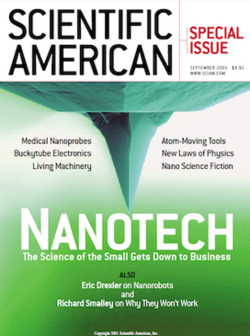
In a September 2001 issue of Scientific American, Richard Smalley challenged the feasibility of molecular assemblers. He compared chemical reactions to an intricate dance, arguing that the coupling of molecules is a subtle process involving motion in multiple dimensions. Smalley questioned the practicality of a single assembler, noting it would take millions of years to produce one mole of material unless the machines were self-replicating.
Smalley's primary critique focused on two fundamental physical barriers he believed would make mechanical nanobots impossible:
- The Fat Fingers Problem: Smalley argued that because the manipulator arms of a nanobot must be made of atoms, they have an irreducible size. He asserted there is simply not enough room in a nanometer-sized reaction region to fit all the "fingers" necessary to control the chemistry of multiple atoms simultaneously.
- The Sticky Fingers Problem: He claimed that atoms of the manipulator hands would adhere to the atom being moved, making it impossible to release the building block in the precise location required.
Smalley concluded that these problems were fundamental and unavoidable, dismissing the idea of self-replicating mechanical nanobots as a fantasy.
Drexler's Rebuttal and the Biological Precedent
K. Eric Drexler, along with colleagues Robert Freitas, J. Storrs Hall, and Ralph Merkle, responded by arguing that Smalley's objections were based on a "straw man" version of their proposals. They countered the "fat fingers" argument by noting that many chemical reactions involve only two reactants, meaning a single "finger" could suffice for positional control.
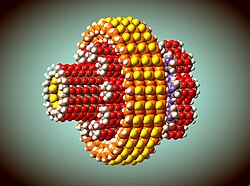
To prove that atomic-scale manipulation is possible, Drexler pointed to the ribosome—a natural biological molecular assembler. Since the ribosome synthesizes proteins without suffering from "fat" or "sticky" fingers, Drexler argued that these problems are not fundamental laws of physics, but rather engineering challenges.
Drexler also criticized Smalley's mathematical assumptions regarding replication speed. While Smalley used a frequency of 1 GHz for atomic placement, Drexler noted that Nanosystems proposed a much slower 1 MHz. He argued that at Smalley's higher frequency, diamondoid nanomachines would overheat and decompose within milliseconds.
The Final Exchange: Chemistry vs. Systems Engineering
The debate culminated in a 2003 "Point–Counterpoint" feature in Chemical & Engineering News. Smalley conceded that "Smalley fingers" (the specific mechanical arms he envisioned) would not work, but he maintained that any precise chemistry requires an enzyme-like tool and a liquid medium (typically water). He argued that because biology is limited to "meat and bone," a mechanical assembler could not create materials like silicon, steel, or titanium.
Drexler countered that his vision was based on positional control—a systems engineering approach rather than traditional solution-phase chemistry. He argued that by mechanically preventing unwanted encounters between reactants, one could achieve synthetic steps with the reliability of digital switching in a computer, without the need for enzymes or solvents.
The debate ended in a stalemate. Smalley remained convinced that the "mechanical world" of Drexler ignored the subtleties of real chemistry, while Drexler maintained that the physical principles of molecular manufacturing were sound and that the only real barrier was a lack of experimental effort.
Key Facts
- Molecular Assembler: A hypothetical device that can manipulate individual atoms to build macroscopic products.
- Fat Fingers Problem: The theory that manipulator arms are too large to fit in the reaction zone.
- Sticky Fingers Problem: The theory that atoms will adhere to the manipulator arm, preventing precise placement.
- Ribosome: Cited by Drexler as a biological example of a functioning molecular assembler.
- Positional Control: Drexler's proposed method of using mechanical precision to avoid side reactions.
- Grey Goo: A hypothetical scenario where self-replicating nanobots consume all matter on Earth.
| Feature | Richard Smalley's View | Eric Drexler's View |
|---|---|---|
| Feasibility | Impossible due to fundamental chemistry | Possible through systems engineering |
| Mechanism | Requires enzyme-like tools in liquid | Mechanical positional control |
| Biological Role | Biology is limited to organic materials | Ribosomes prove atomic assembly is possible |
| Primary Obstacles | Fat and Sticky Fingers | Lack of experimental research |
Frequently Asked Questions
What is the 'fat fingers' problem in nanotechnology?
The 'fat fingers' problem is the argument that the atoms making up a nanobot's manipulator arms are too bulky to allow multiple arms to access a tiny reaction site simultaneously, thereby preventing the precise control of a chemical reaction.
What is the 'sticky fingers' problem?
The 'sticky fingers' problem refers to the concern that an atom being moved by a nanobot would bond to the manipulator arm itself, making it impossible to release the atom at the intended destination.
How did Drexler use the ribosome to counter Smalley?
Drexler pointed out that the ribosome is a naturally occurring molecular machine that assembles proteins with extreme precision. He argued that since the ribosome does not suffer from 'fat' or 'sticky' fingers, these issues cannot be fundamental laws of nature.
What is the difference between solution-phase chemistry and positional control?
Solution-phase chemistry relies on molecules colliding randomly in a liquid medium. Positional control, proposed by Drexler, involves mechanically holding reactants in specific orientations to force a desired reaction and prevent unwanted side reactions.
What is the 'grey goo' scenario mentioned in the debate?
The 'grey goo' scenario is a hypothetical disaster where self-replicating nanobots mutate and consume all organic matter on Earth to build more copies of themselves, eventually leaving the planet as a mass of grey nanobots.