Missile Technology Control Regime: Preventing the Proliferation of WMD Delivery Systems
The Missile Technology Control Regime (MTCR) is a vital multilateral export control regime designed to curb the spread of missiles and missile technology. Established in 1987 by the G-7 industrialized nations, this informal political understanding aims to reduce the risk of weapons of mass destruction (WMD) proliferation by controlling the export of goods and technologies that could serve as delivery systems.
Unlike a formal treaty, the MTCR does not impose legally binding obligations on its partners. Instead, it functions as a cooperative framework where member states work together to monitor and restrict the transfer of sensitive technologies. The regime focuses specifically on rockets and unmanned aerial vehicles (UAVs)—commonly known as drones—that possess the capability to deliver a payload of at least 500 kilograms (1,100 lb) over a range of at least 300 kilometres (190 mi).
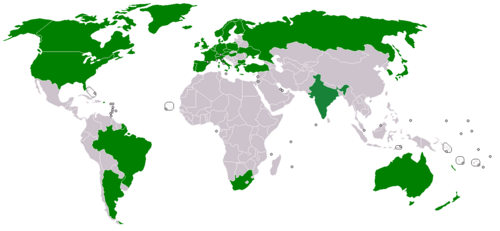
Key Facts
- Founded: 1987 by the G-7 countries.
- Membership: 35 member states.
- Core Objective: Limiting the proliferation of delivery systems for weapons of mass destruction.
- Primary Focus: Rockets and UAVs with a 500kg payload capacity and a 300km range.
- Legal Status: An informal political understanding, not a legally binding treaty.
Guidelines and Export Controls
The MTCR operates through two primary documents: the MTCR Guidelines and the Equipment, Software and Technology Annex. The Guidelines establish the overall structure and rules for member countries, while the Annex provides the technical specifics needed to implement export controls on various items.
The Annex categorizes controlled items into two distinct groups to help partners manage transfers effectively:
Category I Items
The regime applies the greatest level of restraint to Category I items. These include complete rocket systems—such as ballistic missiles, space launch vehicles, and sounding rockets—and advanced UAV systems like cruise missiles, target drones, and reconnaissance drones that exceed the 300km/500kg threshold. This category also covers major sub-systems, including rocket engines, guidance systems, re-entry vehicles, and production facilities.
Category II Items
Category II includes rocket systems and UAVs that do not meet the high-end specifications of Category I but still possess a range of at least 300km. This category also encompasses a wide range of dual-use equipment, materials, and technologies—items that have significant civilian applications but could also contribute to missile development. While partners still exercise restraint, they maintain greater flexibility when evaluating Category II transfer applications.
Historical Development and Impact
Since its inception in April 1987 by Canada, France, Germany, Italy, Japan, the United Kingdom, and the United States, the MTCR has evolved significantly. In 1992, the scope was expanded to specifically include the nonproliferation of unmanned aerial vehicles (UAVs).
The regime has been credited with slowing or stopping several ballistic missile programs. For instance, the joint Condor II program involving Argentina, Egypt, and Iraq was abandoned, and several former Warsaw Pact countries destroyed their ballistic missiles to facilitate their entry into the MTCR. To ensure collective strength, members established a "no undercut" policy in 1994, meaning if one member denies a sale, all other members must also deny it.
| Feature | Category I | Category II |
|---|---|---|
| Level of Restraint | Highest/Greatest | Moderate/Flexible |
| System Types | Complete ballistic missiles, space launch vehicles, advanced UAVs | Rocket systems and UAVs not covered in Category I |
| Technical Threshold | Exceeds 300km range / 500kg payload | Minimum 300km range |
| Components | Major sub-systems (engines, guidance, etc.) | Broad range of dual-use equipment and technology |
Challenges and Limitations
Despite its successes, the MTCR faces ongoing challenges. Some member countries have been known to violate rules clandestinely, and non-member states continue to participate in the global arms market. For example, North Korea is identified as a primary source of ballistic-missile proliferation, and China has historically supplied technology to Pakistan.
The regime also navigates the delicate balance between security and scientific progress. The MTCR guidelines explicitly state that the regime is not intended to impede national space programs or international cooperation, provided those programs do not contribute to WMD delivery systems. However, because satellite-launch vehicle (SLV) technology is virtually identical to ballistic missile technology, transfers in this area remain highly scrutinized.
Frequently Asked Questions
Is the MTCR a legally binding treaty?
No. The MTCR is an informal political understanding among member states rather than a formal treaty, meaning it does not impose legally binding obligations.
What is the specific threshold for MTCR controls?
The regime focuses on rockets and unmanned aerial vehicles capable of delivering a payload of at least 500 kilograms (1,100 lb) to a range of at least 300 kilometres (190 mi).
How does the "no undercut" policy work?
Established in 1994, this policy dictates that if one MTCR member denies a request to sell specific technology to a country, all other member states must also deny that sale.
Does the MTCR affect space exploration?
The guidelines are designed not to impede national space programs or international cooperation, as long as those programs cannot be used as delivery systems for weapons of mass destruction.
Why is China not a member of the MTCR?
While China has pledged to adhere to the guidelines and has participated in discussions, it has not been granted membership due to concerns regarding its export-control standards.