Miocene Epoch: The Era of Grasslands and Global Cooling
The Miocene Epoch, spanning from 23.04 to 5.333 million years ago (Ma), represents a pivotal chapter in Earth's Cenozoic Era. Situated within the Neogene Period, the Miocene was a time of profound transition, characterized by the shift from a warm, forested world to one defined by cooling temperatures, expanding prairies, and the rise of modern ecosystems.
From the gradual closure of ancient oceans to the dramatic fluctuations of atmospheric carbon dioxide, the Miocene set the stage for the biological and geological landscape we recognize today.
Key Facts
- Time Span: 23.04 to 5.333 million years ago.
- Period: Part of the Neogene within the Cenozoic Era.
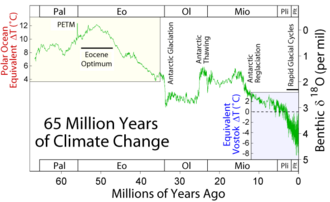
- Major Climate Event: The Middle Miocene Climate Optimum followed by a stepwise global cooling.
- Defining Flora: The widespread expansion of North American prairies and C4 grasslands.
- Geological Marker: The Messinian salinity crisis in the Mediterranean.
- Key Fauna: The emergence of giant sharks like Otodus megalodon and massive mammals like Daeodon.
Chronology and Subdivisions
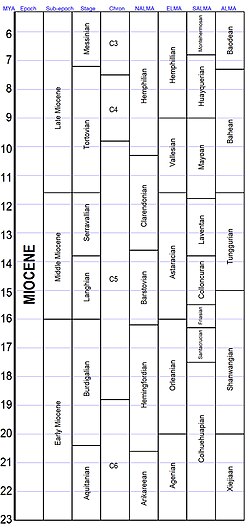
The Miocene is formally divided into three sub-epochs, further broken down into faunal stages. These divisions help geologists and paleontologists synchronize fossil records across different continents.
| Sub-epoch | Stage | Time Range (Ma) |
|---|---|---|
| Late Miocene | Messinian | 7.246–5.333 |
| Tortonian | 11.63–7.246 | |
| Middle Miocene | Serravallian | 13.82–11.63 |
| Langhian | 15.97–13.82 | |
| Early Miocene | Burdigalian | 20.44–15.97 |
| Aquitanian | 23.03–20.44 |
Defining the Boundaries
The lower boundary of the Miocene is defined by the first appearance datum (FAD) of the planktonic foraminiferan (tiny single-shelled marine organisms) Paragloborotalia kugleri at the Lemme-Carrosio Section in Italy. The upper boundary is marked by the base of the Thvera magnetic event.
Paleogeography and Environmental Shifts
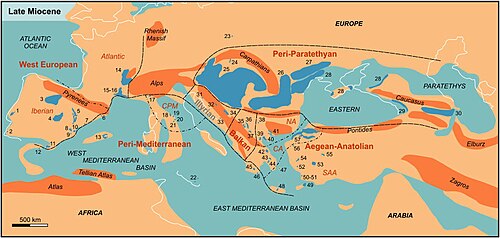
During the Miocene, the Earth's landmasses continued to drift into positions closer to their modern arrangements. In Asia, the phased uplift of the Himalaya-Tibetan plateau influenced the evolution of Asian monsoons. Meanwhile, the closure of the Tethys Ocean led to the evolution of the proto-Mediterranean Sea.

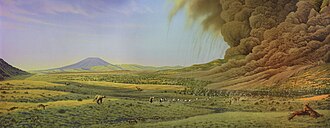
In North America, the landscape underwent a dramatic transformation as forests gave way to expanding prairies. Volcanic activity was also prominent, as seen in the Rattlesnake Formation of the Harney Basin in the western US.
The Mediterranean experienced one of the most extreme geological events of the epoch: the Messinian salinity crisis, where the sea became partially or completely isolated from the Atlantic, leading to massive evaporation and salt deposits.
Climate Dynamics
The Miocene climate was not a steady decline but a series of fluctuations. The Middle Miocene Climate Optimum was a period of significant warmth, potentially serving as a prehistoric analogue for future climate change due to high atmospheric CO2 levels.
Following this peak, the world entered a phase of stepwise cooling. This transition was linked to the intensification of the East Antarctic Ice Sheet and changes in deep ocean circulation. In Australia, this cooling led to the drying of the central regions, while in East Asia, it helped establish a modern-like monsoon system.
Life in the Miocene
Flora and the Rise of Grasslands
One of the most significant biological shifts was the expansion of C4 grasslands. These grasses are more efficient at photosynthesis in low-CO2 and arid conditions. This shift fundamentally altered the food chain, favoring grazing animals over browsers.
![The dragon blood tree is considered a remnant of the Mio-Pliocene Laurasian subtropical forests that are now almost extinct in North Africa.[103]](/images/cc/e4/cce4799dedd785e53a8681cdc1f1608ee9af22e7c88878f945da10a2ff986c4b.jpg)
Faunal Evolution
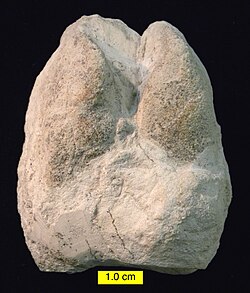
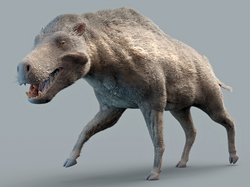
The Miocene saw a diversification of mammals across the globe. In North America, cameloids left distinct footprints in the Barstow Formation, while the massive Daeodon (an entelodont) roamed the land.
The oceans were equally dynamic. The epoch was dominated by the Otodus megalodon, a giant shark that preyed upon early baleen whales such as Eobalaenoptera.

Frequently Asked Questions
What was the Messinian salinity crisis?
It was a geological event during the Late Miocene where the Mediterranean Sea became disconnected from the Atlantic Ocean, causing the sea to evaporate and leave behind massive salt deposits.
How did the climate change during the Miocene?
The epoch began with a warming trend that peaked during the Middle Miocene Climate Optimum, followed by a gradual, stepwise cooling that led to the expansion of polar ice caps and drier continental interiors.
Why were C4 grasslands important?
C4 grasslands expanded as the climate cooled and CO2 levels dropped. This created vast new habitats and food sources, driving the evolution of specialized grazing mammals.
Which apex predator ruled the Miocene oceans?
The Otodus megalodon was the dominant apex predator of the Miocene oceans, known for its massive size and its predation on early whales.
What is a GSSP?
A Global Boundary Stratotype Section and Point (GSSP) is an internationally agreed-upon reference point in a stratigraphic section that defines the lower boundary of a stage or epoch.