Minister of Foreign Affairs of Spain
The Minister of Foreign Affairs serves as the head of the Ministry of Foreign Affairs, European Union and Cooperation. As a key member of the Council of Ministers, this official is tasked with the design and implementation of Spain's foreign policy and development cooperation. Beyond administrative duties, the minister acts as one of the nation's highest international representatives, following only the Monarch and the Prime Minister.
In this capacity, the minister possesses full powers to negotiate, adopt, and authenticate international treaties, ensuring that Spain's consent to be bound by such agreements is formally expressed. The minister also oversees the appointment of representatives for the execution of international acts.
Key Facts
- Incumbent: José Manuel Albares (since July 12, 2021).
- Established: July 11, 1705.
- Official Residence: Palace of Viana, Madrid.
- Appointment: Appointed by the Monarch on the advice of the Prime Minister.
- Protocol Rank: Ranks ahead of other ministers, immediately following the Prime Minister or Deputy Prime Ministers.
- First Holder: Pedro Fernández del Campo, Marquess of Mejorada del Campo.
Historical Evolution
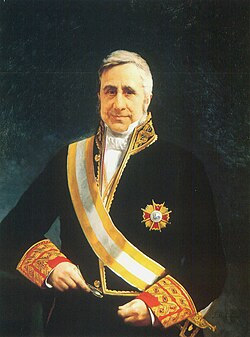
The office was established in 1705 when the Secretary of the Universal Office was split into two roles: one for War and Finance, and another for general affairs, known as the Secretary of State. By 1714, the role was further refined to create an independent department for justice and religious affairs.
Historically, the Secretary of State functioned similarly to a prime minister, often referred to as the "First Secretary of State." During the early 19th century, the department's influence was vast, overseeing not only international relations but also internal matters such as healthcare, education, the post office, and the arts.
Over time, these internal responsibilities were transferred to other portfolios, such as the Ministry of the Interior. While the link between the Presidency of the Council of Ministers and the Ministry of State remained strong for a period, the practice of the foreign minister also serving as the head of government was largely abandoned by the second half of the 19th century.
Governance and the Prime Minister
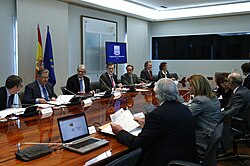
The relationship between the foreign minister and the Prime Minister has evolved toward greater centralization of power. In 2000, the Foreign Policy Council (CPE) was created as an advisory body to support the Prime Minister in foreign policy decision-making.
The CPE is chaired by the Prime Minister and includes Deputy Prime Ministers, Government ministers, and the Moncloa Chief of Staff. To implement the guidelines set by the CPE, the Foreign Policy Executive Council operates under the chairmanship of the Minister of Foreign Affairs, incorporating various secretaries of state and department representatives.
The Palace of Viana
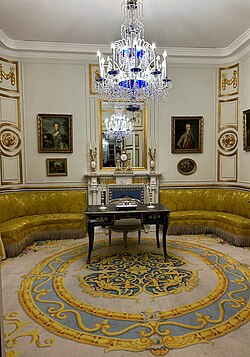
The official residence of the minister is the Palace of Viana, located on Duke of Rivas Street in Madrid. Originally commissioned by Beatriz Galindo, a lady-in-waiting to Queen Isabella the Catholic, the palace was later renovated in the 1840s by Ángel de Saavedra, the 3rd Duke of Rivas.
The Spanish government leased the property in 1939 from the 3rd Marquess of Viana and eventually acquired it outright in 1955.
Civil Orders and Honors
The Ministry of Foreign Affairs manages two of Spain's most prestigious civil decorations. The minister serves as the Grand Chancellor for both, while the under-secretary acts as the Chancellor.
Order of Isabella the Catholic
Established in 1815, this is Spain's primary diplomatic order. It rewards extraordinary civil acts that benefit the nation or foster international cooperation. Notably, the Collar of the Order is typically awarded to outgoing prime ministers.
Order of Civil Merit
Created in 1926, this order recognizes exemplary service to the State by public administration personnel or private individuals, including foreign nationals who have provided distinguished services to Spain.
Parliamentary Oversight
The Minister of Foreign Affairs is subject to strict parliamentary control. Under the Spanish Constitution, the minister must attend questioning sessions and committees. Additionally, the minister is required to appear annually before the Cortes Generales to evaluate the Foreign Action Strategy and must notify the Congress of Deputies Foreign Affairs Committee regarding all ambassadorial appointments.
| Feature | Details |
|---|---|
| Formal Style | The Most Excellent |
| Key Responsibilities | Foreign policy, international treaties, development cooperation |
| Governing Bodies | Council of Ministers, National Security Council, Foreign Policy Council |
| Managed Orders | Order of Isabella the Catholic, Order of Civil Merit |
| Legal Framework | Law 2/2014 (LASEE) and the Spanish Constitution |
Frequently Asked Questions
Who appoints the Minister of Foreign Affairs?
The minister is appointed by the Monarch, acting on the advice and nomination of the Prime Minister.
What is the role of the Foreign Policy Council (CPE)?
The CPE is an advisory body chaired by the Prime Minister that consolidates executive authority over foreign policy decisions, supporting the Prime Minister in strategic planning.
What is the significance of the Palace of Viana?
The Palace of Viana serves as the official residence of the Minister of Foreign Affairs in Madrid and is a historic site acquired by the government in 1955.
How does the minister interact with the Spanish Parliament?
The minister is subject to parliamentary oversight, which includes attending committee sessions and providing an annual assessment of the Foreign Action Strategy to the Cortes Generales.
Which civil orders are overseen by the Ministry?
The Ministry oversees the Order of Isabella the Catholic, primarily used for diplomacy, and the Order of Civil Merit, which rewards exemplary service to the State.