Mikheil Saakashvili: The Political Journey of Georgia's Third President
Mikheil Saakashvili is a prominent jurist and politician who served as the 3rd President of Georgia, leading the nation through a period of intense reform and geopolitical volatility. Known for his energetic leadership and polarizing legacy, Saakashvili's career spans multiple high-level roles in both Georgia and Ukraine, marked by ambitious state-building efforts and significant legal controversies.
His rise to power was characterized by a drive to modernize Georgia's infrastructure and governance, though his tenure was often shadowed by accusations of authoritarianism and clashes with political opponents.
Key Facts
- Presidency: Served as President of Georgia from 2004 to 2013.
- Political Party: Founder and former Chairman of the United National Movement.
- International Roles: Served as the 10th Governor of Odesa Oblast in Ukraine (2015–2016).
- Education: Studied at the National University of Kyiv, Columbia University, and George Washington University.
- Citizenship: Has held Soviet, Georgian, and Ukrainian citizenship.
Early Career and Rise to Power
Before ascending to the presidency, Saakashvili established himself within the Georgian legal and legislative systems. He served as a Member of the Parliament of Georgia starting in 1995 and held the position of Minister of Justice from October 2000 to September 2001 under President Eduard Shevardnadze.
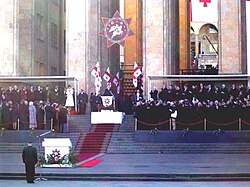
In 2001, he founded the United National Movement, a political party that became the vehicle for his reformist agenda. His political trajectory accelerated rapidly, leading to his first presidential victory in 2004 with a commanding 96.24% of the vote in the first round.
The First Presidency: Reform and Conflict
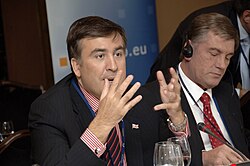
Saakashvili's first term was defined by aggressive state modernization. He implemented sweeping reforms across several sectors to reduce corruption and increase efficiency:
- Economic and Government Reforms: Streamlining bureaucracy and promoting a pro-business environment.
- Law and Order: Overhauling the police force and judicial systems.
- Military and Education: Modernizing the armed forces and updating the national curriculum.
- Healthcare: Implementing systemic changes to the national health infrastructure.
Despite these advancements, his administration faced criticism. By 2006 and 2007, opposition grew, leading to protests and a crisis in 2007 that tested the stability of his government.

Foreign Relations and the Russo-Georgian War
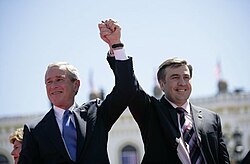
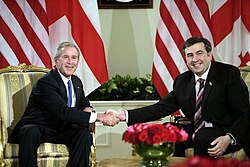
Saakashvili maintained strong ties with Western powers, particularly the United States, seeking closer integration with NATO and the European Union. However, relations with Russia deteriorated sharply, culminating in the Russo-Georgian War of 2008.
Second Presidency and Transition
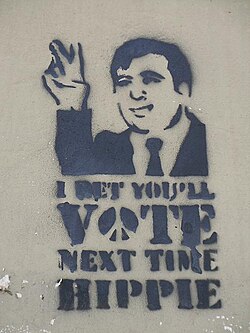
Saakashvili was re-elected in 2008 with 54.73% of the vote. His second term was marked by the aftermath of the 2008 war and increasing domestic unrest. Demonstrations against his leadership spread across Georgia in 2009, 2011, and 2012.
His presidency ended in November 2013, after which he faced a series of legal prosecutions in Georgia, including charges related to abuse of power. He eventually left the country, leading to a period of exile and political activity abroad.
Political Activity in Ukraine
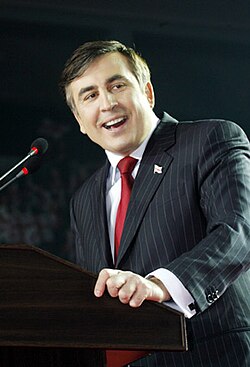
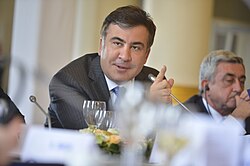
In 2015, Saakashvili transitioned his political focus to Ukraine. He was appointed as the 10th Governor of Odesa Oblast, serving from May 2015 to November 2016. During this time, he founded the Movement of New Forces.
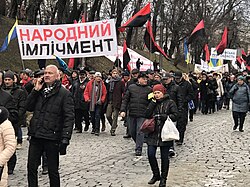
His time in Ukraine was tumultuous. He was stripped of his Ukrainian citizenship in 2017 by President Petro Poroshenko, leaving him stateless for a period. After a defiant return to Ukraine in 2017 and subsequent detention, his citizenship was restored in 2019 by President Volodymyr Zelenskyy.
Later Years and Legal Battles
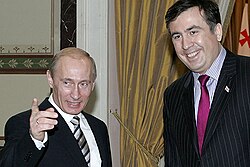
Saakashvili's later years have been dominated by legal disputes in both Georgia and Ukraine. Upon returning to Georgia in 2021, he was arrested and charged with illegal border crossing. This led to a high-profile incarceration marked by a 50-day hunger strike and allegations of poisoning while in prison.
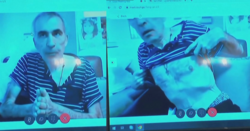
International bodies and foreign governments have expressed concern over his treatment, while Georgian courts have continued to hand down prison sentences, including a recent term added in March 2025.
Summary of Political Offices
| Role | Entity | Period |
|---|---|---|
| Minister of Justice | Georgia | 2000–2001 |
| President | Georgia | 2004–2013 |
| Governor of Odesa Oblast | Ukraine | 2015–2016 |
| Chairman, National Reform Council | Ukraine | 2020–2021 |
Frequently Asked Questions
When did Mikheil Saakashvili serve as President of Georgia?
He served as the 3rd President of Georgia from January 20, 2004, until November 17, 2013.
What was the United National Movement?
The United National Movement is the political party founded by Saakashvili in 2001, which served as the primary political vehicle for his reforms and presidential campaigns.
Why was Saakashvili involved in Ukrainian politics?
Saakashvili sought to apply his reformist experience to Ukraine, serving as the Governor of Odesa and later as Chairman of the Executive Committee of the National Reform Council.
What happened to his citizenship in Ukraine?
His Ukrainian citizenship was stripped in 2017 under a decree by President Petro Poroshenko but was later restored in May 2019 by President Volodymyr Zelenskyy.
What are the current legal issues facing Saakashvili in Georgia?
He has faced multiple charges, including abuse of power and illegal border crossing, resulting in several prison sentences, the most recent of which was extended in March 2025.