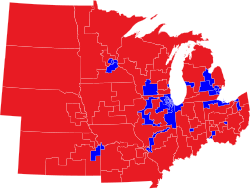
Midwest regionAmerican HeartlandGreat LakesGreat PlainsMidwestern history

Midwestern United States: History, Geography, and Culture of the American Heartland

Exploring the American Midwest: A Journey Through the Heartland Often referred to as the Heartland, the Midwestern United States is a vast and diverse region that serves as a vital engine...

Exploring the American Midwest: A Journey Through the Heartland

Often referred to as the Heartland, the Midwestern United States is a vast and diverse region that serves as a vital engine for the American economy, culture, and history. Spanning from the Great Lakes to the Great Plains, this region is characterized by its expansive agricultural landscapes, industrial heritage, and major metropolitan hubs that connect the nation.

Whether you are exploring the prehistoric earthworks of ancient civilizations, the bustling streets of Chicago, or the sweeping prairies of the Great Plains, the Midwest offers a profound look into the evolution of the United States. This article explores the geography, history, and cultural significance of this essential American region.
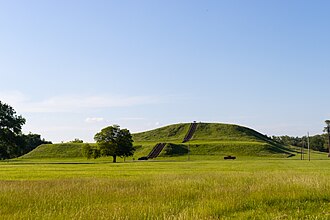
Monks Mound, located at the Cahokia Mounds near Collinsville, Illinois, is the largest Precolumbian earthwork north of Mesoamerica and a World Heritage Site.
: Monks Mound, located at the Cahokia Mounds near Collinsville, Illinois, is the largest Precolumbian earthwork north of Mesoamerica and a World Heritage Site.

Key Facts

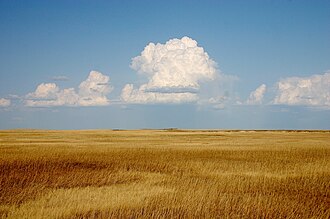
Cumulus clouds hover above a yellowish prairie at Badlands National Park, South Dakota, native lands to the Sioux.
  • Total Area: Approximately 750,522 square miles.
  • Population: Over 68.9 million people (as of 2020).
  • Economic Power: A projected GDP of $5.796 trillion for 2025.
  • Core States: Includes 12 states defined by the U.S. Census Bureau, such as Illinois, Ohio, and Kansas.
  • Major Hubs: Home to massive metropolitan areas including Chicago, Detroit, and Minneapolis–St. Paul.

Geography and Regional Divisions
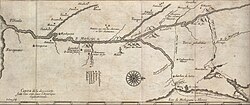
Map by Marquette and Jolliet drawn on their 1673 expedition, published circa 1681

The Midwest is not a monolith; it is a collection of distinct subregions that vary significantly in climate, terrain, and economic focus. The U.S. Census Bureau divides the region into two primary divisions:

East North Central

This division is largely defined by its proximity to the Great Lakes. States like Illinois, Indiana, Michigan, Ohio, and Wisconsin form the industrial and urban core of the region. The landscape is characterized by significant water bodies and highly developed metropolitan areas.
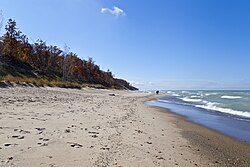
Lake Michigan is shared by Illinois, Indiana, Michigan, and Wisconsin. Pictured is Indiana Dunes National Park in northwest Indiana.
: Lake Michigan is shared by Illinois, Indiana, Michigan, and Wisconsin. Pictured is Indiana Dunes National Park in northwest Indiana.

West North Central

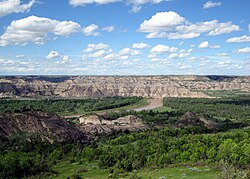
Moving westward, the landscape shifts toward the Great Plains. States such as Iowa, Kansas, Nebraska, North Dakota, and South Dakota feature vast prairies and fertile soil, making them central to American agriculture. This area is defined by its rolling hills, grasslands, and river systems like the Missouri and Mississippi.
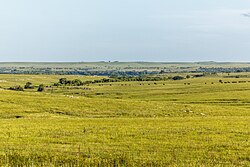
Flint Hills grasslands of Kansas
: Flint Hills grasslands of Kansas
Badlands of Theodore Roosevelt National Park, North Dakota
: Badlands of Theodore Roosevelt National Park, North Dakota

A Rich and Complex History

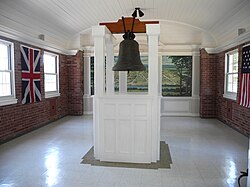
The bell donated by King Louis XV in 1741 to the French mission at Kaskaskia, Illinois. It was later called the "Liberty Bell of the West", after it was rung to celebrate U.S. victory in the Revolution

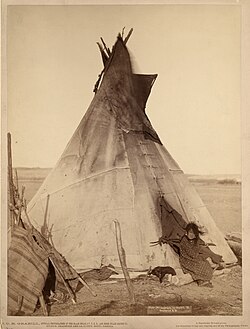
The history of the Midwest is a layered narrative that begins long before European arrival. The region was home to sophisticated indigenous cultures, including the Sioux and various Great Lakes Native American tribes.
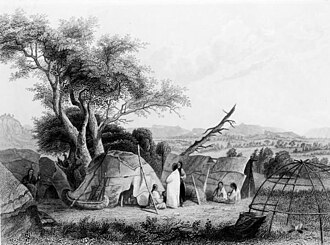
Winnebago family (1852) - Ho-Chunks are often referred to in historical sources by the derogatory exonym, Winnebago
: Winnebago family (1852) - Ho-Chunks are often referred to in historical sources by the derogatory exonym, Winnebago
Young Oglala Lakota girl in front of tipi with puppy beside her, probably on or near Pine Ridge Indian Reservation, South Dakota
: Young Oglala Lakota girl in front of tipi with puppy beside her, probably on or near Pine Ridge Indian Reservation, South Dakota

During the era of European exploration, the region became a "middle ground" where French and British interests intersected with Native American territories. The fur trade became a dominant economic force, driven by the demand for beaver pelts.
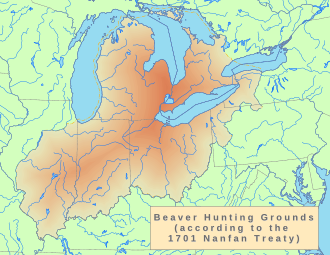
Beaver hunting grounds, the basis of the fur trade
: Beaver hunting grounds, the basis of the fur trade

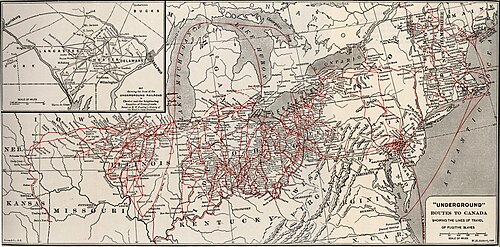
As American settlement expanded through the 18th and 19th centuries, the Midwest became a focal point for national tensions. The region played a critical role in the lead-up to the American Civil War, particularly through the "Bleeding Kansas" era and the activities of the Underground Railroad, a network of secret routes used by enslaved people to escape to freedom.
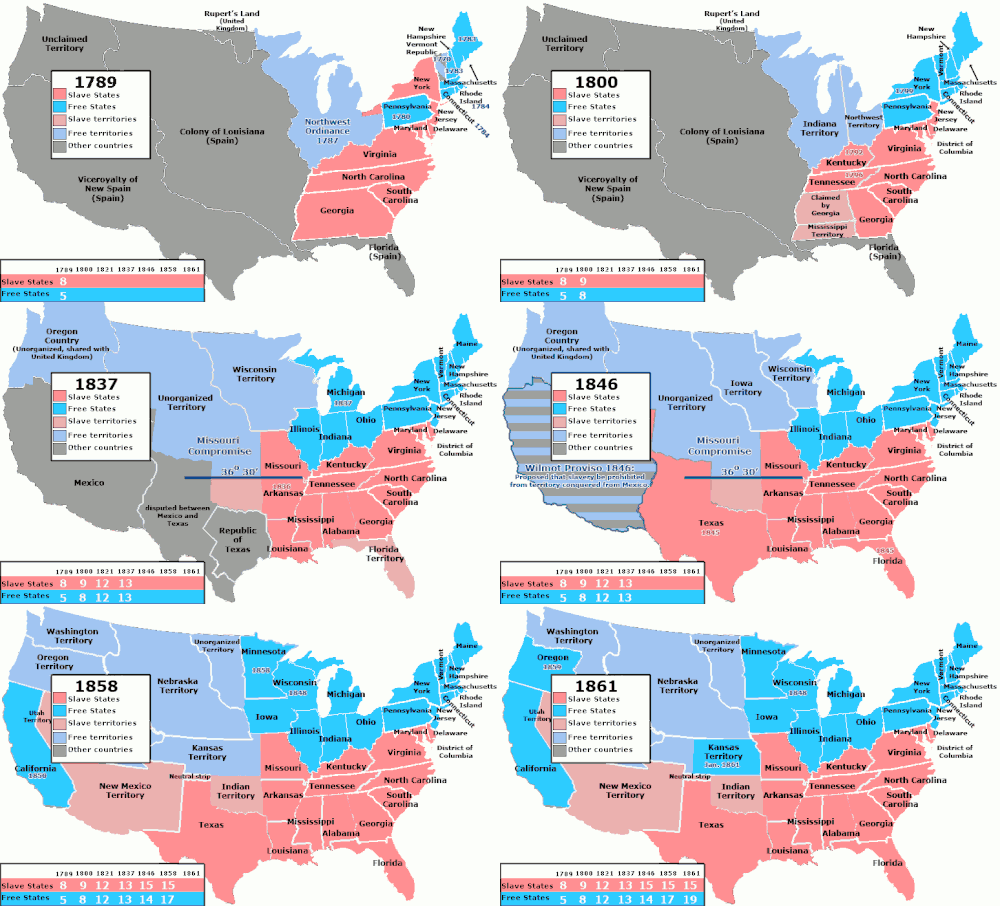
An animation depicting when United States territories and states forbade or allowed slavery, 1789–1861
: An animation depicting when United States territories and states forbade or allowed slavery, 1789–1861
A map of various Underground Railroad routes
: A map of various Underground Railroad routes

Economic Engines: Agriculture and Industry
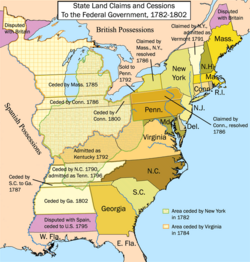
The state cessions that eventually allowed for the creation of the territories northwest and south of the Ohio River

The Midwest's economy has historically been built on two pillars: the farm and the factory. The Corn Belt, a region of highly productive agricultural land, remains a cornerstone of global food production.
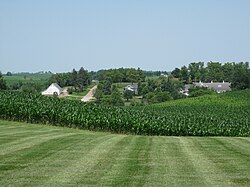
Central Iowa cornfield, part of the Corn Belt
: Central Iowa cornfield, part of the Corn Belt
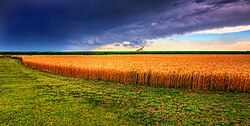
Wheat production in Kansas
: Wheat production in Kansas

Simultaneously, the region became an industrial powerhouse. From the steel mills of Indiana to the automotive plants of Detroit and the oil refineries of the early industrial era, Midwestern manufacturing helped build the modern American economy.

The Gary Works of Gary, Indiana (seen here in 1973) is the largest integrated steel mill in North America.[186]
: The Gary Works of Gary, Indiana (seen here in 1973) is the largest integrated steel mill in North America.
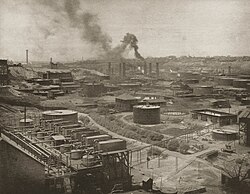
The first Standard Oil refinery was opened in Cleveland by businessman John D. Rockefeller.
: The first Standard Oil refinery was opened in Cleveland by businessman John D. Rockefeller.

Cultural and Urban Landmarks

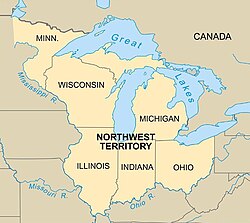
Northwest Territory 1787, with later state divisions

The Midwest is home to some of the most iconic cities and cultural institutions in the United States. From the world-class museums of Cleveland to the musical legacy of Detroit, the region's cultural footprint is immense.

Major cities like Chicago serve as global centers for finance, transportation, and culture. The Chicago Board of Trade, for example, remains one of the world's oldest futures and options exchanges.

The Chicago Board of Trade floor in 1993. It is one of the world's oldest futures and options exchanges.[182]
: The Chicago Board of Trade floor in 1993. It is one of the world's oldest futures and options exchanges.

Music has also been a profound contribution of the Midwest. Detroit's Motown Sound played a pivotal role in the racial integration of popular music, while the "Minneapolis Sound" and the blues of the Great Lakes region have shaped global genres.
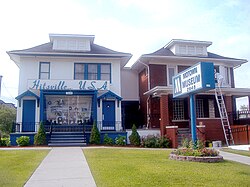
The Hitsville U.S.A. building in Detroit was the first headquarters and studio of Motown, which played an important role in the racial integration of popular music.
: The Hitsville U.S.A. building in Detroit was the first headquarters and studio of Motown, which played an important role in the racial integration of popular music.

Regional Statistics Summary

Midwest Demographic and Economic Overview
Category Data Point
Total Population (2020) 68,985,454
Total Area 750,522 sq mi
Projected GDP (2025) $5.796 trillion
Per Capita GDP (2025) $84,020
White (Non-Hispanic) Share 73.0%
Black (Non-Hispanic) Share 9.9%
Hispanic or Latino Share 8.6%

Frequently Asked Questions

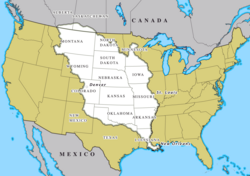
Louisiana Purchase 1803
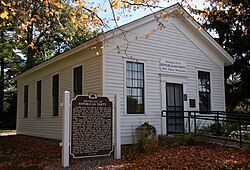
The first local meeting of the new Republican Party took place at the Little White Schoolhouse in Ripon, Wisconsin on March 20, 1854.
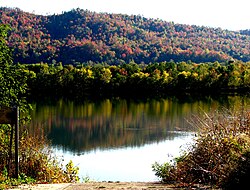
Ohio River near Rome, Ohio
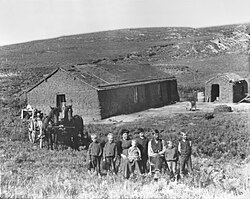
Homesteaders in central Nebraska in 1888
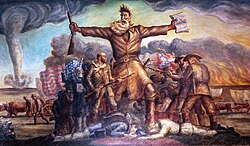
Tragic Prelude, in the Kansas State Capitol
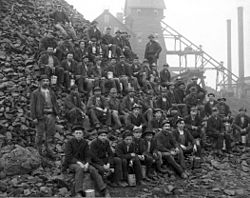
Miners at the Tamarack mine in Michigan's Copper Country, 1905
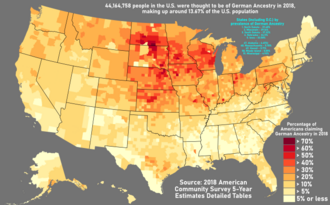
Distribution of Americans claiming German Ancestry by county in 2018
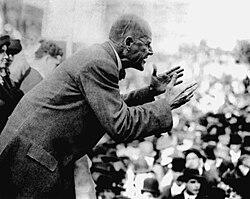
Eugene V. Debs speaking in Canton, Ohio, in 1918, being arrested for sedition shortly thereafter
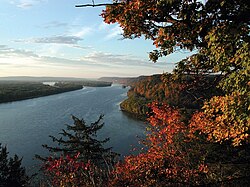
The Upper Mississippi River viewed from Effigy Mounds National Monument, Iowa
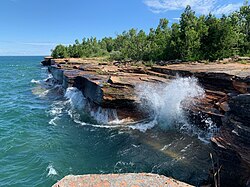
Apostle Islands National Lakeshore, Wisconsin
Divisions of the Midwest by the U.S. Census Bureau into East North Central and West North Central, separated largely by the Mississippi River[1]
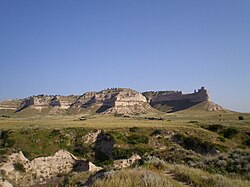
Scotts Bluff National Monument in western Nebraska
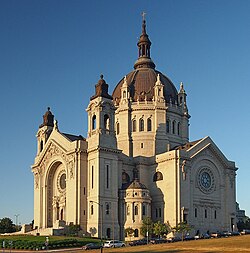
Cathedral of Saint Paul, Minnesota
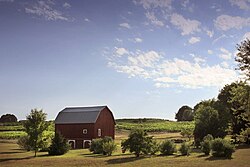
A pastoral farm scene near Traverse City, Michigan, with a classic American red barn
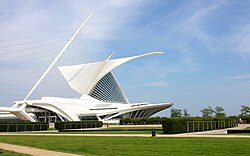
The Milwaukee Art Museum is located on Lake Michigan.
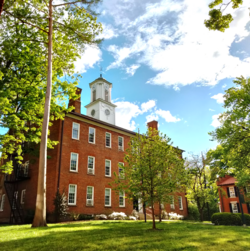
Manasseh Cutler Hall, constructed by 1816, was the first academic building in the former Northwest Territory.
The University of Chicago is considered among the most prestigious universities in the US.[194]
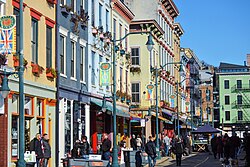
Over-the-Rhine in Cincinnati
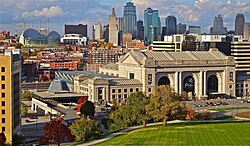
Downtown Kansas City looking over Union Station
The 2007 Indianapolis 500 at Indianapolis Motor Speedway
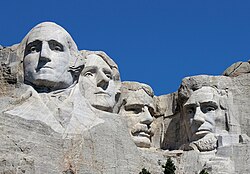
Mount Rushmore is located in the Black Hills of South Dakota.
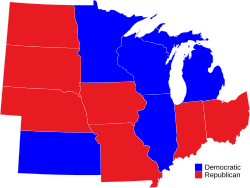
Midwestern governors by party as of 2024
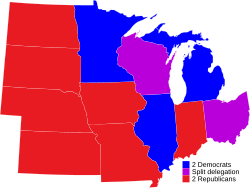
Midwestern U.S. senators by party for the 118th Congress
Midwestern U.S. representatives by party for the 118th Congress

What are the main subregions of the Midwest?

The Midwest is primarily divided into the East North Central (including states like Ohio and Michigan) and the West North Central (including states like Kansas and Nebraska) divisions.

Which cities are the largest in the Midwest?

The largest cities by population include Chicago, Columbus, Indianapolis, Detroit, Milwaukee, Kansas City, Omaha, Minneapolis, Wichita, Cleveland, Cincinnati, St. Paul, and St. Louis.

What is the economic significance of the Midwest?

The Midwest is a major economic driver with a projected GDP of $5.796 trillion for 2025. It is characterized by strong sectors in agriculture (the Corn Belt), manufacturing (steel and automotive), and finance.

How is the Midwest defined by the U.S. Census?

The U.S. Census Bureau defines the Midwest as a region consisting of 12 specific states: Indiana, Iowa, Kansas, Michigan, Minnesota, Missouri, Nebraska, North Dakota, Ohio, South Dakota, Wisconsin, and Illinois.

References

  1. "Census Regions and Divisions of the United States" (PDF). U.S. Census Bureau. Retrieved October 24, 2016.
  2. "Gross Domestic Product (GDP) by State".
  3. Hannum, Elise; Team, the Midstory; Team, Elise Hannum and the Midstory (June 7, 2022). "What is the Midwest?". Midstory. Retrieved February 19, 2026.
  4. "History: Regions and Divisions". United States Census Bureau. Retrieved November 26, 2014.
  5. "Change in Resident Population of the 50 States, the District of Columbia, and Puerto Rico: 1910 to 2020" (PDF). Census.gov. United States Census Bureau. Archived (PDF) from the original on April 26, 2021. Retrieved April 27, 2021.