Midfield Positions in Association Football: Roles and Tactical Evolution
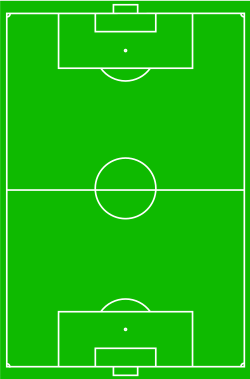
In association football, the midfield serves as the engine room of the team. Positioned primarily in the middle of the pitch, midfielders act as the vital link between the defensive units and the forward units. Depending on the team's formation and tactical goals, a midfielder's role can vary from purely defensive duties to creative attacking assignments.
The size and composition of the midfield unit are determined by the formation used. While some players occupy a fixed area, others are highly mobile, crossing boundaries to support both ends of the field. This versatility makes the midfield one of the most complex and dynamic areas of the game.
Key Facts
- Midfielders occupy the central area of the pitch, bridging the gap between defenders and forwards.
- Central Midfielders can be defensive, attacking, or "box-to-box" depending on their mobility and assignments.
- Wingers have evolved from purely attacking "outside forwards" to integrated midfield roles with defensive responsibilities.
- Formations like 4-3-3, 4-4-2, and 4-2-3-1 dictate how many midfielders are deployed and their specific roles.
- Specialized roles include the deep-lying playmaker (regista) and the inverted winger.
Central Midfield Roles
Central midfielders are the heart of the formation. When the opposing team has possession, these players may drop back to protect the goal or press the ball-carrier to regain possession. A defending central midfielder often positions themselves in front of the centre-backs to block long-range shots and track opposing runs.
The Box-to-Box Midfielder
A box-to-box midfielder is characterized by immense stamina and versatility, contributing effectively to both offensive and defensive phases of the game. They are expected to transition rapidly from their own penalty area to the opponent's.
![A box-to-box midfielder, Steven Gerrard has been lauded for his effectiveness both offensively and defensively at Liverpool.[5][6]](/images/b3/4b/b34bc564c5a30ef6965bea6553e6106207ba77ce4cf8536514c70145d0c378df.jpg)

Defensive and Holding Midfielders
Defensive midfielders focus on breaking up opposition attacks. A holding midfielder specifically maintains a disciplined position to provide a shield for the defense and a reliable outlet for passing.
The Deep-Lying Playmaker
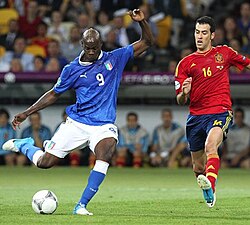
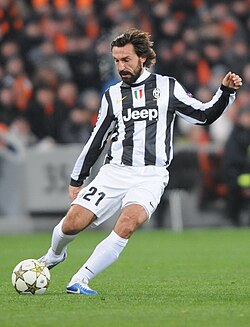
A deep-lying playmaker operates from a deeper position in the midfield, using their vision and passing range to dictate the tempo of the game and initiate attacks from the back.
Attacking Midfield and Creative Roles
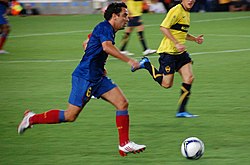
Attacking midfielders operate closer to the opposition's goal with limited defensive assignments. Their primary goal is to create scoring opportunities for the forwards.
Advanced Playmakers and the "False 10"
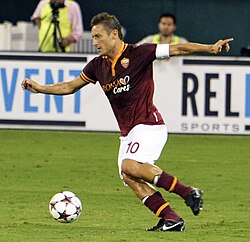
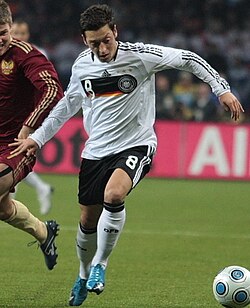
An advanced playmaker focuses on the final third of the pitch. In modern tactics, some players act as a "False 10" or central winger, drifting between lines to confuse defenders and create space.
Wide Midfield and Wingers
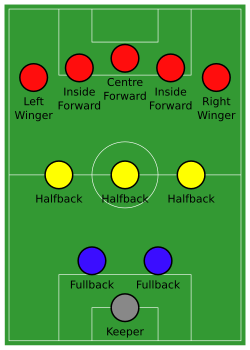
The role of the wide player has undergone significant evolution. In the late 19th century, wingers stayed near the touchlines to cross the ball for centre forwards. Traditionally, they were purely attacking players known as "Outside Right" or "Outside Left." This changed during the 1966 World Cup when England manager Alf Ramsey utilized "Wingless Wonders," paving the way for the modern 4-4-2 formation.
Modern Wingers and Wide Midfielders
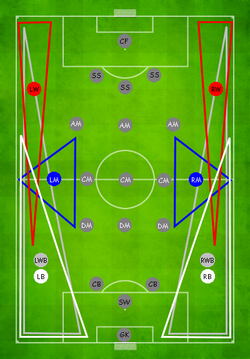
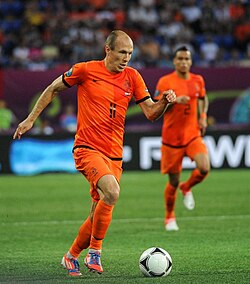
Today, a winger is typically an attacking midfielder stationed wide. A wide midfielder, however, is a "shuttler" who balances crossing ability with a defensive shift. This role is common in 4-4-2, 4-4-1-1, 4-2-3-1, and 4-5-1 formations.
![A wide midfielder, David Beckham was lauded for his range of passing, vision, crossing ability and bending free-kicks.[63]](/images/30/2d/302d7421c0ac249fdfdad21751bb5dd093dbf3c87eee5d1789401a8c80ce71b0.jpg)
Inverted Wingers
An inverted winger is a player deployed on the opposite flank of their natural foot (e.g., a left-footed player on the right wing), allowing them to cut inside and shoot or play through-balls.
Midfield Role Summary
| Role | Primary Focus | Key Attribute | Typical Formation |
|---|---|---|---|
| Defensive Midfielder | Breaking up attacks | Tackling/Positioning | 4-2-3-1, 4-3-3 |
| Box-to-Box | Two-way support | Stamina/Versatility | 4-4-2, 4-3-3 |
| Deep-Lying Playmaker | Game distribution | Vision/Passing | 4-3-3, 4-1-4-1 |
| Attacking Midfielder | Chance creation | Creativity/Technique | 4-2-3-1, 4-4-2 |
| Winger/Wide Midfielder | Flank play/Crossing | Pace/Crossing | 4-4-2, 4-5-1 |
Frequently Asked Questions
What is the difference between a holding midfielder and a defensive midfielder?
While both are defensive, a defensive midfielder focuses on breaking up the opponent's play, whereas a holding midfielder specifically maintains a position to shield the defense and provide a stable passing option.
What does "box-to-box" actually mean?
It refers to a midfielder's ability to contribute to the game in both their own penalty box (defending) and the opponent's penalty box (attacking) throughout the match.
How does an inverted winger differ from a traditional winger?
A traditional winger stays wide to cross the ball with the foot closest to the touchline. An inverted winger plays on the opposite side of their dominant foot to cut inside toward the goal.
What is a "False 10"?
A False 10 is a creative player who does not stay in a fixed attacking midfield position but instead drops deeper or moves wide to create space and confuse the opposition's marking system.
Which formations typically use three central midfielders?
The 4-3-3 and 4-5-1 formations are common examples that utilize three central midfielders to control the middle of the pitch.