Midea Group: A Global Leader in Home Appliances and Robotics
From its humble beginnings as a small workshop producing bottle lids, Midea Group has evolved into a global powerhouse in the electrical appliance industry. Headquartered in Beijiao, Shunde District, Foshan, Guangdong, the company has expanded its reach far beyond China, becoming a staple in households worldwide through both its own brand and its extensive work as an original equipment manufacturer (OEM).
Today, Midea is recognized not only for its consumer electronics but also for its significant ventures into industrial robotics and semiconductor technology, marking its transition from a traditional appliance maker to a diversified technology conglomerate.
Key Facts
- Founded: 1968 by He Xiangjian.
- Global Standing: Listed on the Fortune Global 500 since July 2016.
- Financial Scale: Reported revenue of CN¥ 343.4 billion in 2021.
- Workforce: Approximately 150,000 employees as of 2021.
- Market Presence: Listed on the Shenzhen Stock Exchange (SZSE: 000333).
- Core Specialization: World's largest microwave oven manufacturer and a leader in HVAC systems.
The Evolution of Midea: From Bottle Lids to Robotics
The company's journey began in 1968 when founder He Xiangjian started a business manufacturing bottle lids. By 1980, the company shifted its focus toward finished goods, specifically electric fans. This strategic pivot set the stage for the 1985 launch of its first air conditioner, which remains a cornerstone of the business today.
Throughout the following decades, Midea diversified its portfolio to include refrigerators, washing machines, and microwave ovens. The company began its international expansion in 2007 by opening production facilities in Vietnam, followed by a joint venture with Belarus's Horizont in 2008 to enter the CIS markets.
A pivotal era of growth occurred between 2010 and 2016. Midea formed several joint ventures with the American manufacturer Carrier Corporation across Egypt, Brazil, Argentina, Chile, and India. In 2016, the company made three transformative acquisitions: Toshiba's home appliances business, the German robotics giant KUKA, and the floorcare brand Eureka from Electrolux AB.
Product Portfolio and Market Strategy
Midea operates a dual-track business model. While it sells products under its own name domestically and in various foreign markets, a significant portion of its export business is conducted as an OEM (Original Equipment Manufacturer) and ODM (Original Design Manufacturer). This means Midea designs and builds products that other global brands sell under their own labels.
The company's product range is vast, spanning several categories:
- HVAC: Residential and commercial heating, ventilation, and air conditioning systems.
- Major Appliances: Refrigerators, washing machines, and dishwashers.
- Small Appliances: Microwave ovens, kettles, water dispensers, and vacuum cleaners.
- Automotive Parts: Through its Welling subsidiary, Midea produces electric water pumps, oil pumps, compressors, and power steering motors.
Midea also manages a variety of specialized brands. Little Swan focuses on laundry and refrigeration, Hualing covers air conditioners and refrigerators, and MDV is dedicated to commercial air conditioning.
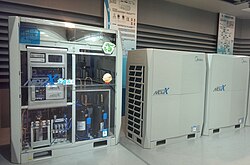
The Microwave Market Dominance
Midea's influence on the global market is particularly evident in the microwave sector. It is the largest microwave oven manufacturer globally. Reports indicate that a vast majority of countertop microwaves sold in the United States for under $100 are produced by Midea or Galanz, including those branded as Toshiba, Whirlpool, and Black+Decker.
Corporate Performance and Competition
Midea maintains a strong financial position, with total assets reaching CN¥ 387.946 billion in 2021. In 2023, its air conditioning business alone generated CNY 161.1 billion in revenue.
| Metric | Value |
|---|---|
| Revenue | CN¥ 343.4 billion |
| Operating Income | CN¥ 33.281 billion |
| Net Income | CN¥ 29.015 billion |
| Total Assets | CN¥ 387.946 billion |
| Total Equity | CN¥ 124.868 billion |
| Employee Count | ~150,000 |
In the competitive landscape, Midea vies for market share with other Chinese giants like Haier and Gree Electric Appliances. Together, these three companies account for 80% of the sales among China's top 10 appliance makers. Internationally, Samsung remains a primary competitor, particularly in the large appliance segment.
Frequently Asked Questions
What is Midea's role as an OEM?
Midea acts as an Original Equipment Manufacturer (OEM), meaning it manufactures products that are sold under other well-known global brand names. This is especially common in the microwave and HVAC markets.
Which major companies has Midea acquired?
Midea has made several high-profile acquisitions, including the German robotics company KUKA, Toshiba's home appliances business, and the floorcare brand Eureka.
Does Midea produce anything other than home appliances?
Yes. Midea is a major producer of industrial robots via KUKA, manufactures automotive parts through its Welling subsidiary, and established a semiconductor subsidiary, MR Semi Co. Ltd., in 2018.
Where is Midea Group headquartered?
Midea Group is headquartered in Beijiao town, Shunde District, Foshan, Guangdong province, China.
What are some of the other brands owned by Midea?
Midea operates several brands, including Little Swan (laundry and refrigeration), Hualing (air conditioners and refrigerators), MDV (commercial HVAC), and Pelonis (heaters).