Michel Aoun: The Military General and President of Lebanon
Michel Aoun is a pivotal figure in Lebanese history, whose career spanned the highest echelons of military command and political leadership. A Maronite Christian born in Haret Hreik, Beirut, Aoun rose from an artillery officer to become the 13th President of Lebanon, serving from 2016 to 2022. His journey is marked by intense conflict, a long period of exile, and a complex series of political alliances that reshaped the Lebanese state.
Key Facts
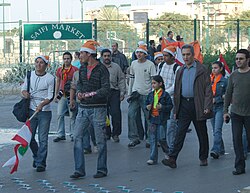
- Presidential Term: Served as the 13th President of Lebanon from October 31, 2016, to October 31, 2022.
- Military Rank: Attained the rank of General and was the 10th Commander of the Lebanese Armed Forces.
- Political Party: Founder and leader of the Free Patriotic Movement (FPM).
- Exile: Lived in France for 15 years (1990–2005) after the Syrian invasion of his strongholds.
- Key Alliance: Signed a landmark memorandum of understanding with Hezbollah in 2006.
Early Military Career and Rise to Power
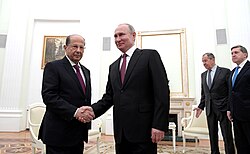
Michel Aoun joined the Military Academy in 1955, graduating as an artillery officer. His ascent within the Lebanese Army was rapid, and by 1984, at the age of 49, he became the youngest Commander of the Army in the nation's history.
During the fourth phase of the Lebanese Civil War, Aoun's role shifted from military command to political governance. On September 22, 1988, departing President Amine Gemayel appointed him as the interim Prime Minister of a military government. This appointment was highly disputed, leading to a period where two rival governments contended for power: one led by Aoun (supported primarily by Christians and Iraq) and another supported by Muslims and Syria.
The War of Liberation and Conflict
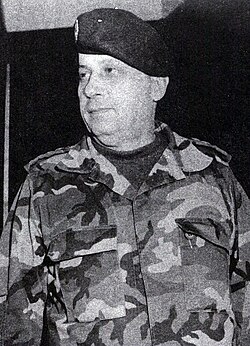
On March 14, 1989, Aoun declared a "War of Liberation" against Syrian Army forces. This period was characterized by his opposition to the Taif Agreement—a peace accord intended to end the civil war—and his refusal to recognize the newly elected presidents René Moawad and Elias Hrawi.
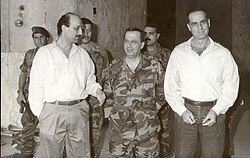
Internal Christian strife also erupted in February 1990, when Aoun launched an offensive against the Lebanese Forces (LF) led by Samir Geagea in East Beirut. The resulting three months of fighting caused immense destruction and resulted in approximately 1,000 deaths.
Exile and the Return to Lebanon
The turning point in Aoun's military career came on October 13, 1990, when Syrian forces launched a decisive operation against his strongholds, including the Presidential Palace in Baabda. Following the invasion, Aoun sought refuge in the French Embassy in Beirut and was subsequently granted asylum in France.
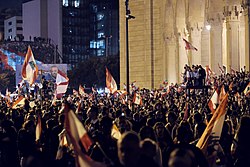
For 15 years, Aoun lived in exile, during which he established the Free Patriotic Movement (FPM) to maintain his political influence from abroad. He eventually returned to Lebanon in 2005 following the Cedar Revolution, a series of protests that led to the withdrawal of Syrian troops from the country.
Political Ascent and the Presidency
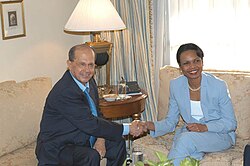
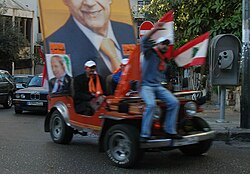
Upon his return, Aoun entered the legislative arena, winning a seat in Parliament for the Keserwan District in 2005. His party, the FPM, became the largest Christian bloc in Parliament. In 2006, Aoun shifted his strategic alignment by signing a memorandum of understanding with Hezbollah, creating a powerful political alliance.
After a protracted 29-month political vacuum and 45 failed attempts to elect a successor, Michel Aoun was finally elected President of Lebanon on October 31, 2016, during the 46th parliamentary session.
Challenges of the Presidency (2016–2022)
Aoun's presidency was marked by severe economic instability and political gridlock. He presided over multiple cabinets, including those led by Saad Hariri and Hassan Diab. His term was further complicated by the 2019–2020 Lebanese protests and the catastrophic Beirut port explosion on August 4, 2020, which triggered widespread public anger and the eventual resignation of the Diab government.
Summary of Political and Military Roles
| Role | Period | Key Context |
|---|---|---|
| Commander of Lebanese Armed Forces | 1984–1989 | Youngest commander in history |
| Acting Prime Minister (Disputed) | 1988–1990 | Military government during Civil War |
| Exile in France | 1990–2005 | Founded Free Patriotic Movement |
| Member of Parliament | 2005–2016 | Represented Keserwan District |
| President of Lebanon | 2016–2022 | 13th President of the Republic |
Personal Life and Honors
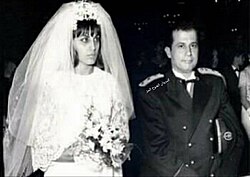
Michel Aoun married Nadia El-Chami in 1968, and they have three children. Throughout his career, he received numerous national decorations, including the Grand Cordon of the National Order of the Cedar. Internationally, he was awarded the Grand Cross of the French Legion of Honour by President Emmanuel Macron in 2017.
Frequently Asked Questions
Why was Michel Aoun's appointment as Prime Minister in 1988 disputed?
It was disputed because it occurred after the parliament failed to elect a new president. This led to the existence of two rival governments: one led by Aoun in East Beirut (supported by Christians and Iraq) and another led by Selim Hoss (supported by Muslims and Syria).
What was the significance of the 2006 memorandum of understanding?
The memorandum established a strategic alliance between Aoun's Free Patriotic Movement and Hezbollah, bridging a gap between a major Christian political force and the Shia Islamist group.
How long did Michel Aoun live in exile?
Michel Aoun lived in exile in France for 15 years, from 1990 until his return to Lebanon in 2005.
What happened during the 46th parliamentary session in 2016?
After 45 previous failed attempts to reach a quorum, the Lebanese Parliament finally convened for the 46th time on October 31, 2016, and elected Michel Aoun as President, ending a 29-month power vacuum.
Which military rank did Michel Aoun hold?
Michel Aoun held the rank of General in the Lebanese Army.