Miami International Autodrome: The Hub of High-Speed Racing in Florida
The Miami International Autodrome is a state-of-the-art, purpose-built temporary racing facility located around the Hard Rock Stadium in Miami Gardens, Florida. Designed to bring the prestige of world-class motorsport to the United States, the circuit blends permanent infrastructure with temporary safety installations to create a high-speed arena capable of hosting the world's fastest cars.
The facility was crafted by Apex Circuit Design, specialists in Formula One track architecture, to meet the rigorous standards of the FIA (Fédération Internationale de l'Automobile). Since its debut, it has become a cornerstone of the Florida sports landscape, combining the excitement of Grand Prix racing with the existing infrastructure of one of the NFL's most iconic stadiums.
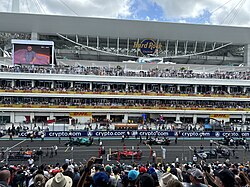
Key Facts
- Location: Hard Rock Stadium, Miami Gardens, Florida, U.S.
- Capacity: 65,000 spectators.
- FIA Grade: Grade 1 (Grand Prix) and FE (MIA Loop).
- Primary Event: Formula One Miami Grand Prix.
- Design: Created by Apex Circuit Design.
- Opening Date: May 7, 2022.
History and Development
The vision for a Miami-based Grand Prix began as early as October 2019. Stadium owner Stephen Ross spent several years working to attract Formula One to the venue. The development process was exhaustive; designers considered up to 75 different circuit layouts and simulated 36 of them to optimize the racing experience.
While an agreement in principle was reached in 2021, the project faced early hurdles, including an initial vote against the track's creation by Miami Gardens commissioners. This decision was reversed on April 14, 2021, paving the way for the official naming of the "Miami International Autodrome" on September 2, 2021.
Circuit Design and Infrastructure
The Autodrome is unique in that it is a temporary circuit. While it utilizes permanent asphalt pathways integrated into the Hard Rock Stadium parking areas, it does not use public streets. Instead, it crosses public roads and relies on safety features that are assembled a few weeks before a race weekend and dismantled immediately afterward, returning the grounds to their normal stadium operations.
The primary Grand Prix Circuit spans 3.363 miles (5.412 km) and features 19 turns. In qualifying sessions, Formula One cars reach an average speed of approximately 139 mph (224 km/h).
Layout Configurations
To ensure the venue can be utilized year-round for various motorsport disciplines, four additional layouts were introduced in September 2024. These variations allow the circuit to accommodate vehicles with different performance profiles, such as the limited range of electric cars.
- Grand Prix Circuit: The full 3.363 mi (5.412 km) layout with 19 turns.
- Extended Marina Loop: A 2.800 mi (4.506 km) layout with 19 turns.
- Marina Loop: A 2.440 mi (3.927 km) layout with 18 turns.
- Extended MIA Loop: A 1.750 mi (2.816 km) layout with 14 turns.
- MIA Loop: A 1.442 mi (2.320 km) layout with 13 turns.
Major Racing Events
The Autodrome is a multi-disciplinary venue. While the Formula One Miami Grand Prix is the headline event held every May, the circuit also hosts the FIA Formula 2 Championship, Porsche Carrera Cup North America, and the McLaren Trophy America.
The facility has also expanded into electric racing. In March 2025, it hosted the Evo Sessions for the Formula E World Championship, where celebrities tested the GEN3 Evo car on the shortened MIA Loop. Additionally, the circuit is scheduled to host the Formula E Miami ePrix starting in 2026.
| Layout | Length (mi/km) | Turns | Primary Use/Event |
|---|---|---|---|
| Grand Prix Circuit | 3.363 mi / 5.412 km | 19 | Formula One |
| Extended Marina Loop | 2.800 mi / 4.506 km | 19 | Ferrari Challenge |
| Marina Loop | 2.440 mi / 3.927 km | 18 | General Racing |
| Extended MIA Loop | 1.750 mi / 2.816 km | 14 | General Racing |
| MIA Loop | 1.442 mi / 2.320 km | 13 | Formula E |
Lap Records
As of May 2026, the fastest official race laps across the various configurations are as follows:
- Formula One (Grand Prix Circuit): 1:29.708 by Max Verstappen (Red Bull Racing RB19) in 2023.
- Formula 2 (Grand Prix Circuit): 1:41.932 by Noel León (Dallara F2 2024) in 2026.
- Formula E (MIA Loop): 1:02.316 by Oliver Rowland (Nissan e-4ORCE 05) in 2026.
- Ferrari Challenge (Extended Marina Loop): 1:36.999 by Massimo Perrina (Ferrari 296 Challenge) in 2025.
Frequently Asked Questions
Is the Miami International Autodrome a permanent track?
No, it is a temporary circuit. While the asphalt paths are permanent parts of the Hard Rock Stadium parking areas, the safety barriers and race-specific infrastructure are assembled and dismantled for each event.
Who designed the circuit?
The track was designed by Apex Circuit Design, a firm specializing in Formula One circuit architecture.
What is the fastest lap ever recorded at the Grand Prix Circuit?
The race lap record for the Grand Prix Circuit is 1:29.708, set by Max Verstappen in a Red Bull Racing RB19 during the 2023 event.
Why are there different loop layouts like the MIA Loop?
The different layouts were created to allow the circuit to be used year-round for various events. Specifically, shorter loops like the MIA Loop are used for Formula E to accommodate the reduced range of electric racing cars compared to Formula One cars.
What is the spectator capacity of the venue?
The Miami International Autodrome can accommodate up to 65,000 spectators.