Miami Herald: A Legacy of South Florida Journalism
The Miami Herald stands as a cornerstone of journalism in South Florida, serving as a primary record of the region's growth, challenges, and triumphs for over a century. From its humble beginnings as a reorganized local paper to its evolution into a digital-first news organization, the Herald has played a pivotal role in shaping the public discourse of Miami and beyond.

Key Facts
- Founded: September 15, 1903, as the Miami Evening Record.
- Ownership: Currently owned by McClatchy.
- Accolades: Recipient of 24 Pulitzer Prizes.
- Format: Traditionally a broadsheet daily newspaper.
- Leadership: Led by Executive Editor Alex Mena, the first immigrant to hold the position.
A Century of Evolution
Founding and Early Years
The newspaper's origins date back to 1903 when Frank B. Stoneman reorganized the Orlando Record and moved it to Miami. The first edition, titled the Miami Evening Record, debuted on September 15, 1903. Following financial struggles during the recession of 1907, the paper became the Miami Morning News-Record. By December 1, 1910, Frank B. Shutts acquired the publication through a loan from Henry Flagler and renamed it the Miami Herald.
While the Herald is the longest continuously published paper in Miami, it was not the first in the region; that honor belongs to The Tropical Sun, established in 1891. The Herald's primary competitor for decades was The Miami News, which operated until 1988.
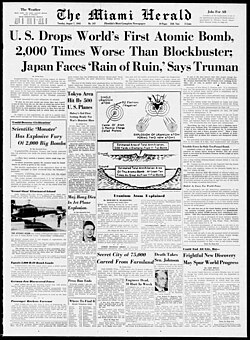
The Knight Era and Expansion
A significant turning point occurred on October 25, 1939, when John S. Knight purchased the Herald. Alongside his brother James L. Knight, John transformed the paper into a powerhouse of regional reporting. This era saw the rise of influential figures like Lee Hills and Alvah H. Chapman, the latter of whom eventually became chairman and CEO of Knight-Ridder Inc.
The Herald's commitment to excellence was cemented in 1950 when it won its first Pulitzer Prize for reporting on organized crime in Miami. The publication also broke social barriers in the newsroom; Thirlee Smith, Jr. became the first African American male reporter in 1967, followed by Bea Hines, the first African American female reporter, in 1970. Hines was later nominated for a Pulitzer in 1981 for her work on police profiling and brutality.
Diversification and Digital Transition
To serve Miami's growing Hispanic population, the paper launched a Spanish-language insert, El Herald, in 1976. This evolved into El Nuevo Herald in 1987 and eventually became an independent publication in 1998. The Herald also pioneered inclusive reporting by assigning Steve Rothaus as the first national reporter dedicated to LGBT news in 1997.
In the 21st century, the paper faced the industry-wide shift toward digital media. While print circulation peaked at 440,225 in 1998, it declined to 12,623 by August 2024. Conversely, the paper has focused on growing its digital subscriber base, which stood at 30,840 in 2023.
Infrastructure and Headquarters
For decades, the Herald was synonymous with its waterfront headquarters at One Herald Plaza on Biscayne Bay, which opened in 1963. However, in 2011, the company sold the 14-acre site to Genting Malaysia Berhad for $236 million. The newspaper relocated to suburban Doral in 2013, and the iconic bayfront building was demolished in 2014.
![The Miami Herald's former headquarters on Biscayne Bay in the Arts & Entertainment District of Downtown Miami; the paper moved from its waterfront headquarters in 2013 to a location in suburban Doral.[needs update] The Herald building was demolished in 2014.](/images/0a/ec/0aec88ac43241d33bf8354979856cc8d26827f087d186ee631ad2c431e854930.jpg)
Further operational changes occurred in 2020 when the Herald closed its Doral printing plant, moving its production to the South Florida Sun Sentinel's facilities in Deerfield Beach.
Impactful Journalism and Community Awards
Investigative Triumphs
The Miami Herald continues to make national headlines through rigorous investigative work. In November 2018, the paper broke a major story regarding a secret 2007 deal signed by U.S. attorney Alexander Acosta, which shielded multimillionaire Jeffrey Epstein from prison despite evidence of sexual abuse of teenagers. This reporting was instrumental in bringing the full extent of Epstein's crimes back into the public eye, leading to his 2019 charges for sex trafficking.
The Silver Knight Awards
Beyond news, the Herald fosters youth excellence through the Silver Knight Awards. Established in Miami-Dade County in 1959 and expanded to Broward County in 1984, the program recognizes high school students for their achievements. Winners receive scholarships and statues, supported by organizations such as the John S. and James L. Knight Foundation.
Summary of Miami Herald Specifications
| Attribute | Detail |
|---|---|
| Founded | September 15, 1903 |
| Owner | McClatchy |
| Executive Editor | Alex Mena |
| Pulitzer Prizes | 24 |
| Print Circulation (2024) | 12,623 (average) |
| Digital Subscribers (2023) | 30,840 |
Frequently Asked Questions
Who is the current executive editor of the Miami Herald?
The current executive editor is Alex Mena, who is the first immigrant to hold this leadership position at the newspaper.
How many Pulitzer Prizes has the Miami Herald won?
The Miami Herald has been awarded 24 Pulitzer Prizes across various categories, including Breaking News Reporting and International Reporting.
What happened to the Miami Herald's waterfront headquarters?
The headquarters on Biscayne Bay were sold to Genting Malaysia Berhad in 2011 for $236 million. The paper moved to Doral in 2013, and the original building was demolished in 2014.
What is the Silver Knight Awards program?
The Silver Knight Awards is a program established by the Miami Herald to honor exceptional high school students in Miami-Dade and Broward counties with scholarships and awards.
What was the Herald's role in the Jeffrey Epstein case?
In 2018, the Miami Herald exposed a secret deal that had previously protected Jeffrey Epstein from prison, which helped lead to his subsequent charges for sex trafficking minors.