Mexican Government: The Three Branches of Power
The government of Mexico operates under a structured system of checks and balances divided into three distinct branches: the Executive, the Legislative, and the Judicial. This separation of powers ensures that no single entity holds absolute authority, maintaining the democratic integrity of the state.
The Executive Branch
The Executive branch is led by the President, who serves as both the head of government and the head of state. In addition to these administrative roles, the President acts as the commander-in-chief of the Mexican Armed Forces. The President is chosen through a direct popular vote for a single six-year term.
In the event that the office becomes vacant, the Secretariat of the Interior assumes the role ad interim (temporarily) until Congress elects a replacement to complete the remainder of the term.
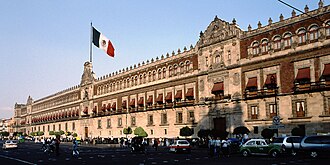
The National Palace serves as the official seat of the executive branch and the president's official residence. Historically, from 1934 until 2018, the official residence was located at Los Pinos.
The Legislative Branch
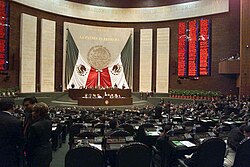
Legislative power is vested in the Congress of the Union, a bicameral system meaning it consists of two separate chambers: the Senate and the Chamber of Deputies. Together, they hold the authority to pass laws, impose taxes, declare war, approve the national budget, ratify diplomatic appointments, and approve or reject international treaties.
The Chamber of Deputies
The Chamber of Deputies is composed of 500 representatives elected every three years. These representatives are chosen through a parallel voting system:
- Uninominal deputies: 300 members elected in single-seat constituencies via first-past-the-post plurality.
- Plurinominal deputies: 200 members elected through proportional representation using closed-party lists across five constituencies.
To prevent any single party from becoming overrepresented, the system includes specific restrictions: a party must secure at least 3% of the vote to earn a plurinominal seat, their total seat percentage cannot exceed their vote percentage by more than 8%, and no party may hold more than 300 total seats regardless of their vote share. Deputies are prohibited from immediate reelection.
The Senate of the Republic
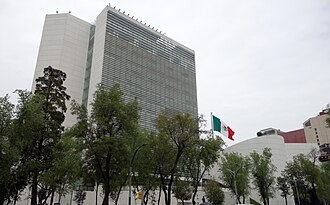
The Senate consists of 128 representatives who serve six-year terms. The Senate focuses specifically on foreign policy, international agreements, and the confirmation of presidential appointments. Its members are elected via a parallel voting system divided as follows:
- 64 senators elected by first-past-the-post plurality (two per state and two for Mexico City).
- 32 senators assigned via the "first minority" principle, awarded to the runner-up party in each state and Mexico City.
- 32 senators elected by proportional representation through a single national constituency.
The Judicial Branch
The Judiciary is responsible for interpreting laws and adjudicating cases of federal competency. At its peak is the Supreme Court of Justice of the Nation, which consists of nine justices—five women and four men—elected by plurality voting. These justices serve twelve-year terms and are not eligible for reelection.
The broader judicial system also includes the Council of the Federal Judiciary, the Electoral Tribunal of the Federal Judiciary, and various district, unitary, and collegiate tribunals.

Key Facts
- Presidential Term: Six years, with no possibility of reelection.
- Legislative Structure: Bicameral (Senate and Chamber of Deputies).
- Chamber of Deputies: 500 members elected every three years.
- Senate: 128 members elected every six years.
- Supreme Court: 9 justices serving 12-year terms.
- Executive Seat: The National Palace.
Government Structure Summary
| Branch | Primary Body | Key Leadership/Composition | Term Length |
|---|---|---|---|
| Executive | President | Head of State & Government | 6 Years |
| Legislative (Lower) | Chamber of Deputies | 500 Representatives | 3 Years |
| Legislative (Upper) | Senate | 128 Senators | 6 Years |
| Judicial | Supreme Court | 9 Justices | 12 Years |
Frequently Asked Questions
Can the President of Mexico be re-elected?
No, the President is elected for a single term of six years and cannot run for reelection.
How are the members of the Chamber of Deputies elected?
They are elected every three years through a parallel system: 300 are elected by plurality in single-seat constituencies, and 200 are elected via proportional representation.
What is the role of the Senate compared to the Chamber of Deputies?
While both pass laws, the Senate specifically handles matters regarding foreign policy, approves international agreements, and confirms presidential appointments.
How is the Supreme Court of Justice of the Nation composed?
The Court consists of nine justices (five women and four men) who are elected by plurality voting to serve twelve-year terms.
What happens if the presidency becomes vacant?
The Secretariat of the Interior assumes the position ad interim while Congress elects a replacement to serve the remainder of the term.