Mesoamerican Ballcourts: Architecture, Evolution, and Design
The ballgame was a central pillar of Mesoamerican society, blending sport, ritual, and politics. The physical spaces where these games occurred—the ballcourts—were not uniform; they evolved over millennia and varied significantly across different cultures and regions. From simple cleared patches of earth to massive stone monuments, the architecture of the ballcourt reflects the complexity of the civilizations that built them.
Key Facts
- Oldest Site: The earliest identified ballcourt is at Paso de la Amada, dating to approximately 1400 BC.
- Size Variance: Courts vary wildly in scale; for example, a small court at Tikal is only one-sixth the size of the Great Ballcourt at Chichen Itza.
- Standard Proportions: Playing alleys generally maintain an average length-to-width ratio of 4-to-1.
- Common Shapes: While many are the famous I-shape, others appear as T-shapes, rectangles, or open-ended alleys.
- Orientation: Most courts align with the city's central monumental precinct, often oriented a few degrees east of north.
Size and Shape of the Playing Alley
The playing alley—the central area where the game took place—shows remarkable consistency in proportion despite vast differences in total area. On average, these alleys follow a 4-to-1 length-to-width ratio. However, regional preferences existed: courts in Central Mexico tended to be longer, while those in the Maya Northern Lowlands were typically wider.
| Site | Culture | Length (m) | Width (m) | Ratio (L:W) |
|---|---|---|---|---|
| Xochicalco | - | 51 | 9 | 5.7 |
| Monte Albán | Zapotec | 26 | 5 | 5.2 |
| El Tajin | Classic Veracruz | 126 | 25 | 5.1 |
| Chichen Itza (Grand) | Maya | 96 | 30.4 | 3.2 |
| Tikal (Small) | Maya | 16 | 5 | 3.2 |
| Yaxchilan II | Maya | 18 | 5 | 3.6 |
| Tula | Toltec | 41 | 10 | 4.1 |
The Evolution of Ballcourt Design
The earliest ballcourts were likely temporary areas of compacted soil, similar to those used today in ulama, the modern descendant of the ancient game. The oldest known permanent structure is found at Paso de la Amada in Soconusco along the Pacific coast, dating to roughly 1400 BC. This early court featured a flat playing alley (80m x 8m) flanked by two earthen mounds with longitudinal "benches."
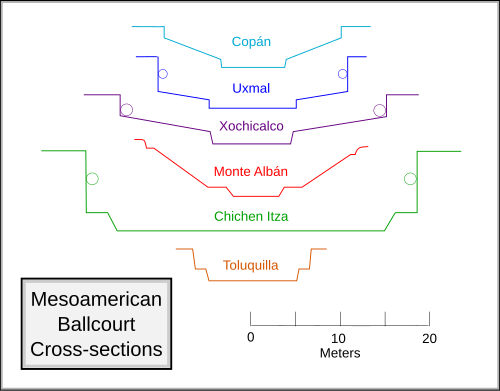
As the game evolved into the Early Classic period, architects added a second pair of mounds beyond the ends of the alley to prevent the ball from rolling too far. By the Terminal Classic, these end zones were often fully enclosed, resulting in the iconic I-shape. However, this evolution was not linear. With over 1,300 known courts, exceptions abound: some remained open-ended, some were T-shaped with only one enclosed end, and others, such as the court at La Lagunita in the Guatemala Highlands, were entirely rectangular with rounded side walls.
Walls and Surface Materials
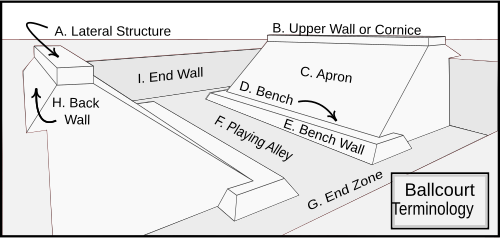
While the playing alleys remained compacted earth, the side walls of formal courts were constructed from stone blocks. These walls typically featured three or more horizontal and sloping surfaces. Over time, sloping aprons were replaced by vertical surfaces, particularly in the largest courts like those at El Tajin and the Great Ballcourt at Chichen Itza.
These vertical walls often served as canvases for elaborate stone reliefs. These carvings frequently depicted scenes related to the ballgame, with a particular emphasis on sacrificial rituals.
Urban Orientation and Placement
Ballcourts were rarely isolated; they were typically integrated into the central monumental precinct of a city, sharing the same alignment as pyramids and other civic structures. In many Mesoamerican cities, this meant an orientation roughly 15° east of north. This pattern is clearly visible in the Valley of Oaxaca, where courts are generally oriented a few degrees east of north or at right angles to that axis.
Regional variations did exist. In the Cotzumalhuapa region, for instance, earlier open-ended courts were oriented north-south, while later enclosed courts shifted to an east-west orientation.
Frequently Asked Questions
What is the oldest known ballcourt?
The oldest identified ballcourt is located at Paso de la Amada in Soconusco, dating back to approximately 1400 BC.
How did the shape of ballcourts change over time?
They began as simple compacted soil areas, evolved into alleys flanked by mounds, and eventually developed enclosed end zones to create the characteristic I-shape by the Terminal Classic period.
What was the typical size ratio of a playing alley?
While sizes varied, the average length-to-width ratio of the playing alley was approximately 4-to-1.
What was the purpose of the vertical walls in larger courts?
Beyond the structural needs of the game, vertical walls in major courts like those at Chichen Itza were used to display elaborate reliefs, often depicting sacrificial scenes.
Did all ballcourts face the same direction?
No, though many followed the general city orientation (often a few degrees east of north). Some regions, like Cotzumalhuapa, showed a shift from north-south to east-west orientations over time.