Memorial to Heroic Self-Sacrifice
Located in the heart of London's Postman's Park, the Memorial to Heroic Self-Sacrifice—often referred to as the Wall of Heroes—stands as a poignant tribute to ordinary people who died while saving the lives of others. Conceived by the artist George Frederic Watts, the memorial transforms a public green space into a place of reflection on bravery, duty, and selfless action.
The project began in 1898 when a friend of Watts suggested to Henry Gamble, the Vicar of St Botolph's Aldersgate, that the church use land owned by the City Postal Fund (CPF) for such a monument. Watts agreed, initially proposing a covered way around three sides of a quadrangle. However, due to objections from the Metropolitan Public Gardens Association (MPGA), who feared the small park (less than one acre) would be overbuilt, the design was scaled back.
The final structure, designed by Ernest George, is a wooden loggia—a covered open-sided gallery—measuring 50 feet long and 9 feet tall with a tiled roof. Watts personally funded the construction cost of £700 (approximately £78,000 in 2025). The memorial was officially unveiled on July 30, 1900, by the Lord Mayor of London and the Bishop of London.
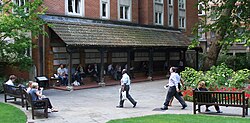
Key Facts
- Founder: George Frederic Watts, an artist known as "The last great Victorian."
- Location: Postman's Park, London, near St Botolph's Aldersgate.
- Structure: A wooden loggia designed to hold up to 120 memorial tablets.
- Artistry: Features hand-painted ceramic tiles by William De Morgan and later Royal Doulton.
- Purpose: To commemorate the bravery of ordinary citizens who sacrificed their lives for others.
The Artistry of the Memorial Tablets
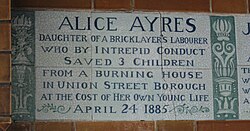
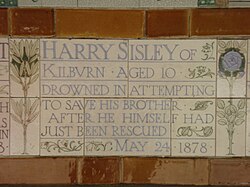
While Watts originally envisioned engraved stone, he opted for hand-painted and glazed ceramic tiles because they were more affordable and accessible. He collaborated with William De Morgan, a premier tile designer of the era. The first four tablets were custom-made, costing £3 5s each (about £360 in 2025). To manage costs for the remaining 116 spaces, the design shifted to standard 6-inch tiles, reducing the price to £2 per tablet.
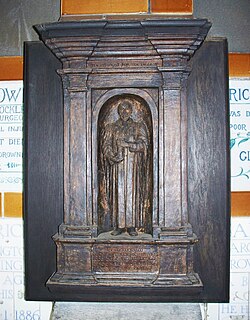
Watts personally curated the list of heroes from newspaper reports. After his death in 1904, his wife, Mary Watts, took over the project. She established the Heroic Self Sacrifice Memorial Committee to ensure the first two rows were completed. In 1905, a relief plaque by T. H. Wren was added to the center of the monument to honor George Frederic Watts himself.
The Transition to Royal Doulton
By 1907, William De Morgan closed his ceramics business to pursue writing. Mary Watts sought a replacement manufacturer and commissioned Royal Doulton to produce 24 tiles for the second row. However, these tiles differed significantly in color and style from De Morgan's originals, a change that Mary Watts found disappointing.
Later Additions and Corrections
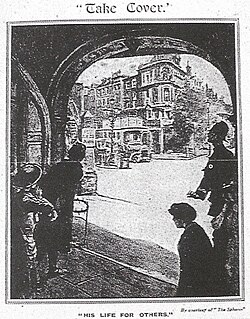
Following the First World War, the memorial expanded to include modern heroes. In 1917, PC Alfred Smith died while shepherding 150 women and girls to safety during a German bombing raid in Finsbury. A public fund raised over £471 to install a Royal Doulton tablet in his honor in 1919.
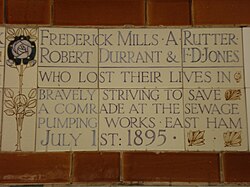
In 1930, the memorial committee began collaborating with public bodies like the British Medical Association and the Metropolitan Police to identify new candidates for commemoration. During this period, a correction was made to a 1902 De Morgan tablet. Watts had mistakenly listed an 1895 accident at the East Ham Sewage Works as occurring at the West Ham Sewage Works in 1885. The original tile was replaced by a Royal Doulton version with the correct data.
The Case of Herbert Maconoghu
The removal of the incorrect sewage works tablet left a gap in the original row. In 1931, Mary Watts commissioned Fred Passenger, a former employee of De Morgan, to create a single panel in the original style. This tablet commemorated Herbert Maconoghu (born Herbert Moore McConaghey), a schoolboy who died in 1882 while attempting to save two friends from drowning.
Memorial Summary
| Feature | Details |
|---|---|
| Architect/Designer | Ernest George (Loggia), George Frederic Watts (Concept) |
| Tile Manufacturers | William De Morgan, Royal Doulton, Fred Passenger |
| Unveiling Date | July 30, 1900 |
| Total Capacity | 120 Tablets |
| Key Figures Honored | Ordinary citizens, police officers, and medical professionals |
Frequently Asked Questions
Who was George Frederic Watts?
George Frederic Watts was a prominent Victorian artist who envisioned the memorial as a way to honor the "salt of the earth"—ordinary people who performed extraordinary acts of bravery.
Why are some tiles different in style?
The earliest tiles were crafted by William De Morgan. After he closed his business in 1907, Royal Doulton was commissioned to produce subsequent tablets, which featured a different design and color palette.
How were the people commemorated on the wall chosen?
Initially, Watts selected names from newspaper reports of heroic actions. Later, the Heroic Self Sacrifice Memorial Committee sought suggestions from the Metropolitan Police, the General Post Office, and the British Medical Association.
What happened to the original tablet for the East Ham Sewage Works?
Because it contained the wrong date and location, the original De Morgan tablet was removed in 1930 and replaced by a Royal Doulton tablet with the correct information.
Who is PC Alfred Smith?
PC Alfred Smith was a Metropolitan Police officer who died in 1917 while protecting factory workers during a German air raid in Finsbury.