Mauser Firearms: The Legacy of German Engineering and Innovation
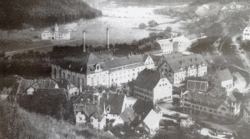
Mauser stands as one of the most influential names in the history of the arms industry. Originally established as the Königlich Württembergische Gewehrfabrik, the company became a global powerhouse of firearm design under the leadership of brothers Wilhelm and Paul Mauser. From the late 19th century through the 20th century, Mauser's precision engineering defined the standard for military bolt-action rifles and semi-automatic pistols worldwide.
The company's impact is most evident in its bolt-action designs, particularly the Gewehr 98, which served as the foundation for countless sporting and military rifles. With approximately 10 million Gewehr 98-style rifles produced, the Mauser action became one of the most copied firearm designs in history.
Key Facts
- Founded: July 31, 1874, by Wilhelm and Paul Mauser.
- Headquarters: Isny im Allgäu, Baden-Württemberg, Germany.
- Most Famous Model: The Gewehr 98 and its derivative, the Karabiner 98k.
- Global Reach: Designs were exported and licensed to numerous countries for military and civilian use.
- Innovation: Developed the world's first anti-tank rifle (T-Gewehr) in 1918.
- Successors: Mauser Jagdwaffen GmbH (civilian) and Rheinmetall Waffe Munition GmbH (military).
The Early Years and Industrial Growth
The Mauser story began with Peter Paul Mauser and his brother Wilhelm. Paul, born in 1838 in Oberndorf am Neckar, worked alongside Wilhelm to develop a new rifle design. Their efforts culminated in the Model 1871, which was accepted by the Prussian government in December 1871 and entered service in February 1872.
While the government handled the primary production of the rifles, the Mausers were contracted to produce the sights. This initial success led to the acquisition of the Königlich Württembergische Gewehrfabrik on May 23, 1874, allowing the brothers to establish a formal partnership and expand their manufacturing capabilities in Oberndorf.
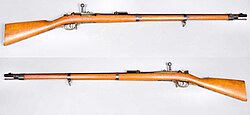
Evolution of the Mauser Bolt-Action Rifle
Early Models and International Adoption
Following the Model 1871, Mauser continued to refine the bolt-action system. The Model 71/84 introduced an 8-shot tubular magazine in 1884. As smokeless powder replaced black powder, Mauser developed high-performance cartridges, including the 7.65×53mm and 7×57mm Mauser rounds.
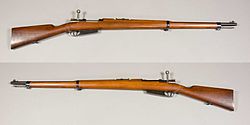
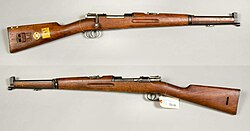
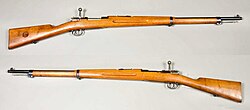
These advancements led to a series of international contracts. Belgium adopted the Model 1889, while the Ottoman Empire utilized the Model 90. Argentina adopted the Model 91, and Chile utilized the Model 1895. Sweden and Norway adopted the 6.5×55mm cartridge, leading to the production of the m/94 carbine and m/96 rifle.
The Definitive Model 98
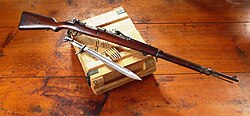
The Model 98, adopted by the German Army on April 5, 1898, represents the pinnacle of Mauser's bolt-action evolution. It incorporated improvements from all previous models and became the standard for the German military through two World Wars.
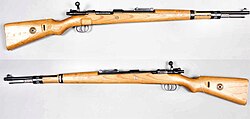
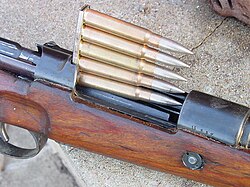
The Model 98 evolved into various forms, most notably the Karabiner 98k (K98k), adopted in 1935 as the standard-issue infantry rifle for the Wehrmacht. The K98k is remembered as one of the most ubiquitous rifles of World War II.
Specialized Rifles and Anti-Tank Innovation
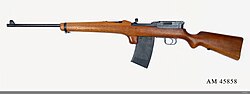
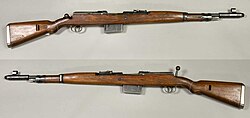
Mauser also ventured into specialized weaponry. The Mauser 1918 T-Gewehr was the world's first anti-tank rifle, designed specifically to destroy armored targets using 13×92mm cartridges. Additionally, the company produced the M1916 semi-automatic carbine, which used a delayed blowback mechanism and was adopted by the Imperial German Flying Corps due to the clean environment of aircraft combat.
Mauser Handguns and Pocket Pistols
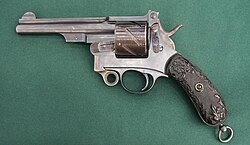
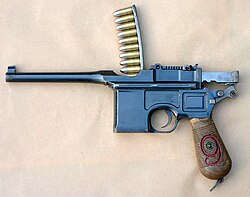
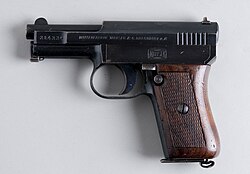
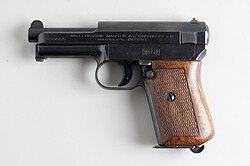
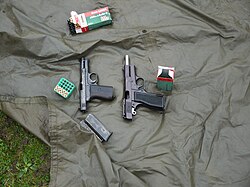
Beyond rifles, Mauser was a pioneer in semi-automatic pistols. The company produced a variety of compact firearms, including the Model 1910 (.25 ACP) and the Model 1914 (.32 ACP). These were widely used by the Wehrmacht and Kriegsmarine.
Other notable handguns include the Model 1934 pocket pistol and the Mauser HSc, a double-action blowback design introduced in the 1940s that remained in production into the early 1970s.
Summary of Key Mauser Models
| Model | Type | Key Feature/Usage | Notable Caliber |
|---|---|---|---|
| Model 1871 | Bolt-Action Rifle | First Mauser rifle; Prussian service | 11×60mm |
| Model 1896 | Bolt-Action Rifle | Swedish service rifle | 6.5×55mm |
| Gewehr 98 | Bolt-Action Rifle | Foundation for modern sporting rifles | 7.92×57mm |
| Karabiner 98k | Bolt-Action Rifle | WWII German standard infantry rifle | 7.92×57mm |
| T-Gewehr | Anti-Tank Rifle | World's first dedicated anti-tank rifle | 13×92mm |
| HSc | Semi-Auto Pistol | Compact double-action design | .32 ACP / .380 ACP |
Modern Era and Legacy
After 1945, Mauser continued to produce firearms, shifting toward civilian and specialized markets. This included the Model 66 and Model 77 series, as well as high-precision sniper rifles like the SR 93 and the SP66.
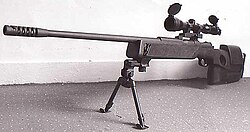
The company's military legacy continues through its successors, with Rheinmetall handling military weapons and Mauser Jagdwaffen focusing on the civilian hunting market. The enduring influence of the Mauser action can still be seen in the offerings of manufacturers like Česká Zbrojovka (CZ) and the Blaser Group.
Frequently Asked Questions
What is the significance of the Gewehr 98?
The Gewehr 98 is one of the most successful firearm designs in history. It served as the primary military rifle for Germany and was widely copied and licensed globally, forming the mechanical basis for many modern sporting bolt-action rifles.
What was the T-Gewehr?
The T-Gewehr (Tank- und Flieger) was the world's first anti-tank rifle, introduced in 1918. It was essentially an enlarged G98 designed to destroy armored targets and aircraft using a massive 13mm cartridge.
How did the K98k differ from the Gewehr 98?
The Karabiner 98k was a shorter, more compact version of the Model 98 action, developed from the Karabiner 98b. It was designed for better maneuverability and became the standard infantry rifle for Nazi Germany in 1935.
Which countries used Mauser rifles?
Mauser rifles were used extensively worldwide, including Germany, Belgium, Turkey, Argentina, Chile, Sweden, Norway, Mexico, China, Portugal, Brazil, and Serbia.
What happened to the Mauser company?
The original company became defunct in 2004. Its legacy was split between Mauser Jagdwaffen GmbH, which focuses on civilian hunting weapons, and Rheinmetall Waffe Munition GmbH, which handles military weapons.