Carl Walther GmbH: A Legacy of German Firearm Engineering
For over 130 years, Carl Walther GmbH has stood as a cornerstone of the global arms industry. Known simply as Walther, this German manufacturer has evolved from a small 19th-century workshop into a world-renowned producer of high-precision firearms and air guns. Today, as a subsidiary of the PW Group, Walther continues to blend traditional craftsmanship with modern innovation from its headquarters in Ulm, Baden-Württemberg.
Key Facts
- Founded: 1886 by Carl Walther in Zella-Mehlis, Germany.
- Headquarters: Ulm, Baden-Württemberg, Germany.
- Parent Company: PW Group (acquired by Umarex in 1993).
- US Presence: Walther Arms, Inc., based in Fort Smith, Arkansas.
- Core Products: Handguns, air rifles, target rifles, and sporting goods.
The Evolution of Walther: From Workshop to Global Brand
The roots of the company stretch back to 1780 with Matthias Conrad Pistor, the chief armorer of the Kassel Armory and an ancestor of the Walther family. However, the formal establishment of the brand occurred in 1886 when Carl Walther opened a small shop in Zella-Mehlis, Thuringia. Initially, the business focused on the production of target and hunting rifles.
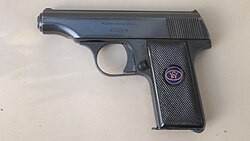
The company's trajectory shifted in 1908 under Fritz Walther, Carl's eldest son, who introduced the production of pistols. Early models (1-5 and 7-9) were chambered in .25 ACP (6.35mm) and .32 ACP (7.65mm). A notable early attempt at a 9mm Luger pistol, the Model 6, utilized a blowback system—a mechanism where the firearm's recoil pushes the slide back without a locking mechanism—rather than a locked breech. Due to its design, it was largely unsuccessful, with only about 1,000 units produced, making it a prized rarity for modern collectors.
The Era of the PP and PPK
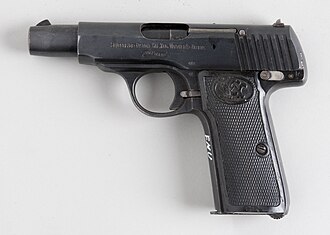
In 1929, Walther launched the Polizeipistole (PP), followed by the Polizeipistole Kriminalmodell (PPK) in 1931. These models were revolutionary as the first mass-produced pistols to utilize stamped parts, which reduced manufacturing costs while maintaining high quality and reliability. These pistols were offered in various calibers, most commonly .32 ACP, but also .22 Long Rifle, .380 ACP, and .25 ACP.
War and Reconstruction
By 1938, the German government selected Walther to produce the 9mm P38 as a replacement for the P-08 Luger. A dark chapter of the company's history occurred between 1942 and 1945, during which Walther operated a factory at the Neuengamme concentration camp using slave labor.
Following the destruction of its facilities in World War II and the placement of Zella-Mehlis within the Soviet occupation zone, Fritz Walther rebuilt the company from the ground up in Ulm, West Germany, in 1953. In 1957, the company resumed production of the P38, renamed the P1, to arm the Bundeswehr (the West German Army).
Modern Product Portfolio
Under the leadership of Karl-Heinz Walther after 1966, the company pivoted toward the sports sector. Following its acquisition by Umarex (now PW Group) in 1993, Walther expanded its reach, including a partnership with Smith & Wesson as the authorized US importer starting in 1999.
Handguns and Competition Pistols
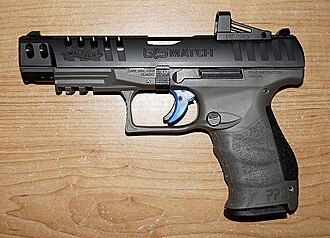
Walther produces a vast array of handguns, ranging from professional duty weapons to Olympic-grade competition tools. Their current lineup includes the PDP and the legacy of the PPK. For competitive shooters, they offer specialized air pistols like the LP500 and target pistols such as the GSP and SSP.
Rifles and Air Guns
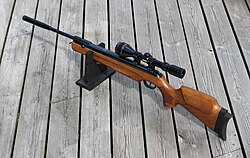
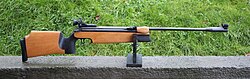
Beyond handguns, Walther is a leader in precision air rifles and target rifles. Their catalog includes the LGR and LGV series for match shooting, as well as the KK series of target rifles. They have also produced specialized firearms such as the WA 2000 and various submachine guns like the MPK/MPL.
Walther Product Summary
| Category | Notable Models | Primary Use |
|---|---|---|
| Police/Duty Pistols | P38, P99, PDP, PPQ | Law Enforcement & Defense |
| Compact Pistols | PP, PPK, CCP | Concealed Carry & Police |
| Competition Air Guns | LP500, LGR, LGV Master | Olympic & Match Shooting |
| Target Rifles | KK200, KK300, KK500 | Precision Target Shooting |
Frequently Asked Questions
What does PP and PPK stand for?
PP stands for Polizeipistole (Police Pistol), and PPK stands for Polizeipistole Kriminalmodell (Police Pistol Detective Model).
Who owns Carl Walther GmbH today?
Carl Walther GmbH is a subsidiary of the PW Group, having been acquired by Umarex in 1993.
Where is Walther's US business unit located?
The US business unit, Walther Arms, Inc., is based in Fort Smith, Arkansas.
Why was the Walther Model 6 unsuccessful?
The Model 6 was Walther's first 9mm Luger pistol, but it used a blowback system instead of a locked breech, which proved ineffective for the caliber.
Which Walther pistol replaced the P-08 Luger?
The 9mm P38 was awarded the contract to replace the P-08 Luger in 1938.