Matter Waves: The Quantum Nature of Particles
In the classical world, we distinguish clearly between particles—tiny bits of matter—and waves, such as sound or light. However, at the quantum scale, this distinction vanishes. Matter waves are a fundamental concept in quantum mechanics, representing the wave-like behavior exhibited by all particles of matter. This phenomenon is a cornerstone of wave-particle duality, the principle that every particle or quantum entity may be described as either a particle or a wave.
Whether it is a lightweight electron or a complex organic molecule, matter exhibits wave-like properties. For instance, a beam of electrons can be diffracted in the same manner as a beam of light or a water wave, proving that the "solid" particles we imagine are governed by wave dynamics.
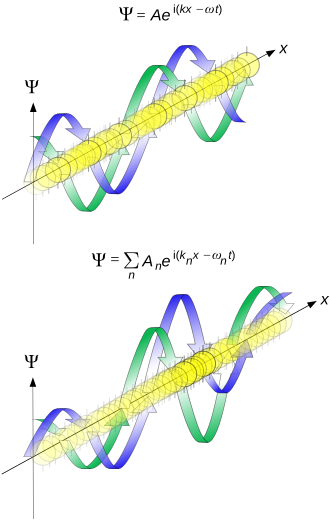
Key Facts
- Origin: Proposed by French physicist Louis de Broglie in 1924; consequently, matter waves are often called de Broglie waves.
- Universality: All matter, regardless of mass, exhibits wave-like behavior at practical measurement scales.
- Experimental Proof: Confirmed through diffraction experiments using electrons, neutrons, atoms, and large molecules.
- Core Application: Used extensively in crystallography and the study of biological materials via neutron diffraction.
The De Broglie Hypothesis and Wave Mechanics
The theoretical foundation of matter waves began with Louis de Broglie, who hypothesized that if light (traditionally a wave) could behave like a particle (a photon), then matter (traditionally a particle) must also behave like a wave. This relationship is defined by the de Broglie wavelength, which relates a particle's momentum to its wavelength.
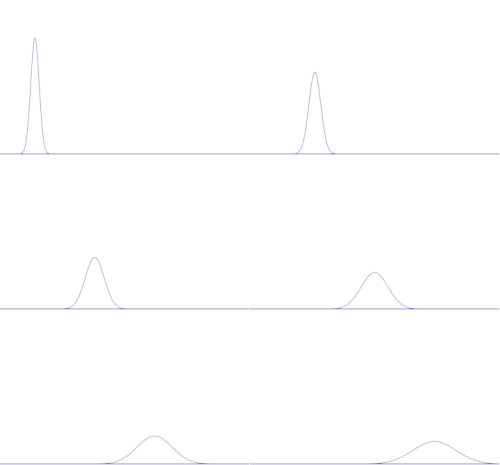
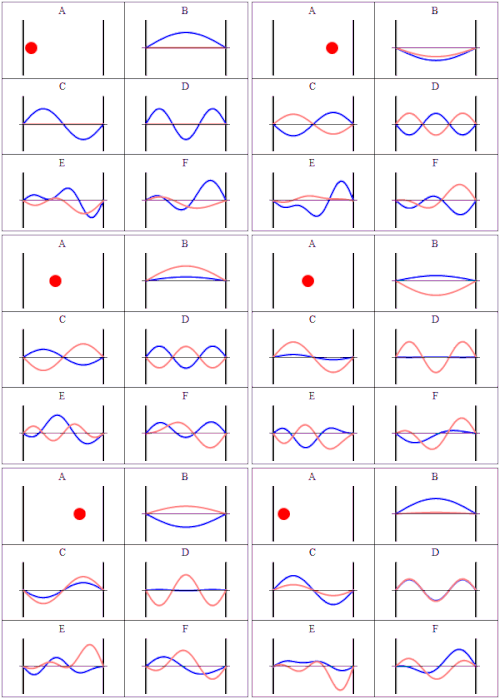
Following this hypothesis, Erwin Schrödinger developed the Schrödinger wave equation, which provides the mathematical framework to describe how these matter waves evolve over time. The state of a particle is described by a wavefunction, where the square of the amplitude represents the probability density of finding the particle at a specific location.
Experimental Confirmation
The theoretical predictions of de Broglie were soon validated by empirical evidence. Early experiments focused on electrons, with G.P. Thomson and the team of Davisson and Germer demonstrating that electrons could be diffracted by crystals, mirroring the behavior of X-rays.
One of the most striking demonstrations of this phenomenon is the double-slit experiment. When particles are sent through two slits, they do not simply pile up behind the openings; instead, they create an interference pattern of fringes, proving that each particle behaves as a wave that interferes with itself.
![Matter wave double slit diffraction pattern building up electron by electron. Each white dot represents a single electron hitting a detector. With a statistically large number of electrons, interference fringes appear.[30]](/images/66/de/66de98c43fc36234963691c3c50d768efce3203a3878cb253c963fa5c17cddd1.gif)
Neutron Matter Waves
Neutrons, discovered in the early 1930s, also exhibit wave properties. In nuclear reactors, neutrons with high kinetic energy (around 1 MeV) are "thermalized" to approximately 0.025 eV. At this energy, their de Broglie wavelength is roughly 180 pm, which matches the spacing between atoms in a crystal. Because neutrons scatter strongly from hydrogen atoms, they are invaluable for crystallography, particularly in analyzing biological materials. This field was pioneered in the 1940s by Ernest O. Wollan and Clifford G. Shull.
Atoms and Large Molecules
Wave-particle duality is not limited to subatomic particles. Experiments have successfully demonstrated interference patterns using neutral atoms (such as Rubidium) and increasingly large molecules. This includes C60 fullerenes and even complex polypeptides like Gramicidin A, pushing the boundaries of quantum superposition into the macroscopic realm.
Comparative Analysis of Matter Waves
The wavelength of a matter wave depends heavily on the mass and kinetic energy of the particle. As mass increases, the wavelength typically decreases, making wave-like behavior harder to detect in everyday objects.
| Matter | Mass | Kinetic Energy | Wavelength | Reference/Experiment |
|---|---|---|---|---|
| Electron | 1/1823 Da | 54 eV | 167 pm | Davisson–Germer |
| Neutron | 1 Da | 0.025 eV | 181 pm | Wollan and Shull |
| Helium (He) | 4 Da | 0.065 eV | 56 pm | Estermann and Stern |
| C60 Fullerene | 720 Da | 0.2 eV | 5 pm | Arndt et al. |
| Polypeptide | 1860 Da | - | 360 fm | Shayeghi et al. |
Frequently Asked Questions
What is the difference between a matter wave and a mechanical wave?
A mechanical wave, such as a sound wave, requires a physical medium (like air or water) to propagate. A matter wave is a quantum mechanical property of the particle itself and does not require a medium to exist.
Why don't we see people or cars behaving like waves?
Because the de Broglie wavelength is inversely proportional to mass, the wavelength of macroscopic objects is so incredibly small that it is impossible to detect with current technology, making them appear purely as particles.
How are matter waves used in science today?
They are used in neutron diffraction for crystallography to study the structure of materials and biological molecules, and in atom interferometry to perform high-precision measurements of gravity and other physical constants.
What is the significance of the double-slit experiment for matter waves?
It provides direct visual evidence of wave-particle duality. By showing that single particles (like electrons) can create an interference pattern, it proves that particles travel as waves of probability.