Mastering the Mark: The Art and Science of Australian Rules Football
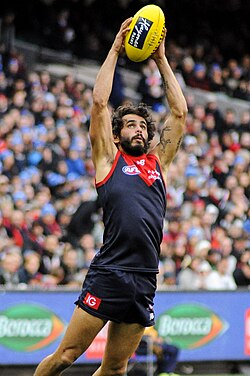
In the high-octane world of Australian rules football, few moments capture the imagination quite like a perfectly executed mark. A mark occurs when a player cleanly catches a ball that has been kicked, granting them a free kick and a moment of composure in an otherwise frantic game. Beyond its tactical utility, marking is often the most spectacular element of the sport, blending athletic prowess with precision timing.
For any player not kicking for goal, the primary objective is to find a teammate who can successfully mark the ball. This skill is so central to the game that the most impressive catch of the AFL season is honored with the prestigious "Mark of the Year" award.
The Fundamental Rules of Marking
To be awarded a mark, the catch must be clean. The umpire must determine that the player had control of the ball for a sufficient amount of time. If the ball is tipped or touches the ground before being caught, it cannot be marked. Interestingly, if a player catches the ball but it is immediately punched out of their hands or dislodged upon hitting the ground, the mark is still paid, provided there was an instant of complete control.
Since 2002, most Australian competitions have required the ball to travel a minimum distance of 15 metres (approximately 16 yards or 49 feet) in any direction. If the kick is shorter, the umpire will call "play on," meaning the ball remains live and the player does not receive a free kick.
The Procedure After the Mark
Once the umpire blows the whistle to signify a mark, the player is entitled to an unimpeded kick. The nearest opponent must stand on the spot where the mark was taken—a position known as "the mark"—becoming the "man on the mark."
- Play-on: The player may choose to forego their free kick and run into space, at which point defenders can tackle as normal.
- Time Limits: Players generally have 10 seconds to move the ball. If they are taking a shot on goal, this limit extends to 30 seconds.
- Penalties: If a player exceeds these time limits, the umpire will call "play-on," rescinding the free kick.
In contested situations where two players appear to mark the ball simultaneously, convention dictates that the umpire awards the mark to the player in front. If no clear front position is established, a "ball-up" (a neutral restart) is called.
Standing the Mark and the Protected Area
To ensure fairness, specific rules govern the space around the kicker. Since 1924, only one player is permitted to stand the mark. As of 2021, this player must remain completely stationary until the ball is disposed of or the kicker plays on; failure to do so results in a 50-metre penalty.
Additionally, a "protected area" is established to prevent defenders from crowding the kicker. This corridor extends:
- Ten metres on either side of the line between the kicker and the man on the mark.
- Five metres behind the kicker.
- Five metres behind the mark.
A Guide to Marking Styles
Marking is a diverse skill with various techniques depending on the game situation. These are often categorized by the player's body position and the level of contest.
Aerial and Spectacular Marks
The overhead mark involves catching the ball with arms extended above the head. When this is done while jumping, it is called a high mark.
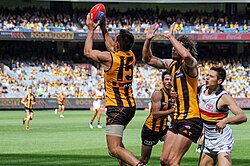
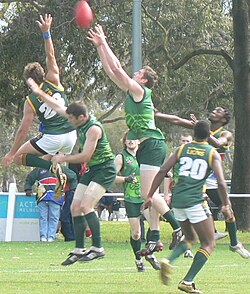
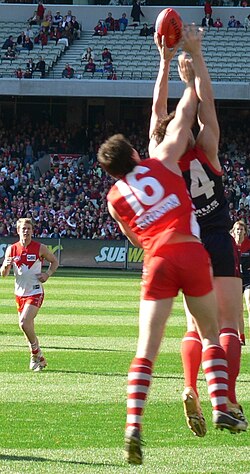
The most famous variation is the spectacular mark (often called a "specky," "screamer," or "hanger"). This occurs when a player leaps into the air, using the backs or shoulders of other players to gain additional height. A pack mark is a similar contested catch, but it occurs within a dense group of teammates and opponents.
Technical and Strategic Marks
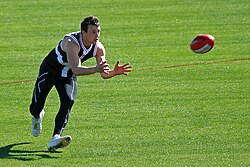
- Out in Front: Catching the ball with arms extended forward. This is highly valued by coaches as it makes it harder for defenders to spoil from behind.
- Chest Mark: Drawing the ball into the chest. While easier and useful in wet weather, it is often discouraged at the professional level because it is easier for opponents to intercept.
- One-handed Mark: Catching with a single hand, often used when one arm is impeded or when fending off an opponent.
- Diving Mark: Leaping horizontally to catch the ball just before it hits the turf.
Specialized Marking Scenarios
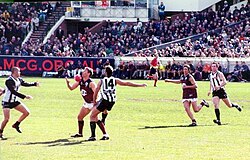
Players may also take marks with the flight (running in the direction of the ball), standing their ground (remaining stationary), or backing into a pack (jogging backward while facing the ball). Other rare occurrences include the fingertip mark, the slips catch (a low fingertip mark borrowed from cricket terminology), and the juggled mark, where a player takes multiple touches to gain control.
The Evolution and History of the Mark
The mark has been a cornerstone of the game since the first written rules appeared in 1859. While similar to the "fair catch" found in early English public school football, the Australian version evolved uniquely. Some historians suggest the game was influenced by Marn Grook, a traditional Aboriginal game where jumping to catch the ball (called "mumarki") resulted in a free kick.
The distance requirements have shifted significantly over time. In the early decades, "little marks" (very short kicks) were common. The minimum distance evolved from no limit (until 1877) to 6 yards, then 5 yards, and as low as 2 yards in 1887. The "little mark" was finally abolished in 1897 in favor of a 10-yard minimum, which eventually became 15 metres in 2002.
The style of marking also changed. Early games featured low kicks and chest marks. It wasn't until the 1880s, through players like Jack Kerley and Jack Worrall, that the high overhead mark became popular. To protect these athletes, the Australasian Football Council banned pushing in the back during marking contests in 1890.
| Player | Total Career Marks | Average Marks Per Game |
|---|---|---|
| Nick Riewoldt | 2,944 | ~8 |
| Gary Dempsey | 2,906 | ~8 |
| Stewart Loewe | 2,503 | ~8 |
| Matthew Richardson | 2,270 | ~8 |
Legendary Moments and Defensive Tactics
Certain marks have become etched in sporting history. Alex Jesaulenko's leap in the 1970 Grand Final inspired a massive Carlton comeback, while Leo Barry's contested mark in the final seconds of the 2005 Grand Final sealed a victory for Sydney. Other icons include Roy Cazaly, whose high-flying ability inspired the phrase "Up There Cazaly," and Shaun Smith and Gary Ablett, who share the title of "Mark of the Century."
Spoiling and Infringements
Defenders use a technique called spoiling—punching the ball away just before an opponent can catch it—to prevent a mark. However, rules prohibit pushing opponents out of contests or making forceful front-on contact.
Another critical rule involves "taking the arms." Since 2005, deliberately hacking, chopping, or pulling an opponent's arms during a marking contest is a free-kick infringement. This rule was introduced to assist forwards and counter the defensive tactic of flooding (crowding the forward line with defenders).
The Physical Toll
The intensity of marking can lead to severe hand and finger injuries, including fractures and dislocations. Some professional players have suffered chronic arthritis or required surgery. In extreme cases, players like Brett Backwell and Daniel Chick have opted for the amputation of digits to extend their playing careers.