Australian rules football: History, Rules, and Culture
Known affectionately as footy or Aussie rules, Australian rules football is more than just a sport; it is a cultural phenomenon. From its humble beginnings in the mid-19th century to its status as one of the world's best-attended sports leagues, the game is defined by its high-flying marks, fast-paced action, and deep connection to Australian identity.
The Fundamentals of the Game
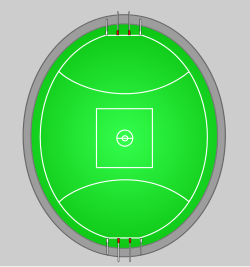
At its core, Australian rules football is a contact team sport played on an oval-shaped field. Unlike the rectangular pitches used in soccer or rugby, these fields range from 135 to 185 metres in length and 110 to 155 metres in width. A key feature of the field is the centre circle, a 10 by 10 metre area where the game often restarts.
Equipment and Gear
Players wear a uniform consisting of a guernsey (a sleeveless jersey), shorts, socks, and boots. The game is played with an ellipsoid ball—an oval-shaped ball—typically made of cowhide leather. The official game ball of the Australian Football League (AFL) is produced by Sherrin.

![A Sherrin Kangaroo Brand football. Sherrin is the official game ball of the Australian Football League.[78]](/images/ff/00/ff00ac8d4c02baafe34287403a89e38ee56c0841bebd9af729af04b29dbd6e1f.jpg)
The ball size varies by competition to ensure fairness and accessibility. For men's matches, the ball has a long circumference of 72–73 cm and a short circumference of 54.5–55.5 cm. Women's competitions use a slightly smaller ball, measuring 69 cm by 53 cm. To maintain consistent bounce and flight, the ball is inflated to a pressure of 69 kilopascals.
Key Gameplay Skills
The game is characterized by several unique skills that distinguish it from other football codes:
- Kicking and Handballing: These are the primary methods of moving the ball across the field.
- Marking: A "mark" occurs when a player cleanly catches the ball from a kick that has travelled at least 15 metres. This grants the player a free kick.
- Tackling: A physical defensive move used to stop an opponent from disposing of the ball.
- Rucking: This occurs during a "ball-up" (a restart where the umpire throws the ball into the air), where two tall players, known as ruckmen, leap to hit the ball toward their teammates.


Scoring and Officiation
The scoring system is straightforward but distinct. At each end of the oval are four posts: two tall central goal posts and two shorter outer behind posts.
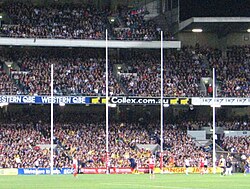
A goal is scored when the ball is kicked between the two central posts, earning six points. A "behind" is worth one point and is scored if the ball hits a goal post, is carried or knocked through the goal by a player, or passes between a goal post and a behind post.
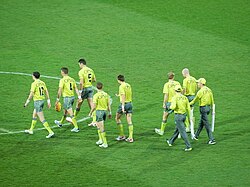
Matches are managed by umpires who ensure the laws of the game are followed and maintain fair play.
The Evolution of the Sport
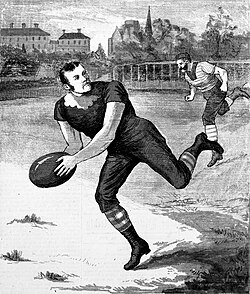
Australian rules football was first played on June 15, 1859, in Melbourne. Tom Wills is credited as a pivotal figure in the game's early development, serving as a player, umpire, and co-writer of the original rules.
![Statue next to the Melbourne Cricket Ground on the approximate site of the 1858 football match between Melbourne Grammar and Scotch College. Tom Wills is depicted umpiring behind two young players contesting the ball. The plaque reads that Wills "did more than any other person – as a footballer and umpire, co-writer of the rules and promoter of the game – to develop Australian football during its first decade."[9]](/images/9c/3c/9c3cdd4ce9e034d5a7380e2a847404204b0d40f90e6aef5f019a4693f73debd2.jpg)
Early Growth and Colonial Spread
The sport expanded rapidly beyond Victoria. In 1860, the Adelaide Football Club was formed, becoming the oldest club outside Victoria. While South Australian and Tasmanian clubs initially used varying rules, they eventually adopted the Victorian code—South Australia in 1876 and Tasmania in 1879.
![Engraving of a football match at the Richmond Paddock, 1866. The MCG and its first pavilion are visible in the background, as are kick-off posts, the forerunner of today's behind posts.[28]](/images/8f/fc/8ffc10b3c495d049d76f49b8a337e1542da7b71b47d7c0a000f382d3b974441c.jpg)
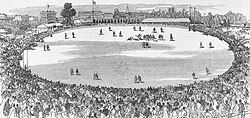
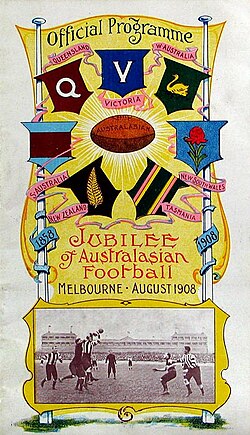
By the early 20th century, the game saw a revival in New South Wales, Queensland, and New Zealand. This growth led to the formation of the Australasian Football Council, which organized the first national interstate competition, the Jubilee Australasian Football Carnival, in 1908.
War and National Identity
The sport's deep integration into Australian life was evident during the World Wars. In 1915, the first recruitment poster for the war used the popularity of football to question the public's commitment to the nation.

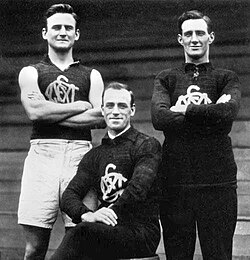
The game also became a source of cultural idioms. In the 1920s, South Melbourne player Roy Cazaly was famous for his leaping ability, leading to the phrase "Up there, Cazaly!" This expression became a popular cry of encouragement and was even used by Australian soldiers during World War II.
The Modern Era and Global Reach
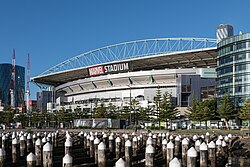
The transition toward a truly national competition was championed by legends like Ron Barassi, who advocated for a club-based national league. Today, the sport is governed by the AFL Commission, headquartered at Melbourne's Docklands Stadium.
![Hall of Fame Legend Ron Barassi was a leading advocate of a national club-based competition.[57]](/images/ba/fb/bafbbabed7a2e4ec516eb801f559ca1b633ff1f45efbd6e0ecf8a1bba167430b.jpg)
The Rise of Women's Football
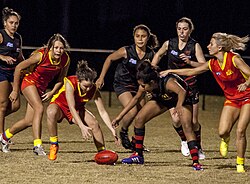
While women played the sport informally in the 19th century and organized teams appeared in the 1910s, the professional era began more recently. Following the emergence of state leagues in the 1980s, the AFL launched the AFL Women's (AFLW) competition in 2017, with eight inaugural licensed clubs.
International Expansion
The AFL has actively sought to expand its footprint. This includes hosting matches in China and New Zealand, and granting the 19th AFL license to the Tasmania Football Club in 2023, with competition expected by 2028.
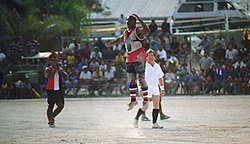
Globally, the sport has found a home in various countries. In Nauru, Australian rules football is the national sport. Additionally, a hybrid code called International Rules Football was created to combine the similarities between Aussie rules and Gaelic football from Ireland.
Cultural Impact and Popularity
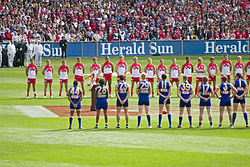
Australian rules football is a powerhouse of engagement. In 2024, the AFL averaged 38,344 fans per match, and approximately 1 in 20 Australians are members of an AFL club. It is also a vital part of Indigenous communities, where the sport is widely played and celebrated.

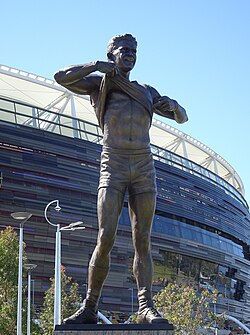
The game's social significance is further highlighted by the Australian Football Hall of Fame, established in 1996. The Hall of Fame honors the sport's greatest contributors, including figures like Nicky Winmar, whose 1993 protest against racial vilification is commemorated by a statue at Perth Stadium.
Aussie Rules Quick Facts
| Feature | Details |
|---|---|
| First Played | June 15, 1859 (Melbourne, Australia) |
| Governing Body | AFL Commission |
| Team Size | 22 players (18 on-field, 5 interchange) |
| Field Shape | Oval |
| Ball Type | Ellipsoid (Official: Sherrin) |
| Scoring | Goal (6 pts), Behind (1 pt) |
| Key Competitions | AFL, AFLW, International Cup |