Masked Booby: The Giant Diver of the Tropical Oceans
The masked booby (Sula dactylatra), also known as the blue-faced booby or masked gannet, is a magnificent seabird belonging to the family Sulidae. First described by French naturalist René-Primevère Lesson in 1831, this species stands out as the largest of the six booby species within the genus Sula. With its striking white plumage and distinctive dark facial mask, it is a master of the tropical skies and seas.
Physically, the masked booby is built for efficiency and speed. It possesses an aerodynamic body, long slender wings, a pointed tail, and a long, yellowish pointed bill. Adults typically measure between 75 and 85 cm (30–33 in) in length. While the plumage is bright white with black wings and tail, the sexes are similar in appearance, making them difficult to distinguish by sight alone.
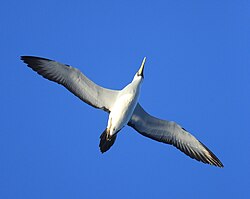
Key Facts
- Scientific Name: Sula dactylatra
- Conservation Status: Least Concern (IUCN 3.1)
- Size: 75–85 cm; the largest booby species.
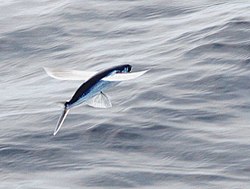
- Diet: Primarily fish, including Atlantic flyingfish.
- Hunting Style: High-speed vertical plunge diving.
- Distribution: Tropical oceans globally, excluding the eastern Atlantic and eastern Pacific.
Taxonomy and Subspecies
The masked booby exhibits a clinal change in size—a gradual change in a physical trait across a geographic range. The smallest individuals are found in the Atlantic, with size increasing westward through the Pacific to the Indian Ocean, where the largest birds reside.
Genetic research using mtDNA control region sequences suggests that populations in the Indian and Pacific Oceans expanded roughly 180,000 years ago, eventually separating from Atlantic populations about 115,000 years ago. Interestingly, gene flow is often reduced between populations even when no physical barriers exist.
The species is divided into several subspecies, including:
- S. d. dactylatra
- S. d. melanops
- S. d. personata (which includes S. d. californica and S. d. bedouti)
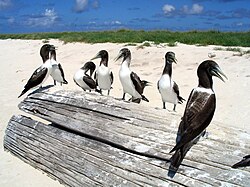
Distribution and Breeding Habitat
Masked boobies are found across most tropical oceans. In the eastern Pacific, they are replaced by the Nazca booby (Sula granti), a bird previously considered a subspecies of the masked booby. Their breeding colonies are typically established on remote cays, atolls, and islands, with Lord Howe Island marking the southernmost colony.
These birds prefer nesting on flat, exposed, or bare open ground that remains above the high-tide line. Access to the ocean is critical, as they rely on nearby deep waters for foraging. For instance, waters near Raine Island at the Great Barrier Reef range from 180 to 3,700 meters deep.
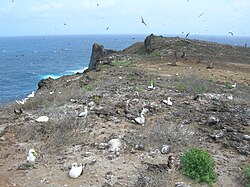
Major nesting sites in the Atlantic include Ascension Island, Rocas Atoll off Brazil, and the Campeche Bank in the Gulf of Mexico. While most birds return to their birth colony to breed annually, juveniles and some adults disperse widely during non-breeding periods.
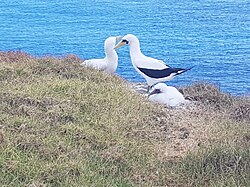
Feeding Behavior and Hunting
The masked booby is a spectacular hunter, utilizing a technique known as plunge diving. The bird flies to heights between 12 and 100 meters (most commonly 15 to 35 meters) and dives vertically at high speed, penetrating the water to depths of up to 3 meters to capture fish.
They generally swallow their prey underwater. Research at Clipperton Island indicates that these birds may fly up to 103 km (64 mi) from their colony to feed their chicks, with some traveling as far as 242 km (150 mi). They do not rest at sea at night, even during these longer expeditions.
Longevity and Movement
These seabirds are remarkably long-lived and capable of vast migrations. One documented individual tagged at Nepean Island in 1979 was recovered nearly 25 years later in 2004 off the Isle of Pines, New Caledonia. Another bird tagged at Raine Island in 1981 was recovered at Phillip Island in 1986, having traveled a distance of 3,152 km (1,959 mi).
| Feature | Details |
|---|---|
| Average Length | 75–85 cm |
| Primary Habitat | Remote tropical islands and atolls |
| Diving Depth | Up to 3 meters |
| Max Dive Height | 100 meters |
| Conservation Status | Least Concern |
Frequently Asked Questions
What is the difference between a masked booby and a Nazca booby?
While they were once considered the same species, the Nazca booby (Sula granti) is now recognized as a separate species that replaces the masked booby in the eastern Pacific.
How do masked boobies hunt for food?
They use high-speed vertical plunge diving, dropping from heights of 12 to 100 meters into the ocean to catch fish, which they typically swallow underwater.
Where do masked boobies typically nest?
They nest on remote islands, atolls, and cays, specifically choosing flat, bare, or exposed ground that is above the high-tide level.
How long can a masked booby live?
They are long-lived; one recorded instance involved a bird that was recovered nearly 25 years after it was first tagged.
Do masked boobies sleep on the water?
Evidence from Clipperton Island suggests that they do not rest at sea at night, even when foraging far from their colonies.