Marne River: France's Historic Waterway and Seine Tributary
The Marne is a vital river in France, serving as a primary eastern tributary of the Seine. Stretching 514 kilometres (319 mi), it flows through the landscapes east and southeast of Paris, leaving a lasting mark on the region's geography and administration. In fact, the river's significance is reflected in the names of four French departments: Haute-Marne, Marne, Seine-et-Marne, and Val-de-Marne.
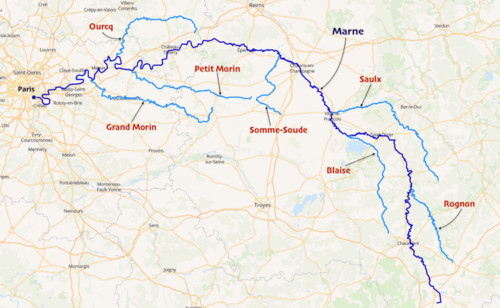
The river originates on the Langres Plateau in Haute-Marne, traveling generally north before bending west between Saint-Dizier and Châlons-en-Champagne. Its journey concludes at Charenton-le-Pont, where it joins the Seine just upstream from the capital city of Paris.
Key Facts
- Total Length: 514 kilometres (319 mi).
- Source: Langres Plateau, Haute-Marne.
- Mouth: Seine at Charenton-le-Pont.
- Basin Size: 12,800 square kilometres (4,900 sq mi).
- Average Discharge: 100 cubic metres per second.
- Major Tributaries: Rognon, Blaise, Saulx, Ourcq, Petit Morin, and Grand Morin.
Hydrology and Water Management
The Marne's flow is managed to balance environmental needs and human safety. Near the town of Saint-Dizier, a portion of the river is diverted into the artificial Lake Der-Chantecoq. This reservoir serves a dual purpose: preventing floods during periods of high rainfall and maintaining minimum river flows during droughts to ensure the ecosystem and navigation remain viable.
Historical Significance
Ancient and Medieval Roots
The river has been a site of spiritual and engineering importance for centuries. The Gauls once worshipped the goddess Dea Matrona (the divine mother goddess), who was closely associated with the Marne. In 1235, the Canal de Cornillon was constructed in Meaux; this 500-metre gated shortcut is recognized as the oldest canal in France.
The World Wars
The Marne is globally recognized as the site of two pivotal battles during World War I. The First Battle of the Marne in September 1914 saw General Joseph Gallieni drive German forces back from Paris, disrupting their strategic war plan. Four years later, the Second Battle of the Marne (July–August 1918) saw an Allied counter-attack defeat the final major German offensive on the Western Front, paving the way for the Armistice.
Navigation and Infrastructure
Until the 19th century, the Marne was a free-flowing navigable river. To improve transport, canalization began in 1837 and reached Épernay by 1867, utilizing various canals to bypass extreme meanders (winding curves in the river).
During the peak of canal transport, the Marne acted as a critical artery connecting Paris and the Seine to other major European river systems. Through a network of canals, it linked to the Meuse, Moselle, Rhine, Saône, and Rhône. Key infrastructure includes the 67 km Canal latéral à la Marne, as well as the canals of Chelles, Saint-Maurice, and Meaux à Chalifert.
Regional Impact and Art
The river traverses several departments and major towns, including Langres, Chaumont, Saint-Dizier, Châlons-en-Champagne, Épernay, Meaux, and various communes in the Val-de-Marne area near Paris.
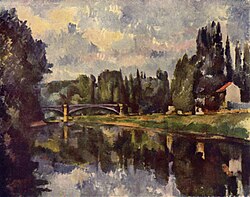
Beyond commerce and war, the Marne's scenic beauty has long inspired the art world. During the 19th and 20th centuries, it became a frequent subject for renowned painters such as Camille Corot, Pierre Emmanuel Damoye, Camille Pissarro, Henri Rousseau, and Paul Cézanne.
| Feature | Detail |
|---|---|
| Country | France |
| Length | 514 km |
| Basin Area | 12,800 km² |
| Primary Mouth | Seine River |
| Key Infrastructure | Lake Der-Chantecoq, Canal de Cornillon |
Frequently Asked Questions
Where does the Marne River begin and end?
The Marne begins on the Langres Plateau in the Haute-Marne department and ends at its confluence with the Seine in Charenton-le-Pont.
What is the purpose of Lake Der-Chantecoq?
Lake Der-Chantecoq is an artificial lake used to prevent flooding and ensure the river maintains a minimum flow during drought periods.
Why is the Marne river historically significant in military history?
It was the site of two major World War I battles: the First Battle of the Marne (1914), which stopped the German advance on Paris, and the Second Battle of the Marne (1918), which helped lead to the end of the war.
What is the oldest canal in France?
The Canal de Cornillon in Meaux, a 500-metre shortcut built in 1235, is the oldest canal in France.
Which famous artists have depicted the Marne?
Many influential artists have painted the Marne, including Paul Cézanne, Camille Pissarro, Henri Rousseau, and Camille Corot.